



 Chat with AI
Exam 10: Thermal Relations

Exam 1: Animals and Environments: Function on the Ecological Stage66 Questions
Exam 2: Molecules and Cells in Animal Physiology65 Questions
Exam 3: Genomics, Proteomics, and Related Approaches to Physiology64 Questions
Exam 4: Physiological Development and Epigenetics59 Questions
Exam 5: Transport of Solutes and Water67 Questions
Exam 6: Nutrition, Feeding, and Digestion77 Questions
Exam 7: Energy Metabolism68 Questions
Exam 8: Aerobic and Anaerobic Forms of Metabolism75 Questions
Exam 9: The Energetics of Aerobic Activity72 Questions
Exam 10: Thermal Relations84 Questions
Exam 11: Food, Energy, and Temperature at Work: The Lives of Mammals in Frigid Places76 Questions
Exam 12: Neurons59 Questions
Exam 13: Synapses58 Questions
Exam 14: Sensory Processes67 Questions
Exam 15: Nervous System Organization and Biological Clocks59 Questions
Exam 16: Endocrine and Neuroendocrine Physiology69 Questions
Exam 17: Reproduction68 Questions
Exam 18: Integrating Systems at Work: Animal Navigation61 Questions
Exam 19: Control of Movement71 Questions
Exam 20: Muscle78 Questions
Exam 21: Movement and Muscle at Work: Plasticity in Response to Use and Disuse67 Questions
Exam 22: Introduction to Oxygen and Carbon Dioxide in Physiology65 Questions
Exam 23: External Respiration: the Physiology of Breathing70 Questions
Exam 24: Transport of Oxygen and Carbon Dioxide in Body Fluids With an Introduction to Acid- Base Physiology68 Questions
Exam 25: Circulation72 Questions
Exam 26: Oxygen, Carbon Dioxide, and Internal Transport at Work: Diving by Marine Mammals63 Questions
Exam 27: Water and Salt Physiology: Introduction and Mechanisms72 Questions
Exam 29: Kidneys and Excretion With Notes on Nitrogen Excretion89 Questions
Exam 30: Water, Salts, and Excretion at Work: Mammals of Deserts and Dry Savannas64 Questions
Exam 28: Water and Salt Physiology of Animals in Their Environments87 Questions
Select questions type


Besides temperature, the factor that is important for conduction, convection, and thermal radiation is
(Multiple Choice)
4.8/5  (79)
(79) Suppose that an animal is sweating profusely. The dripping of sweat off the animal's surface
(Multiple Choice)
4.8/5 (71)
(71) Refer to the figure shown. One species of homeotherm under two different environmental conditions was exposed to temperature changes.
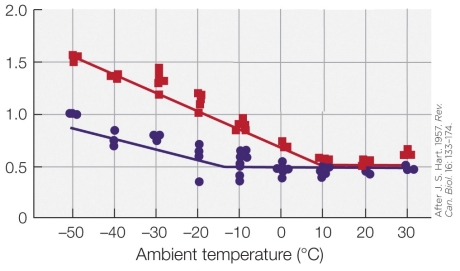 In the following list, what is the lowest lower-critical temperature represented in this figure?
 (Multiple Choice)
4.7/5 (82)
(82) Animals most commonly use _______ in terms of their thermal relationship with the environment.
(Multiple Choice)
4.8/5 (90)
(90) How might a vapor barrier liner in a sleeping bag decrease a person's heat loss when camping outside in the cold?
(Essay)
4.9/5 (87)
(87) When carp or goldfish that are acclimated to warm temperatures are subsequently acclimated to colder temperatures, their swimming performance is impaired initially but then improves over time. Which of the following is thought to be the most likely explanation?
(Multiple Choice)
4.9/5 (84)
(84) Per unit of surface area, animals emit _______ radiation than the sun; at wavelengths shorter than 3 m, they emit _______ radiation than the sun.
(Multiple Choice)
4.8/5 (83)
(83) When the body temperature of ghost crabs is raised from 15°C to 24°C, resting metabolic rate and V̇O2max both increase, but the increase in V̇O2max is much greater than the increase in resting metabolic rate. Given this information, what would be the likely result if ghost crabs in nature experienced conditions that raised their typical body temperature from 15°C to 24°C?
(Multiple Choice)
4.8/5 (82)
(82) Refer to the figure shown. Multiple species of poikilotherms that naturally experience different body temperatures are shown in the figure. The response of each species at multiple temperatures is plotted on the figure.
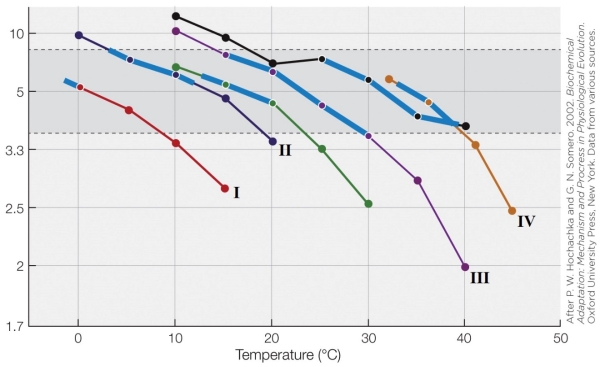 Which line indicates the species that needs to be coldest for enzyme function to be in the range favored by evolution?
 (Multiple Choice)
4.8/5 (87)
(87) Refer to the figure shown. One species of homeotherm under two different environmental conditions was exposed to temperature changes.
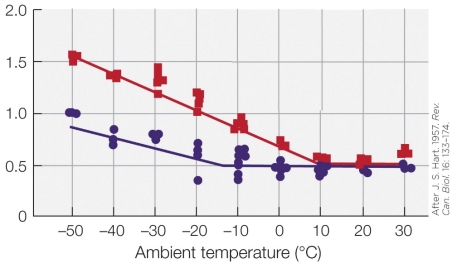 Data from which species is most likely represented in this figure?
 (Multiple Choice)
4.9/5 (69)
(69) _______ describes the process of rewarming of the tissues of a mammal after controlled hypothermia.
(Multiple Choice)
5.0/5 (87)
(87) Which structure has a physiological function that shares major similarities with the function of brown adipose tissues?
(Multiple Choice)
4.9/5 (83)
(83) The environmental temperature is 15°C. The internal temperature of a sphinx moth after 30 minutes of rest is _______ and the internal temperature of a sphinx moth after 30 minutes of flight is _______.
(Multiple Choice)
4.8/5 (75)
(75) With respect to heat flow between animals and their environments, high conductance corresponds to _______ insulation and to _______ resistance to heat loss
(Multiple Choice)
4.9/5 (84)
(84) 
Filters
- Essay(0)
- Multiple Choice(0)
- Short Answer(0)
- True False(0)
- Matching(0)