



 Chat with AI
Exam 21: Movement and Muscle at Work: Plasticity in Response to Use and Disuse

Exam 1: Animals and Environments: Function on the Ecological Stage66 Questions
Exam 2: Molecules and Cells in Animal Physiology65 Questions
Exam 3: Genomics, Proteomics, and Related Approaches to Physiology64 Questions
Exam 4: Physiological Development and Epigenetics59 Questions
Exam 5: Transport of Solutes and Water67 Questions
Exam 6: Nutrition, Feeding, and Digestion77 Questions
Exam 7: Energy Metabolism68 Questions
Exam 8: Aerobic and Anaerobic Forms of Metabolism75 Questions
Exam 9: The Energetics of Aerobic Activity72 Questions
Exam 10: Thermal Relations84 Questions
Exam 11: Food, Energy, and Temperature at Work: The Lives of Mammals in Frigid Places76 Questions
Exam 12: Neurons59 Questions
Exam 13: Synapses58 Questions
Exam 14: Sensory Processes67 Questions
Exam 15: Nervous System Organization and Biological Clocks59 Questions
Exam 16: Endocrine and Neuroendocrine Physiology69 Questions
Exam 17: Reproduction68 Questions
Exam 18: Integrating Systems at Work: Animal Navigation61 Questions
Exam 19: Control of Movement71 Questions
Exam 20: Muscle78 Questions
Exam 21: Movement and Muscle at Work: Plasticity in Response to Use and Disuse67 Questions
Exam 22: Introduction to Oxygen and Carbon Dioxide in Physiology65 Questions
Exam 23: External Respiration: the Physiology of Breathing70 Questions
Exam 24: Transport of Oxygen and Carbon Dioxide in Body Fluids With an Introduction to Acid- Base Physiology68 Questions
Exam 25: Circulation72 Questions
Exam 26: Oxygen, Carbon Dioxide, and Internal Transport at Work: Diving by Marine Mammals63 Questions
Exam 27: Water and Salt Physiology: Introduction and Mechanisms72 Questions
Exam 29: Kidneys and Excretion With Notes on Nitrogen Excretion89 Questions
Exam 30: Water, Salts, and Excretion at Work: Mammals of Deserts and Dry Savannas64 Questions
Exam 28: Water and Salt Physiology of Animals in Their Environments87 Questions
Select questions type


Refer to the figure showing the changes in heart mass of Burmese pythons 3 days after feeding (DPF), infusion with plasma from fed or fasted snakes, or infusion with a solution of bovine serum albumin (BSA) with or without three specific fatty acids (FA) found in blood of fed snakes.
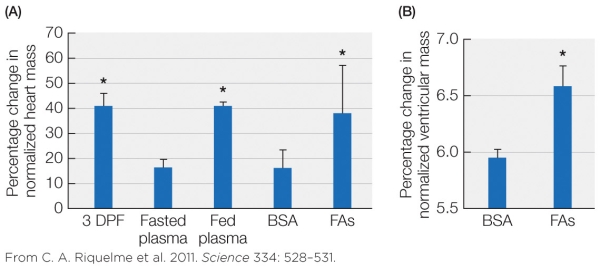 According to the figure, feeding increases heart mass primarily through
 (Multiple Choice)
4.7/5  (89)
(89) In skeletal muscle cells, endurance exercise training typically produces
(Multiple Choice)
4.9/5 (83)
(83) Endurance exercise generates signals in muscle cells, such as
(Multiple Choice)
4.8/5 (86)
(86) Resistance exercise involves _______ repetitions per unit time of movements involving _______ force and _______ metabolism.
(Multiple Choice)
4.8/5 (74)
(74) Which drug would likely be the most effective for restoring muscle mass in a cancer patient undergoing chemotherapy?
(Multiple Choice)
4.8/5 (74)
(74) Atrophy of muscles due to disuse is accompanied by a shift in fiber type from _______ fibers to _______ fibers.
(Multiple Choice)
4.8/5 (79)
(79) In humans, endurance training typically causes _______ muscle fibers to be converted to _______.
(Multiple Choice)
4.9/5 (80)
(80) Which drug would likely be the most effective for restoring muscle mass in a cancer patient undergoing chemotherapy?
(Multiple Choice)
4.8/5 (77)
(77) Refer to the figure shown.
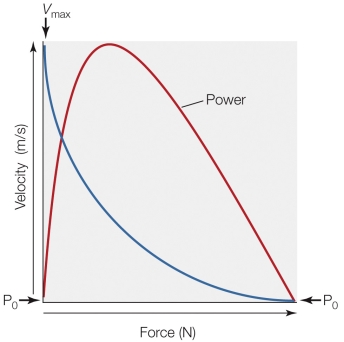 If the muscle represented in the figure can produce a maximal force of 20 N and has a Vmax of 1 m/s, what is its maximal power output?
 (Multiple Choice)
4.7/5 (66)
(66) Endurance training increases the amounts of both glycogen and lipid stored in muscle cells. This most directly increases the
(Multiple Choice)
4.8/5 (66)
(66) Refer to the figure shown.
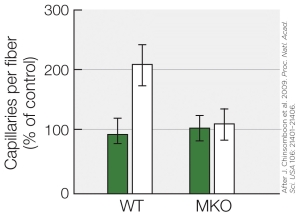 What best explains the results for the experimental group of mice on the right of the figure?
 (Multiple Choice)
4.9/5 (71)
(71) The recruitment order of different fiber types matches and reinforces their cellular properties because
(Multiple Choice)
4.8/5 (66)
(66) Explain how the cellular effects of endurance training improve the balance between ATP supply and demand during extended exercise. Refer to specific changes that occur and indicate whether they increase or decrease ATP supply or ATP demand.
(Essay)
4.8/5 (84)
(84) Adding structural proteins to individual muscle cells is known as
(Multiple Choice)
5.0/5 (85)
(85) Cachexia, or muscle wasting (loss of muscle mass), is a common complication of cancer. A muscle biopsy sample from a cancer patient would likely show
(Multiple Choice)
4.8/5 (67)
(67) 
Filters
- Essay(0)
- Multiple Choice(0)
- Short Answer(0)
- True False(0)
- Matching(0)