



 Chat with AI
Exam 28: Water and Salt Physiology of Animals in Their Environments

Exam 1: Animals and Environments: Function on the Ecological Stage66 Questions
Exam 2: Molecules and Cells in Animal Physiology65 Questions
Exam 3: Genomics, Proteomics, and Related Approaches to Physiology64 Questions
Exam 4: Physiological Development and Epigenetics59 Questions
Exam 5: Transport of Solutes and Water67 Questions
Exam 6: Nutrition, Feeding, and Digestion77 Questions
Exam 7: Energy Metabolism68 Questions
Exam 8: Aerobic and Anaerobic Forms of Metabolism75 Questions
Exam 9: The Energetics of Aerobic Activity72 Questions
Exam 10: Thermal Relations84 Questions
Exam 11: Food, Energy, and Temperature at Work: The Lives of Mammals in Frigid Places76 Questions
Exam 12: Neurons59 Questions
Exam 13: Synapses58 Questions
Exam 14: Sensory Processes67 Questions
Exam 15: Nervous System Organization and Biological Clocks59 Questions
Exam 16: Endocrine and Neuroendocrine Physiology69 Questions
Exam 17: Reproduction68 Questions
Exam 18: Integrating Systems at Work: Animal Navigation61 Questions
Exam 19: Control of Movement71 Questions
Exam 20: Muscle78 Questions
Exam 21: Movement and Muscle at Work: Plasticity in Response to Use and Disuse67 Questions
Exam 22: Introduction to Oxygen and Carbon Dioxide in Physiology65 Questions
Exam 23: External Respiration: the Physiology of Breathing70 Questions
Exam 24: Transport of Oxygen and Carbon Dioxide in Body Fluids With an Introduction to Acid- Base Physiology68 Questions
Exam 25: Circulation72 Questions
Exam 26: Oxygen, Carbon Dioxide, and Internal Transport at Work: Diving by Marine Mammals63 Questions
Exam 27: Water and Salt Physiology: Introduction and Mechanisms72 Questions
Exam 29: Kidneys and Excretion With Notes on Nitrogen Excretion89 Questions
Exam 30: Water, Salts, and Excretion at Work: Mammals of Deserts and Dry Savannas64 Questions
Exam 28: Water and Salt Physiology of Animals in Their Environments87 Questions
Select questions type


List and briefly explain three factors that determine the rate of passive exchange of water and ions.
(Essay)
4.8/5  (86)
(86) Refer to the figure shown.
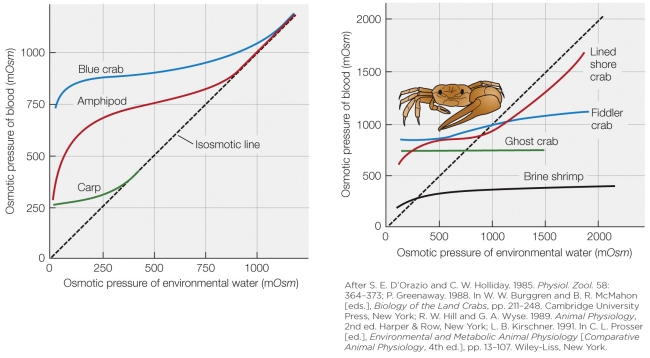 Overall, which animal represented in the graph is the best osmotic regulator?
 (Multiple Choice)
4.9/5 (71)
(71) If an octopus has an osmolarity of 300 mOsm, the environment it lives in must have an osmolarity of _______ mOsm.
(Multiple Choice)
5.0/5 (85)
(85) Describe the structure of the gills and explain another role they serve, in addition to being respiratory organs.
(Essay)
4.8/5 (85)
(85) Explain how teleosts can drink hyperosmotic seawater to replenish water loss by diffusion and excretion.
(Essay)
4.9/5 (81)
(81) In early freshwater fish larvae, the major site of chloride exchange is the
(Multiple Choice)
4.7/5 (93)
(93) The blood osmotic pressure of marine teleosts is about _______ mOsm _______ than the environmental osmotic pressure.
(Multiple Choice)
4.8/5 (90)
(90) Which statement regarding ionic movement across the gills of marine animals is true?
(Multiple Choice)
4.8/5 (80)
(80) Refer to the figure shown.
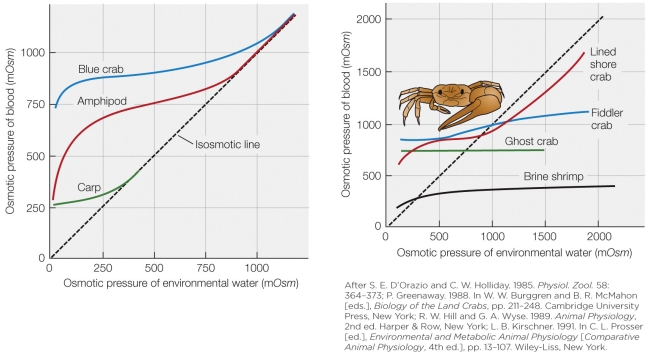 Taking into account both numerical scales and shape on both graphs, which line most closely represents that of a Pacific salmon?
 (Multiple Choice)
4.9/5 (88)
(88) Which statement best describes the movement of sodium in freshwater fish?
(Multiple Choice)
4.8/5 (100)
(100) MRCs are abundant with Na+-K+-ATPases. In each cell, there are about _______ Na+-K+-ATPase molecules.
(Multiple Choice)
5.0/5 (87)
(87) Animals that leave a freshwater environment to breed in a saltwater environment are known as
(Multiple Choice)
4.8/5 (73)
(73) In terms of its lifecycle, the European eel is classified as
(Multiple Choice)
4.7/5 (86)
(86) Virtually all the resistance to water across the integument of xeric animals resides
(Multiple Choice)
4.7/5 (78)
(78) Explain how rate of water loss is correlated with oxygen consumption.
(Essay)
4.8/5 (88)
(88) Why is volume regulation at odds with ionic regulation in marine teleost fish?
(Multiple Choice)
4.9/5 (67)
(67) Which hormone is controlled to a major extent by the renin-angiotensin system?
(Multiple Choice)
4.9/5 (83)
(83) You perform an immunocytochemistry technique on fish MRCs and you observe that the Cl-/HCO3- countertransport protein is expressed in greater quantities than normal. The fish must have been living in a(n) _______ environment.
(Multiple Choice)
4.9/5 (71)
(71) 
Filters
- Essay(0)
- Multiple Choice(0)
- Short Answer(0)
- True False(0)
- Matching(0)