



 Chat with AI
Exam 28: Water and Salt Physiology of Animals in Their Environments

Exam 1: Animals and Environments: Function on the Ecological Stage66 Questions
Exam 2: Molecules and Cells in Animal Physiology65 Questions
Exam 3: Genomics, Proteomics, and Related Approaches to Physiology64 Questions
Exam 4: Physiological Development and Epigenetics59 Questions
Exam 5: Transport of Solutes and Water67 Questions
Exam 6: Nutrition, Feeding, and Digestion77 Questions
Exam 7: Energy Metabolism68 Questions
Exam 8: Aerobic and Anaerobic Forms of Metabolism75 Questions
Exam 9: The Energetics of Aerobic Activity72 Questions
Exam 10: Thermal Relations84 Questions
Exam 11: Food, Energy, and Temperature at Work: The Lives of Mammals in Frigid Places76 Questions
Exam 12: Neurons59 Questions
Exam 13: Synapses58 Questions
Exam 14: Sensory Processes67 Questions
Exam 15: Nervous System Organization and Biological Clocks59 Questions
Exam 16: Endocrine and Neuroendocrine Physiology69 Questions
Exam 17: Reproduction68 Questions
Exam 18: Integrating Systems at Work: Animal Navigation61 Questions
Exam 19: Control of Movement71 Questions
Exam 20: Muscle78 Questions
Exam 21: Movement and Muscle at Work: Plasticity in Response to Use and Disuse67 Questions
Exam 22: Introduction to Oxygen and Carbon Dioxide in Physiology65 Questions
Exam 23: External Respiration: the Physiology of Breathing70 Questions
Exam 24: Transport of Oxygen and Carbon Dioxide in Body Fluids With an Introduction to Acid- Base Physiology68 Questions
Exam 25: Circulation72 Questions
Exam 26: Oxygen, Carbon Dioxide, and Internal Transport at Work: Diving by Marine Mammals63 Questions
Exam 27: Water and Salt Physiology: Introduction and Mechanisms72 Questions
Exam 29: Kidneys and Excretion With Notes on Nitrogen Excretion89 Questions
Exam 30: Water, Salts, and Excretion at Work: Mammals of Deserts and Dry Savannas64 Questions
Exam 28: Water and Salt Physiology of Animals in Their Environments87 Questions
Select questions type


The kidneys of marine teleosts produce urine at a rate that is _______ compared to freshwater teleosts.
(Multiple Choice)
4.9/5  (76)
(76) Refer to the figure shown.
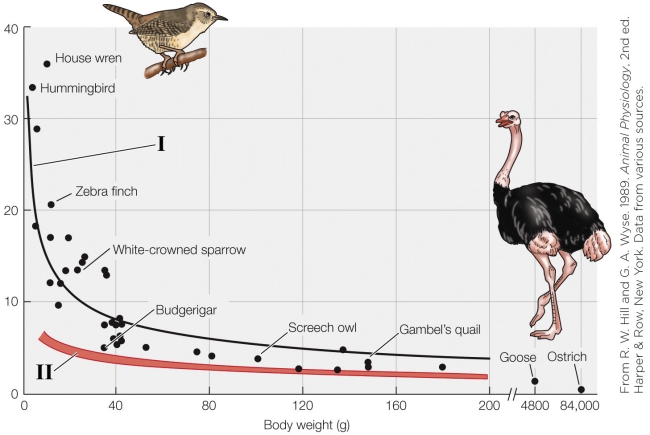 The line indicated by the number I represents
 (Multiple Choice)
4.8/5 (80)
(80) Due to sodium active transport in gills of freshwater fish, the epithelial cells of the gills
(Multiple Choice)
4.8/5 (78)
(78) Refer to the figure shown.
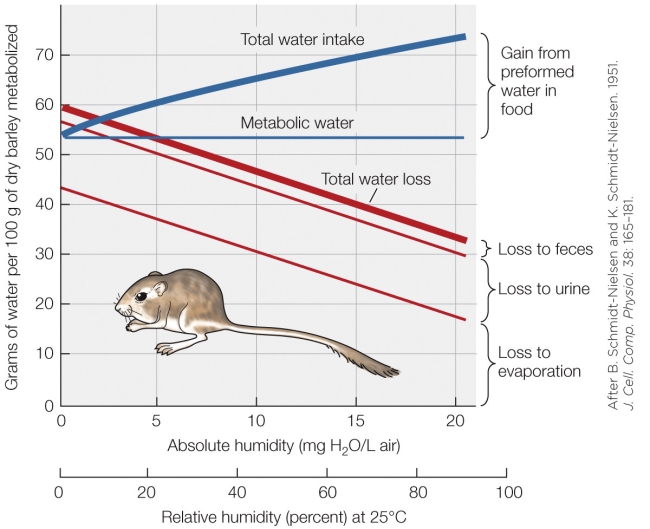 What is the greatest contributor to total water loss in this animal?
 (Multiple Choice)
4.8/5 (84)
(84) Refer to the figure shown.
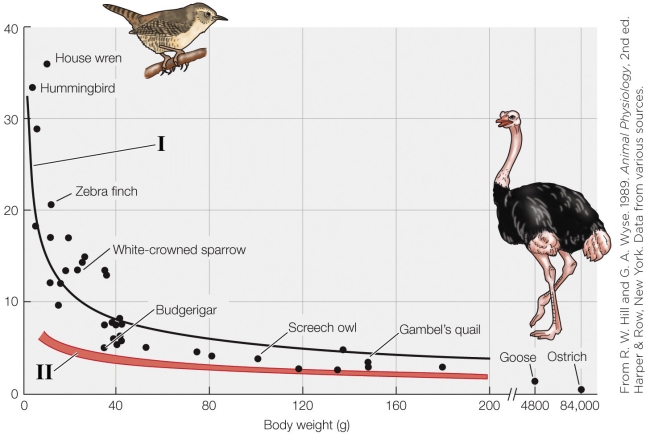 The line indicated by the number II represents
 (Multiple Choice)
4.8/5 (86)
(86) Why are stickleback populations especially useful for understanding physiological evolution?
(Multiple Choice)
4.9/5 (85)
(85) Animals that can live in dry, water poor environments are called
(Multiple Choice)
4.9/5 (74)
(74) You conduct an experiment in which you make the environment of freshwater fish highly basic. You then isolate the ionocytes and conduct an immunocytochemistry technique. Under these conditions, you would be most likely to observe _______ in Cl-/HCO3- protein expression.
(Multiple Choice)
4.7/5 (80)
(80) Based on the immunohistochemistry method used, the most common proteins found in the cells of gills in freshwater teleosts are
(Multiple Choice)
4.9/5 (74)
(74) Why is the permeability of a freshwater animal's integument to water and ions relatively low?
(Essay)
4.8/5 (90)
(90) If a researcher applies BAPTA, a calcium chelator (binds calcium), to the environment of freshwater fish, the
(Multiple Choice)
4.8/5 (76)
(76) 
Filters
- Essay(0)
- Multiple Choice(0)
- Short Answer(0)
- True False(0)
- Matching(0)