



 Chat with AI
Exam 2: Atoms and Molecules: the Chemical Basis of Life

Exam 1: A View of Life88 Questions
Exam 2: Atoms and Molecules: the Chemical Basis of Life85 Questions
Exam 3: The Chemistry of Life: Organic Compounds95 Questions
Exam 4: Organization of the Cell68 Questions
Exam 5: Biological Membranes77 Questions
Exam 6: Cell Communication73 Questions
Exam 7: Energy and Metabolism76 Questions
Exam 8: How Cells Make Atp: Energy-Releasing Pathways90 Questions
Exam 9: Photosynthesis: Capturing Light Energy80 Questions
Exam 10: Chromosomes, Mitosis, and Meiosis91 Questions
Exam 11: The Basic Principles of Heredity75 Questions
Exam 12: Dna: the Carrier of Genetic Information80 Questions
Exam 13: Gene Expression76 Questions
Exam 14: Gene Regulation77 Questions
Exam 15: Dna Technology and Genomics79 Questions
Exam 16: Human Genetics and the Human Genome78 Questions
Exam 17: Developmental Genetics79 Questions
Exam 18: Introduction to Darwinian Evolution70 Questions
Exam 19: Evolutionary Change in Populations79 Questions
Exam 20: Speciation and Macroevolution91 Questions
Exam 21: The Origin and Evolutionary History of Life89 Questions
Exam 22: The Evolution of Primates87 Questions
Exam 23: Understanding Diversity: Systematics79 Questions
Exam 24: Viruses and Subviral Agents41 Questions
Exam 25: Bacteria and Archaea55 Questions
Exam 26: Protists92 Questions
Exam 27: Seedless Plants80 Questions
Exam 28: Seed Plants78 Questions
Exam 29: The Fungi87 Questions
Exam 30: An Introduction to Animal Diversity79 Questions
Exam 31: Sponges, Cnidarians, Ctenophores, and Protostomes146 Questions
Exam 32: The Deuterostomes90 Questions
Exam 33: Plant Structure, Growth, and Development86 Questions
Exam 34: Leaf Structure and Function76 Questions
Exam 35: Stem Structure and Transport74 Questions
Exam 36: Roots and Mineral Nutrition84 Questions
Exam 37: Reproduction in Flowering Plants89 Questions
Exam 38: Plant Developmental Responses to External and Internal Signals95 Questions
Exam 39: Animal Structure and Function: an Introduction96 Questions
Exam 40: Protection, Support, and Movement101 Questions
Exam 41: Neural Signaling87 Questions
Exam 42: Neural Regulation88 Questions
Exam 43: Sensory Systems111 Questions
Exam 44: Internal Transport104 Questions
Exam 45: The Immune System: Internal Defense85 Questions
Exam 46: Gas Exchange109 Questions
Exam 47: Processing Food and Nutrition119 Questions
Exam 48: Osmoregulation and Disposal of Metabolic Wastes94 Questions
Exam 49: Endocrine Regulation82 Questions
Exam 50: Reproduction104 Questions
Exam 51: Animal Development98 Questions
Exam 52: Animal Behavior77 Questions
Exam 53: Introduction to Ecology: Population Ecology97 Questions
Exam 54: Community Ecology74 Questions
Exam 55: Ecosystems and the Biosphere88 Questions
Exam 56: Ecology and the Geography of Life105 Questions
Exam 57: Biological Diversity and Conservation Biology66 Questions
Select questions type


Which of the following statements concerning van der Waal interactions is FALSE:
(Multiple Choice)
4.7/5  (75)
(75) An atom has six protons and eight neutrons.Its atomic mass is __________ atomic mass units.
(Multiple Choice)
4.8/5 (63)
(63) Diagram and carefully label two water molecules using a ball-and-stick model.Then use this diagram to demonstrate how hydrogen bonds form between them.
(Essay)
4.7/5 (90)
(90) MATCHING
Match the type of bond or interaction with its description.
a.hydrogen bond
c.ionic bond
b.van de Waals interaction
d.covalent bond
-Weak attractive force joining a hydrogen atom with an electronegative atom such as oxygen
(Essay)
4.7/5 (91)
(91) Which property of water enables living things to survive in ponds covered with ice?
(Multiple Choice)
4.9/5 (87)
(87) In a water molecule, because oxygen is more electronegative than hydrogen, the shared electrons are more commonly found around the __________ nucleus than the __________ nucleus.
(Multiple Choice)
4.8/5 (80)
(80) MATCHING
Match the type of bond or interaction with its description.
a.hydrogen bond
c.ionic bond
b.van de Waals interaction
d.covalent bond
-Strong attractive force resulting from the transfer of electrons between atoms
(Essay)
4.8/5 (70)
(70) Match the term with its description:
a.adhesion
c.surface tension
b.cohesion
d.capillary action
-Tendency of water to move in narrow tubes
(Essay)
4.9/5 (83)
(83) When a small amount of hydrochloric acid (HCl) is added to a solution of Na2HPO4, the pH of the solution does not change markedly.The pH also does not change drastically when a small amount of sodium hydroxide (NaOH) is added to this same solution.Based on these observations, the compound Na2HPO4 is:
(Multiple Choice)
4.9/5 (79)
(79) Which of the following atoms would most likely be involved in an ionic bond?
(Multiple Choice)
4.8/5 (73)
(73) Covalently bonded atoms with similar electronic negativities are:
(Multiple Choice)
4.8/5 (80)
(80) A stalk of celery is placed in a solution of blue colored dye.After one hour, the leaves have blue fluid in their veins.Which property of water is being demonstrated?
(Multiple Choice)
4.8/5 (73)
(73) Which of the following elements is NOT responsible for a significant portion of the mass of living organisms?
(Multiple Choice)
4.8/5 (85)
(85) Figure 2-1
Use the figure below to answer the corresponding question(s). 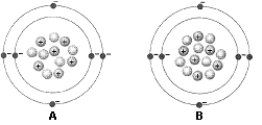 -The difference between the two atoms in Figure 2-1 is:
 (Multiple Choice)
5.0/5 (76)
(76) Which characteristic of water molecules directly contributes to the remarkable "water walking" success of the aquatic insects pictured in the accompanying figure? 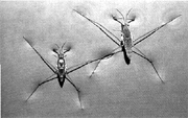
(Multiple Choice)
5.0/5 (68)
(68) MATCHING
Match the type of bond or interaction with its description.
a.hydrogen bond
c.ionic bond
b.van de Waals interaction
d.covalent bond
-In a structural formula this is represented by a straight line
(Essay)
4.9/5 (80)
(80) The difference between an electrically neutral atom and an ion is that:
(Multiple Choice)
4.9/5 (90)
(90) 
Filters
- Essay(0)
- Multiple Choice(0)
- Short Answer(0)
- True False(0)
- Matching(0)