



 Chat with AI
Exam 36: The Urinary System

Exam 1: An Introduction to Life on Earth85 Questions
Exam 2: Atoms, Molecules, and Life90 Questions
Exam 3: Biological Molecules98 Questions
Exam 4: Cell Structure and Function90 Questions
Exam 5: Cell Membrane Structure and Function95 Questions
Exam 6: Energy Flow in the Life of a Cell90 Questions
Exam 7: Capturing Solar Energy: Photosynthesis102 Questions
Exam 8: Harvesting Energy: Glycolysis and Cellular Respiration97 Questions
Exam 9: Cellular Reproduction133 Questions
Exam 10: Meiosis: the Basis of Sexual Reproduction103 Questions
Exam 11: Patterns of Inheritance98 Questions
Exam 12: Dna: the Molecule of Heredity97 Questions
Exam 13: Gene Expression and Regulation93 Questions
Exam 14: Biotechnology91 Questions
Exam 15: Principles of Evolution97 Questions
Exam 16: How Populations Evolve109 Questions
Exam 17: The Origin of Species89 Questions
Exam 18: The History of Life125 Questions
Exam 19: Systematics: Seeking Order Amid Diversity90 Questions
Exam 20: The Diversity of Prokaryotes and Viruses97 Questions
Exam 21: The Diversity of Protists102 Questions
Exam 22: The Diversity of Plants115 Questions
Exam 23: The Diversity of Fungi107 Questions
Exam 24: Animal Diversity I: Invertebrates101 Questions
Exam 25: Animal Diversity II: Vertebrates118 Questions
Exam 26: Animal Behavior116 Questions
Exam 27: Population Growth and Regulation114 Questions
Exam 28: Community Interactions125 Questions
Exam 29: Energy Flow and Nutrient Cycling in Ecosystems122 Questions
Exam 30: Earths Diverse Ecosystems126 Questions
Exam 31: Conserving Earths Biodiversity109 Questions
Exam 32: Homeostasis and the Organization of the Animal Body95 Questions
Exam 33: Circulation89 Questions
Exam 34: Respiration92 Questions
Exam 35: Nutrition and Digestion91 Questions
Exam 36: The Urinary System99 Questions
Exam 37: Defenses Against Disease104 Questions
Exam 38: Chemical Control of the Animal Body: the Endocrine System133 Questions
Exam 39: The Nervous System118 Questions
Exam 40: The Senses94 Questions
Exam 41: Action and Support: the Muscles and Skeleton90 Questions
Exam 42: Animal Reproduction120 Questions
Exam 43: Animal Development122 Questions
Exam 44: Plant Anatomy and Nutrient Transport95 Questions
Exam 45: Plant Reproduction and Development90 Questions
Exam 46: Plant Responses to the Environment87 Questions
Select questions type


The feces of which of the following would contain a high concentration of uric acid?
(Multiple Choice)
4.9/5  (84)
(84) Which of these animals has the greatest proportion of long- looped nephrons in their kidneys?
(Multiple Choice)
4.8/5 (81)
(81) A friend receives the results of a urine test and finds that dissolved nutrients, such as amino acids and glucose, are present in his urine. You deduce that part of his kidney is not functioning properly. Which part is most likely malfunctioning?
(Multiple Choice)
4.9/5 (84)
(84) An animal whose kidneys have a high percentage of long- looped nephrons probably lives in a _ environment.
(Multiple Choice)
4.9/5 (68)
(68) Which type of fish stores urea in its tissues to keep its body the same osmolarity as the water in which it lives?
(Multiple Choice)
4.8/5 (79)
(79) Animals vary the composition of their urine depending on their environment and their need to conserve water.
(True/False)
4.9/5 (80)
(80) Which of the following has a urinary system that makes use of flame cells?
(Multiple Choice)
4.9/5 (86)
(86) The primary nitrogenous waste product excreted in the urine of all mammals is .
(Short Answer)
4.8/5 (80)
(80) Most reabsorption takes place in what part of the tubule system in the kidney?
(Multiple Choice)
4.9/5 (74)
(74) Water may be reabsorbed from many regions of the nephron; however, which regions can do so only if the blood levels of ADH are elevated?
(Multiple Choice)
4.8/5 (92)
(92) Briefly explain why animals that live in very dry climates have the longest nephron loops.
(Essay)
4.9/5 (67)
(67) You analyze a blood sample taken from a man who survived for 2 days in the desert with no water to drink. Based on your knowledge of kidney physiology, you are not surprised to find that his blood level of ADH is
(Multiple Choice)
4.8/5 (76)
(76) A person taking antibiotics must take pills several times each day to maintain effective concentrations in the blood. This is because of
(Multiple Choice)
4.9/5 (87)
(87) Explain why the process in the kidneys is called "filtration." (What is acting as a "filter"?)
(Essay)
4.8/5 (75)
(75) According to the illustration, blood entering which structure will undergo no further modification by the nephron? 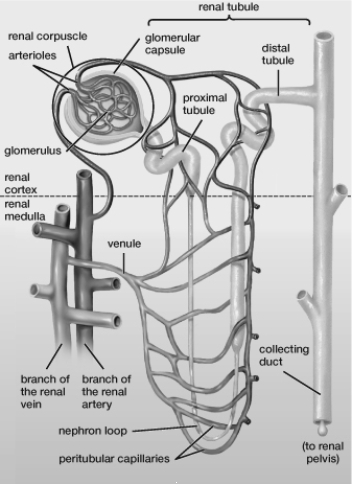
(Multiple Choice)
4.9/5 (69)
(69) How does drinking a lot of water affect ADH production and urine output?
(Essay)
4.9/5 (85)
(85) What is the force that drives glomerular filtration (movement of fluid from the glomerulus to the glomerular capsule)?
(Multiple Choice)
5.0/5 (95)
(95) 
Filters
- Essay(0)
- Multiple Choice(0)
- Short Answer(0)
- True False(0)
- Matching(0)