



 Chat with AI
Exam 30: Earths Diverse Ecosystems

Exam 1: An Introduction to Life on Earth85 Questions
Exam 2: Atoms, Molecules, and Life90 Questions
Exam 3: Biological Molecules98 Questions
Exam 4: Cell Structure and Function90 Questions
Exam 5: Cell Membrane Structure and Function95 Questions
Exam 6: Energy Flow in the Life of a Cell90 Questions
Exam 7: Capturing Solar Energy: Photosynthesis102 Questions
Exam 8: Harvesting Energy: Glycolysis and Cellular Respiration97 Questions
Exam 9: Cellular Reproduction133 Questions
Exam 10: Meiosis: the Basis of Sexual Reproduction103 Questions
Exam 11: Patterns of Inheritance98 Questions
Exam 12: Dna: the Molecule of Heredity97 Questions
Exam 13: Gene Expression and Regulation93 Questions
Exam 14: Biotechnology91 Questions
Exam 15: Principles of Evolution97 Questions
Exam 16: How Populations Evolve109 Questions
Exam 17: The Origin of Species89 Questions
Exam 18: The History of Life125 Questions
Exam 19: Systematics: Seeking Order Amid Diversity90 Questions
Exam 20: The Diversity of Prokaryotes and Viruses97 Questions
Exam 21: The Diversity of Protists102 Questions
Exam 22: The Diversity of Plants115 Questions
Exam 23: The Diversity of Fungi107 Questions
Exam 24: Animal Diversity I: Invertebrates101 Questions
Exam 25: Animal Diversity II: Vertebrates118 Questions
Exam 26: Animal Behavior116 Questions
Exam 27: Population Growth and Regulation114 Questions
Exam 28: Community Interactions125 Questions
Exam 29: Energy Flow and Nutrient Cycling in Ecosystems122 Questions
Exam 30: Earths Diverse Ecosystems126 Questions
Exam 31: Conserving Earths Biodiversity109 Questions
Exam 32: Homeostasis and the Organization of the Animal Body95 Questions
Exam 33: Circulation89 Questions
Exam 34: Respiration92 Questions
Exam 35: Nutrition and Digestion91 Questions
Exam 36: The Urinary System99 Questions
Exam 37: Defenses Against Disease104 Questions
Exam 38: Chemical Control of the Animal Body: the Endocrine System133 Questions
Exam 39: The Nervous System118 Questions
Exam 40: The Senses94 Questions
Exam 41: Action and Support: the Muscles and Skeleton90 Questions
Exam 42: Animal Reproduction120 Questions
Exam 43: Animal Development122 Questions
Exam 44: Plant Anatomy and Nutrient Transport95 Questions
Exam 45: Plant Reproduction and Development90 Questions
Exam 46: Plant Responses to the Environment87 Questions
Select questions type


Reef- building corals enter into a mutually beneficial relationship with photosynthetic protists called as a means of obtaining food.

Free
(Short Answer)
4.9/5  (80)
(80) Correct Answer: Verified
dinoflagellates
In a tropical rain forest, the majority of animals are found
Free
(Multiple Choice)
4.9/5 (83)
(83) Correct Answer:Verified
VerifiedC
You are called to investigate a lake in your home town, where the residents fear that a broken pipe from the local sewage treatment plant has turned the formerly pristine lake eutrophic. What three things would you measure, or observe, in the lake to determine whether it is eutrophic?
Free
(Essay)
4.8/5 (89)
(89) Correct Answer:Verified
VerifiedPossible options are decreased oxygen levels in deeper water, decreased water clarity, increased nitrogen levels, increased phosphate levels, increased levels of sewage bacteria, and increased algae growth.
 -As cities along the western coast of North America grew, people began building houses in the chaparral regions. Many homeowners have chosen to landscape with drought- resistant native plants in an effort of conserve water, a valuable resource in this dry biome. Nevertheless, the dry chaparral summer remains susceptible to fires. Nearly every year, fires sweep through the area, destroying homes, displacing people, and costing millions of dollars. What is the best solution to this problem?
 (Multiple Choice)
4.9/5 (82)
(82) The primary driving force behind winds, ocean currents, and the global water cycle is
(Multiple Choice)
4.9/5 (78)
(78) Why do areas of upwelling tend to have large and diverse populations of organisms?
(Multiple Choice)
4.8/5 (75)
(75) In the unique seafloor vent community, the primary producers are
(Multiple Choice)
4.9/5 (72)
(72) The highest biodiversity is found in temperate deciduous forests.
(True/False)
5.0/5 (99)
(99) The Atlantic cod population decreased dramatically during the 1900s due to overfishing. What conservation measure, presently being applied, is most likely to help this fish population recover?
(Multiple Choice)
4.9/5 (70)
(70) Which area contains aquatic organisms that can tolerate exposure to air?
(Multiple Choice)
4.7/5 (80)
(80)
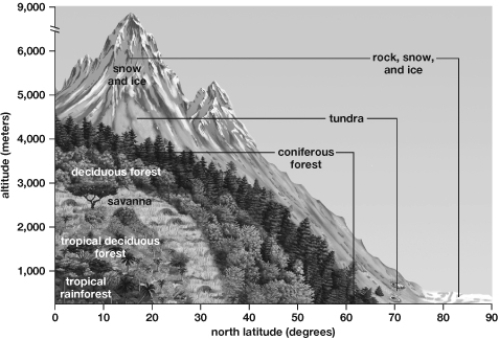
-What biome would you expect to find at 45° N latitude and elevations of 2,500 meters?
-What biome would you expect to find at 45° N latitude and elevations of 2,500 meters? (Multiple Choice)
4.9/5 (82)
(82) Plants from both the chaparral and the Arctic have waxy coatings even though the temperatures in the two biomes are vastly different. Why?
(Essay)
4.8/5 (67)
(67)
-The animals shown in the photographs are found in which biome? 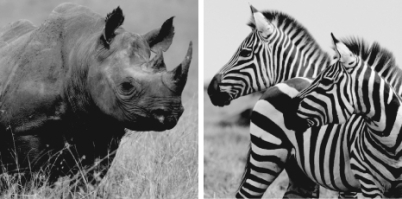
-The animals shown in the photographs are found in which biome? (Multiple Choice)
4.9/5 (77)
(77) Which biome probably contains the largest number and most diverse group of large mammals?
(Multiple Choice)
4.9/5 (91)
(91) Which biome is characterized by widely spaced trees surrounded by grasses?
(Multiple Choice)
4.8/5 (76)
(76) Patterns of temperature and precipitation that prevail over years are referred to as weather.
(True/False)
4.9/5 (91)
(91) In which biome would you expect to find large numbers of black bears, snowshoe hares, moose, lynx, wolves, and deer?
(Multiple Choice)
4.9/5 (80)
(80) The is the zone near the shore of a lake where a diverse group of organisms lives and where light and nutrients are abundant.
(Multiple Choice)
4.8/5 (91)
(91) In the temperate rain forest, the establishment of new tree seedlings is limited by the lack of light reaching the forest floor.
(True/False)
4.8/5 (80)
(80) 
Filters
- Essay(0)
- Multiple Choice(0)
- Short Answer(0)
- True False(0)
- Matching(0)