



 Chat with AI
Exam 30: Earths Diverse Ecosystems

Exam 1: An Introduction to Life on Earth85 Questions
Exam 2: Atoms, Molecules, and Life90 Questions
Exam 3: Biological Molecules98 Questions
Exam 4: Cell Structure and Function90 Questions
Exam 5: Cell Membrane Structure and Function95 Questions
Exam 6: Energy Flow in the Life of a Cell90 Questions
Exam 7: Capturing Solar Energy: Photosynthesis102 Questions
Exam 8: Harvesting Energy: Glycolysis and Cellular Respiration97 Questions
Exam 9: Cellular Reproduction133 Questions
Exam 10: Meiosis: the Basis of Sexual Reproduction103 Questions
Exam 11: Patterns of Inheritance98 Questions
Exam 12: Dna: the Molecule of Heredity97 Questions
Exam 13: Gene Expression and Regulation93 Questions
Exam 14: Biotechnology91 Questions
Exam 15: Principles of Evolution97 Questions
Exam 16: How Populations Evolve109 Questions
Exam 17: The Origin of Species89 Questions
Exam 18: The History of Life125 Questions
Exam 19: Systematics: Seeking Order Amid Diversity90 Questions
Exam 20: The Diversity of Prokaryotes and Viruses97 Questions
Exam 21: The Diversity of Protists102 Questions
Exam 22: The Diversity of Plants115 Questions
Exam 23: The Diversity of Fungi107 Questions
Exam 24: Animal Diversity I: Invertebrates101 Questions
Exam 25: Animal Diversity II: Vertebrates118 Questions
Exam 26: Animal Behavior116 Questions
Exam 27: Population Growth and Regulation114 Questions
Exam 28: Community Interactions125 Questions
Exam 29: Energy Flow and Nutrient Cycling in Ecosystems122 Questions
Exam 30: Earths Diverse Ecosystems126 Questions
Exam 31: Conserving Earths Biodiversity109 Questions
Exam 32: Homeostasis and the Organization of the Animal Body95 Questions
Exam 33: Circulation89 Questions
Exam 34: Respiration92 Questions
Exam 35: Nutrition and Digestion91 Questions
Exam 36: The Urinary System99 Questions
Exam 37: Defenses Against Disease104 Questions
Exam 38: Chemical Control of the Animal Body: the Endocrine System133 Questions
Exam 39: The Nervous System118 Questions
Exam 40: The Senses94 Questions
Exam 41: Action and Support: the Muscles and Skeleton90 Questions
Exam 42: Animal Reproduction120 Questions
Exam 43: Animal Development122 Questions
Exam 44: Plant Anatomy and Nutrient Transport95 Questions
Exam 45: Plant Reproduction and Development90 Questions
Exam 46: Plant Responses to the Environment87 Questions
Select questions type


The prevailing winds in the Glacier National Park area of Montana are from the west. Which side of this mountainous region receives the most rain and snow?
(Multiple Choice)
4.9/5  (84)
(84) The windward side of a mountain range has the drier climate because of the rain shadow.
(True/False)
4.9/5 (79)
(79) Plant life in the different biomes is limited only by the amount of sunlight.
(True/False)
5.0/5 (79)
(79) As large tracts of rain forest disappear due to human activities, the region tends to become drier. Why?
(Essay)
4.7/5 (86)
(86) One of the most popular hikes in Rocky Mountain National Park is the tundra trail. What effects would you expect from hundreds of people walking on this trail every day during the season?
(Essay)
4.7/5 (82)
(82) What are the main factors that determine the locations of terrestrial biomes?
(Essay)
4.9/5 (83)
(83) The striking dissimilarities in plant communities among different biomes that have the same average yearly amount of rainfall can be explained by the fact that
(Multiple Choice)
4.8/5 (74)
(74) Which of the following North American biomes has been almost completely destroyed by agricultural use?
(Multiple Choice)
4.9/5 (81)
(81) In many parts of the Amazon Basin, farmers have cut down the tropical rain- forest trees and planted crops. However, the farmers often abandon these croplands after a few years and move on. What are some possible reasons for this?
(Essay)
4.8/5 (63)
(63) A(n) is an area that is very dry because the air in that region has passed over a mountain and lost most of its moisture.
(Multiple Choice)
4.7/5 (71)
(71) Rain- forest soils store large amounts of nutrients, which makes them ideal for farming.
(True/False)
4.9/5 (76)
(76) The most heat- tolerant organisms presently known come from
(Multiple Choice)
4.7/5 (80)
(80)  -In an attempt to stop desertification, some groups have changed the way they work with the land. They plant trees to stop erosion, build small barriers to slow water runoff on slopes, and bring food to their animals rather than letting them graze freely. Why would these techniques help stop desertification?
 (Multiple Choice)
4.9/5 (82)
(82) What are the major limiting factors that determine the distribution of organisms in aquatic ecosystems?
(Multiple Choice)
4.7/5 (65)
(65) is the year- round layer of frozen soil that limits the growth of trees and other deep- rooted plants in the arctic tundra.
(Short Answer)
4.8/5 (86)
(86) What are the fundamental resources required to support life?
(Multiple Choice)
4.8/5 (75)
(75) In one area is a desert ecosystem and in another area is a tundra. What two fundamental resources differ in the ecosystems of these two areas? Why are these two more important than the other fundamental resources?
(Essay)
4.9/5 (84)
(84) A biome that is characterized by an annual rainfall of 10 inches or less is called a .
(Short Answer)
4.8/5 (87)
(87)
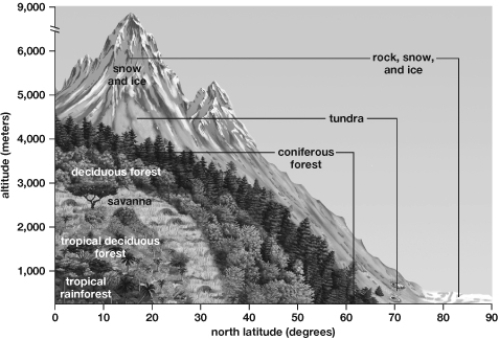
-What biome would you expect to find at 30° N latitude and elevations of 1,500 meters?
-What biome would you expect to find at 30° N latitude and elevations of 1,500 meters? (Multiple Choice)
5.0/5 (74)
(74) 
Filters
- Essay(0)
- Multiple Choice(0)
- Short Answer(0)
- True False(0)
- Matching(0)