



 Chat with AI
Exam 43: Animal Development

Exam 1: An Introduction to Life on Earth85 Questions
Exam 2: Atoms, Molecules, and Life90 Questions
Exam 3: Biological Molecules98 Questions
Exam 4: Cell Structure and Function90 Questions
Exam 5: Cell Membrane Structure and Function95 Questions
Exam 6: Energy Flow in the Life of a Cell90 Questions
Exam 7: Capturing Solar Energy: Photosynthesis102 Questions
Exam 8: Harvesting Energy: Glycolysis and Cellular Respiration97 Questions
Exam 9: Cellular Reproduction133 Questions
Exam 10: Meiosis: the Basis of Sexual Reproduction103 Questions
Exam 11: Patterns of Inheritance98 Questions
Exam 12: Dna: the Molecule of Heredity97 Questions
Exam 13: Gene Expression and Regulation93 Questions
Exam 14: Biotechnology91 Questions
Exam 15: Principles of Evolution97 Questions
Exam 16: How Populations Evolve109 Questions
Exam 17: The Origin of Species89 Questions
Exam 18: The History of Life125 Questions
Exam 19: Systematics: Seeking Order Amid Diversity90 Questions
Exam 20: The Diversity of Prokaryotes and Viruses97 Questions
Exam 21: The Diversity of Protists102 Questions
Exam 22: The Diversity of Plants115 Questions
Exam 23: The Diversity of Fungi107 Questions
Exam 24: Animal Diversity I: Invertebrates101 Questions
Exam 25: Animal Diversity II: Vertebrates118 Questions
Exam 26: Animal Behavior116 Questions
Exam 27: Population Growth and Regulation114 Questions
Exam 28: Community Interactions125 Questions
Exam 29: Energy Flow and Nutrient Cycling in Ecosystems122 Questions
Exam 30: Earths Diverse Ecosystems126 Questions
Exam 31: Conserving Earths Biodiversity109 Questions
Exam 32: Homeostasis and the Organization of the Animal Body95 Questions
Exam 33: Circulation89 Questions
Exam 34: Respiration92 Questions
Exam 35: Nutrition and Digestion91 Questions
Exam 36: The Urinary System99 Questions
Exam 37: Defenses Against Disease104 Questions
Exam 38: Chemical Control of the Animal Body: the Endocrine System133 Questions
Exam 39: The Nervous System118 Questions
Exam 40: The Senses94 Questions
Exam 41: Action and Support: the Muscles and Skeleton90 Questions
Exam 42: Animal Reproduction120 Questions
Exam 43: Animal Development122 Questions
Exam 44: Plant Anatomy and Nutrient Transport95 Questions
Exam 45: Plant Reproduction and Development90 Questions
Exam 46: Plant Responses to the Environment87 Questions
Select questions type


The developing fetus secretes chorionic gonadotropin only during the first 2 weeks of pregnancy.

Free
(True/False)
4.9/5  (70)
(70) Correct Answer: Verified
False
Based on experiments with amphibian embryos, Spemann and Mangold found that
Free
(Multiple Choice)
4.8/5 (89)
(89) Correct Answer:Verified
VerifiedC
Recent studies have shown that cells of the dorsal lip of the blastopore contain active genes that code for proteins that are able to induce the development of other cells.
(Short Answer)
4.7/5 (80)
(80) A recent series of TV commercials promoted the idea that a woman who wants to have a healthy baby must begin to eat well and avoid some medications and alcohol before she knows she is pregnant. Why?
(Essay)
4.7/5 (92)
(92) An embryo was exposed to a chemical early in its development. At birth, there is chromosomal damage to the skin linked to the chemical exposure. What other organ system should be examined for the same type of damage?
(Essay)
4.9/5 (73)
(73) A human embryologist examines a 3- week- old embryo and notices that it has not developed a notochord. If the embryo survives, it will lack
(Multiple Choice)
4.8/5 (99)
(99) is the medication given to combat morning sickness that caused deformed and missing limbs in infants in the late 1950s and early 1960s.
(Multiple Choice)
4.7/5 (79)
(79) In what ways are the juveniles of direct- development species like their parents, and in what way are they different?
(Essay)
4.8/5 (76)
(76) 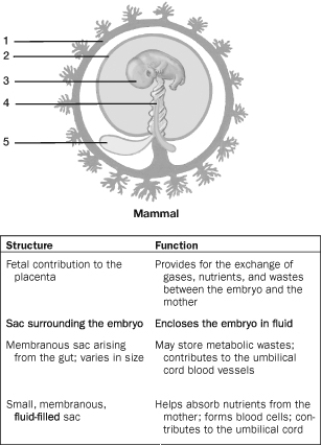 -A mad scientist decides to start combining embryos and see what develops. He takes cells from the blastula of a frog with blue skin and transplants them into the blastula of a yellow- skinned frog. The embryo receiving the cells develops blue cells in its brain and spinal cord. The scientist must have transplanted the cells into the of the recipient embryo.
 (Multiple Choice)
4.9/5 (88)
(88) What will occur if a morula divides into three masses of cells?
(Multiple Choice)
4.8/5 (89)
(89) Why do organisms that have indirect development produce hundreds of offspring, whereas those with direct development produce relatively few offspring?
(Essay)
4.7/5 (69)
(69) How does direct development of an embryo differ from indirect development?
(Essay)
4.8/5 (79)
(79) 
Filters
- Essay(0)
- Multiple Choice(0)
- Short Answer(0)
- True False(0)
- Matching(0)