



 Chat with AI
Exam 39: The Nervous System

Exam 1: An Introduction to Life on Earth85 Questions
Exam 2: Atoms, Molecules, and Life90 Questions
Exam 3: Biological Molecules98 Questions
Exam 4: Cell Structure and Function90 Questions
Exam 5: Cell Membrane Structure and Function95 Questions
Exam 6: Energy Flow in the Life of a Cell90 Questions
Exam 7: Capturing Solar Energy: Photosynthesis102 Questions
Exam 8: Harvesting Energy: Glycolysis and Cellular Respiration97 Questions
Exam 9: Cellular Reproduction133 Questions
Exam 10: Meiosis: the Basis of Sexual Reproduction103 Questions
Exam 11: Patterns of Inheritance98 Questions
Exam 12: Dna: the Molecule of Heredity97 Questions
Exam 13: Gene Expression and Regulation93 Questions
Exam 14: Biotechnology91 Questions
Exam 15: Principles of Evolution97 Questions
Exam 16: How Populations Evolve109 Questions
Exam 17: The Origin of Species89 Questions
Exam 18: The History of Life125 Questions
Exam 19: Systematics: Seeking Order Amid Diversity90 Questions
Exam 20: The Diversity of Prokaryotes and Viruses97 Questions
Exam 21: The Diversity of Protists102 Questions
Exam 22: The Diversity of Plants115 Questions
Exam 23: The Diversity of Fungi107 Questions
Exam 24: Animal Diversity I: Invertebrates101 Questions
Exam 25: Animal Diversity II: Vertebrates118 Questions
Exam 26: Animal Behavior116 Questions
Exam 27: Population Growth and Regulation114 Questions
Exam 28: Community Interactions125 Questions
Exam 29: Energy Flow and Nutrient Cycling in Ecosystems122 Questions
Exam 30: Earths Diverse Ecosystems126 Questions
Exam 31: Conserving Earths Biodiversity109 Questions
Exam 32: Homeostasis and the Organization of the Animal Body95 Questions
Exam 33: Circulation89 Questions
Exam 34: Respiration92 Questions
Exam 35: Nutrition and Digestion91 Questions
Exam 36: The Urinary System99 Questions
Exam 37: Defenses Against Disease104 Questions
Exam 38: Chemical Control of the Animal Body: the Endocrine System133 Questions
Exam 39: The Nervous System118 Questions
Exam 40: The Senses94 Questions
Exam 41: Action and Support: the Muscles and Skeleton90 Questions
Exam 42: Animal Reproduction120 Questions
Exam 43: Animal Development122 Questions
Exam 44: Plant Anatomy and Nutrient Transport95 Questions
Exam 45: Plant Reproduction and Development90 Questions
Exam 46: Plant Responses to the Environment87 Questions
Select questions type


 -Identify the numbered region in the above graph that indicates the action potential.
Free
(Multiple Choice)
4.8/5  (84)
(84) Correct Answer: Verified
D
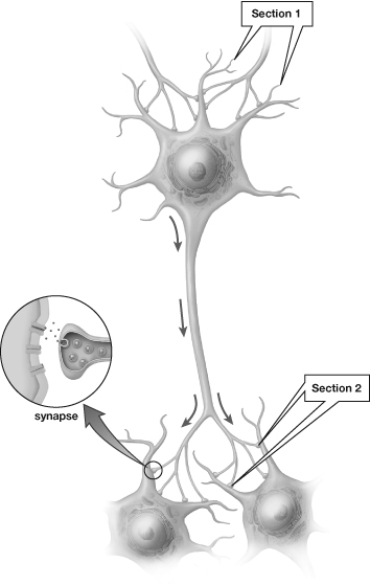
-What part of the neuron is labeled "Section 1"?
-What part of the neuron is labeled "Section 1"?Free
(Multiple Choice)
4.8/5 (70)
(70) Correct Answer:Verified
VerifiedD
Sensory information processing as well as the direction of voluntary movements are carried out by the
Free
(Multiple Choice)
4.9/5 (84)
(84) Correct Answer:Verified
VerifiedD
A diffuse nerve net would be found in which of the following animals?
(Multiple Choice)
5.0/5 (78)
(78) People with multiple sclerosis develop areas in which the myelin sheath on their neurons has disintegrated. This disease often results in paralysis and extreme weakness. Using what you know about the myelin sheath, explain why these symptoms might occur.
(Essay)
4.9/5 (86)
(86) The more complex the organism, the more likely it is to have nerve net.
(True/False)
4.8/5 (81)
(81) Which of these neurotransmitters, released by neurons of the sympathetic nervous system, helps prepare the body for energetic activity?
(Multiple Choice)
4.8/5 (72)
(72) It is possible that brain damage from a stroke or other injury could leave a person with the ability to comprehend written language but not spoken language (assume the person's hearing is fine). Which statement best explains this?
(Multiple Choice)
4.9/5 (72)
(72) Which portion of the neuron typically receives information?
(Multiple Choice)
4.8/5 (71)
(71) The is a cluster of neurons that plays a role in wake- sleep cycles, muscle tone, emotions, and some reflexes.
(Short Answer)
4.9/5 (73)
(73) The left and right hemispheres of the brain are connected through the _, a large band of axons.
(Short Answer)
4.8/5 (81)
(81) In an unstimulated neuron, the sodium- potassium pump maintains the concentration gradient of sodium and potassium ions by transporting
(Multiple Choice)
4.9/5 (71)
(71) Complex organisms tend to have a nervous system with sense organs concentrated in the head.
(Short Answer)
4.9/5 (71)
(71) If a bone fragment resulting from a broken nose pushed against the olfactory (smell) nerve, triggering an action potential, the person would
(Multiple Choice)
4.7/5 (83)
(83) The concentrations of ions inside and outside of a neuron are maintained by sodium- chloride (Na+- Cl-) pumps.
(True/False)
4.8/5 (57)
(57) The brain interprets the of light on the basis of the number and frequency of action potentials it receives from light receptors in the retina.
(Short Answer)
4.9/5 (69)
(69) The part of a neuron that contains a nucleus and other organelles typical of cells is the .
(Short Answer)
4.8/5 (71)
(71) Which of the following does NOT describe the autonomic nervous system?
(Multiple Choice)
4.9/5 (76)
(76) 
Filters
- Essay(0)
- Multiple Choice(0)
- Short Answer(0)
- True False(0)
- Matching(0)