



 Chat with AI
Exam 39: The Nervous System

Exam 1: An Introduction to Life on Earth85 Questions
Exam 2: Atoms, Molecules, and Life90 Questions
Exam 3: Biological Molecules98 Questions
Exam 4: Cell Structure and Function90 Questions
Exam 5: Cell Membrane Structure and Function95 Questions
Exam 6: Energy Flow in the Life of a Cell90 Questions
Exam 7: Capturing Solar Energy: Photosynthesis102 Questions
Exam 8: Harvesting Energy: Glycolysis and Cellular Respiration97 Questions
Exam 9: Cellular Reproduction133 Questions
Exam 10: Meiosis: the Basis of Sexual Reproduction103 Questions
Exam 11: Patterns of Inheritance98 Questions
Exam 12: Dna: the Molecule of Heredity97 Questions
Exam 13: Gene Expression and Regulation93 Questions
Exam 14: Biotechnology91 Questions
Exam 15: Principles of Evolution97 Questions
Exam 16: How Populations Evolve109 Questions
Exam 17: The Origin of Species89 Questions
Exam 18: The History of Life125 Questions
Exam 19: Systematics: Seeking Order Amid Diversity90 Questions
Exam 20: The Diversity of Prokaryotes and Viruses97 Questions
Exam 21: The Diversity of Protists102 Questions
Exam 22: The Diversity of Plants115 Questions
Exam 23: The Diversity of Fungi107 Questions
Exam 24: Animal Diversity I: Invertebrates101 Questions
Exam 25: Animal Diversity II: Vertebrates118 Questions
Exam 26: Animal Behavior116 Questions
Exam 27: Population Growth and Regulation114 Questions
Exam 28: Community Interactions125 Questions
Exam 29: Energy Flow and Nutrient Cycling in Ecosystems122 Questions
Exam 30: Earths Diverse Ecosystems126 Questions
Exam 31: Conserving Earths Biodiversity109 Questions
Exam 32: Homeostasis and the Organization of the Animal Body95 Questions
Exam 33: Circulation89 Questions
Exam 34: Respiration92 Questions
Exam 35: Nutrition and Digestion91 Questions
Exam 36: The Urinary System99 Questions
Exam 37: Defenses Against Disease104 Questions
Exam 38: Chemical Control of the Animal Body: the Endocrine System133 Questions
Exam 39: The Nervous System118 Questions
Exam 40: The Senses94 Questions
Exam 41: Action and Support: the Muscles and Skeleton90 Questions
Exam 42: Animal Reproduction120 Questions
Exam 43: Animal Development122 Questions
Exam 44: Plant Anatomy and Nutrient Transport95 Questions
Exam 45: Plant Reproduction and Development90 Questions
Exam 46: Plant Responses to the Environment87 Questions
Select questions type


Alice's PET (positron emission tomography) scan shows a large red area in the occipital lobe when taken while Alice is looking at color images. Which of the following is TRUE about Alice's PET scan?
(Multiple Choice)
4.8/5  (92)
(92) The brain is able to take sensory inputs from many neurons, integrate them, and determine an appropriate response.
(True/False)
4.8/5 (85)
(85) The peripheral nervous system consists of the brain and spinal cord.
(True/False)
4.7/5 (84)
(84) Which of the following is part of the peripheral nervous system?
(Multiple Choice)
4.9/5 (77)
(77) A person who is unable to speak after a stroke has had damage to what part of the brain?
(Short Answer)
4.8/5 (82)
(82) The integration of excitatory postsynaptic potentials (EPSPs) and inhibitory postsynaptic potentials (IPSPs) received by a postsynaptic neuron determines its activity.
(True/False)
4.9/5 (95)
(95) 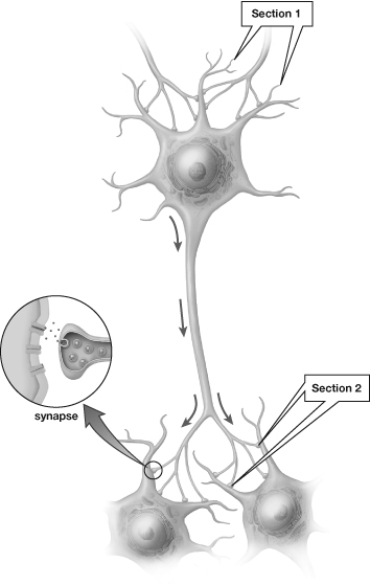 -A person you know has been in an automobile accident. The accident caused a dramatic personality change. Before the accident, he was industrious and well liked; after the accident, he is profane, impetuous, and incapable of working toward a goal. Which portion of the brain was most likely damaged?
 (Multiple Choice)
4.9/5 (93)
(93) The intensity of a stimulus is indicated by the of action potentials.
(Multiple Choice)
4.9/5 (75)
(75) The is a cluster of neurons that plays a role in wake- sleep cycles, muscle tone, emotions, and some reflexes.
(Multiple Choice)
4.7/5 (75)
(75) You arrive ten minutes late for your final exam and immediately regret stopping for donuts, which feel like a dead weight in your stomach. Your heart is pounding and your palms are sweaty. What part of your nervous system is in control?
(Multiple Choice)
4.8/5 (78)
(78) Individuals diagnosed with Huntington's disease exhibit abnormal involuntary movements due to deterioration of the _ .
(Short Answer)
4.8/5 (91)
(91) The interior of an unstimulated neuron maintains a constant negative charge, called the .
(Short Answer)
4.8/5 (71)
(71) Individuals with viral hemorrhagic fever lose the ability to regulate their K+ levels. Why does this condition create neurological problems?
(Essay)
4.8/5 (80)
(80) The junction across which electrical signals are passed from a neuron to a muscle fiber, a gland, or another neuron is called the
(Multiple Choice)
4.9/5 (81)
(81) While walking barefoot along the beach, you step on a shard of glass and reflexively lift your injured foot. Which path did the reflex to lift your foot take?
(Multiple Choice)
4.9/5 (77)
(77) The more frequently an action potential is triggered by a stimulus, the greater the intensity of the sensation.
(True/False)
4.8/5 (83)
(83) During the repolarization phase of an action potential, the membrane potential falls from +60 to - 70 mV. This drop is due mostly to the movement of _ ions.
(Multiple Choice)
4.8/5 (82)
(82) 
Filters
- Essay(0)
- Multiple Choice(0)
- Short Answer(0)
- True False(0)
- Matching(0)