



 Chat with AI
Exam 27: Population Growth and Regulation

Exam 1: An Introduction to Life on Earth85 Questions
Exam 2: Atoms, Molecules, and Life90 Questions
Exam 3: Biological Molecules98 Questions
Exam 4: Cell Structure and Function90 Questions
Exam 5: Cell Membrane Structure and Function95 Questions
Exam 6: Energy Flow in the Life of a Cell90 Questions
Exam 7: Capturing Solar Energy: Photosynthesis102 Questions
Exam 8: Harvesting Energy: Glycolysis and Cellular Respiration97 Questions
Exam 9: Cellular Reproduction133 Questions
Exam 10: Meiosis: the Basis of Sexual Reproduction103 Questions
Exam 11: Patterns of Inheritance98 Questions
Exam 12: Dna: the Molecule of Heredity97 Questions
Exam 13: Gene Expression and Regulation93 Questions
Exam 14: Biotechnology91 Questions
Exam 15: Principles of Evolution97 Questions
Exam 16: How Populations Evolve109 Questions
Exam 17: The Origin of Species89 Questions
Exam 18: The History of Life125 Questions
Exam 19: Systematics: Seeking Order Amid Diversity90 Questions
Exam 20: The Diversity of Prokaryotes and Viruses97 Questions
Exam 21: The Diversity of Protists102 Questions
Exam 22: The Diversity of Plants115 Questions
Exam 23: The Diversity of Fungi107 Questions
Exam 24: Animal Diversity I: Invertebrates101 Questions
Exam 25: Animal Diversity II: Vertebrates118 Questions
Exam 26: Animal Behavior116 Questions
Exam 27: Population Growth and Regulation114 Questions
Exam 28: Community Interactions125 Questions
Exam 29: Energy Flow and Nutrient Cycling in Ecosystems122 Questions
Exam 30: Earths Diverse Ecosystems126 Questions
Exam 31: Conserving Earths Biodiversity109 Questions
Exam 32: Homeostasis and the Organization of the Animal Body95 Questions
Exam 33: Circulation89 Questions
Exam 34: Respiration92 Questions
Exam 35: Nutrition and Digestion91 Questions
Exam 36: The Urinary System99 Questions
Exam 37: Defenses Against Disease104 Questions
Exam 38: Chemical Control of the Animal Body: the Endocrine System133 Questions
Exam 39: The Nervous System118 Questions
Exam 40: The Senses94 Questions
Exam 41: Action and Support: the Muscles and Skeleton90 Questions
Exam 42: Animal Reproduction120 Questions
Exam 43: Animal Development122 Questions
Exam 44: Plant Anatomy and Nutrient Transport95 Questions
Exam 45: Plant Reproduction and Development90 Questions
Exam 46: Plant Responses to the Environment87 Questions
Select questions type


In a population of lemmings, a sudden freeze that caused many of the lemmings to die is an example of a

Free
(Multiple Choice)
4.9/5  (77)
(77) Correct Answer: Verified
B
To determine the number of individuals added to a population during a given time, multiply the growth rate (r) by the
Free
(Multiple Choice)
4.9/5 (89)
(89) Correct Answer:Verified
VerifiedE
An effective parasite is one that kills its host quickly.
Free
(True/False)
4.8/5 (85)
(85) Correct Answer:Verified
VerifiedFalse
An insect population grows exponentially until an early winter freeze kills almost all of the insects. The next spring, the population grows exponentially again. This type of population growth is called
(Multiple Choice)
4.9/5 (81)
(81) Predation is considered a density- dependent factor that controls the population size of prey species. Give two examples of predators acting in density- dependent ways in response to fluctuations in the size of prey populations.
(Essay)
4.9/5 (73)
(73) Which of the following is an important density- independent factor limiting population size?
(Multiple Choice)
4.8/5 (83)
(83) At the start of a study, 200 spotted owls lived in an old- growth forest patch in western Oregon. During the next year, a biologist tracking the birds observed that 25 new birds hatched and 5 died. What was the growth rate (r) for this year?
(Multiple Choice)
4.9/5 (83)
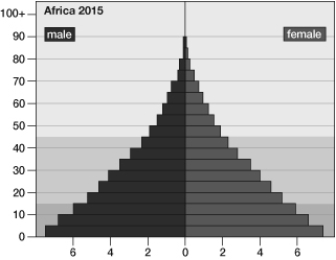
(83) Although social changes and increased access to contraceptives have caused a decrease in fertility rates in some less- developed countries, their rates are still above RLF.
(True/False)
4.9/5 (64)
(64) In a maple forest in the spring, the ground is often covered with young maple seedlings, which compete for light and nutrients. By fall, most of the seedlings have died, leaving only a few survivors. This is an example of
life history pattern.
(Short Answer)
4.9/5 (80)
(80) Why has it been so hard to come up with an accurate measure of Earth's carrying capacity for humans?
(Essay)
4.8/5 (82)
(82) 
Competition among individual members of the same species is referred to as competition.
(Short Answer)
4.8/5 (83)
(83) What percentage of Earth's productive land is currently used by the human population for crops and livestock?
(Multiple Choice)
4.8/5 (82)
(82) Increased population densities and increased competition lead to increased emigration.
(True/False)
4.8/5 (70)
(70) Why do many non- native species, such as a prickly pear cactus brought to Australia from South America, rapidly become abundant when first introduced?
(Multiple Choice)
4.7/5 (76)
(76) In a stable population with neither immigration nor emigration, the RLF is 1.0 (one child per woman).
(True/False)
4.8/5 (90)
(90) Why does a bacteria population have a higher biotic potential than a population of humans?
(Essay)
4.9/5 (85)
(85) To support the world population at the same standard of living as we have in the United States would require times the resources that are available on Earth today.
(Multiple Choice)
4.8/5 (72)
(72) When a population has inhabited an area for a long time and the population size has stabilized, then
(Multiple Choice)
4.7/5 (96)
(96) Prey, such as lemmings, may have a density- dependent effect on predator populations, such as those of the snowy owl, by enabling the predator to increase the number of its offspring at high prey densities.
(True/False)
4.9/5 (79)
(79) 
Filters
- Essay(0)
- Multiple Choice(0)
- Short Answer(0)
- True False(0)
- Matching(0)