



 Chat with AI
Exam 27: Population Growth and Regulation

Exam 1: An Introduction to Life on Earth85 Questions
Exam 2: Atoms, Molecules, and Life90 Questions
Exam 3: Biological Molecules98 Questions
Exam 4: Cell Structure and Function90 Questions
Exam 5: Cell Membrane Structure and Function95 Questions
Exam 6: Energy Flow in the Life of a Cell90 Questions
Exam 7: Capturing Solar Energy: Photosynthesis102 Questions
Exam 8: Harvesting Energy: Glycolysis and Cellular Respiration97 Questions
Exam 9: Cellular Reproduction133 Questions
Exam 10: Meiosis: the Basis of Sexual Reproduction103 Questions
Exam 11: Patterns of Inheritance98 Questions
Exam 12: Dna: the Molecule of Heredity97 Questions
Exam 13: Gene Expression and Regulation93 Questions
Exam 14: Biotechnology91 Questions
Exam 15: Principles of Evolution97 Questions
Exam 16: How Populations Evolve109 Questions
Exam 17: The Origin of Species89 Questions
Exam 18: The History of Life125 Questions
Exam 19: Systematics: Seeking Order Amid Diversity90 Questions
Exam 20: The Diversity of Prokaryotes and Viruses97 Questions
Exam 21: The Diversity of Protists102 Questions
Exam 22: The Diversity of Plants115 Questions
Exam 23: The Diversity of Fungi107 Questions
Exam 24: Animal Diversity I: Invertebrates101 Questions
Exam 25: Animal Diversity II: Vertebrates118 Questions
Exam 26: Animal Behavior116 Questions
Exam 27: Population Growth and Regulation114 Questions
Exam 28: Community Interactions125 Questions
Exam 29: Energy Flow and Nutrient Cycling in Ecosystems122 Questions
Exam 30: Earths Diverse Ecosystems126 Questions
Exam 31: Conserving Earths Biodiversity109 Questions
Exam 32: Homeostasis and the Organization of the Animal Body95 Questions
Exam 33: Circulation89 Questions
Exam 34: Respiration92 Questions
Exam 35: Nutrition and Digestion91 Questions
Exam 36: The Urinary System99 Questions
Exam 37: Defenses Against Disease104 Questions
Exam 38: Chemical Control of the Animal Body: the Endocrine System133 Questions
Exam 39: The Nervous System118 Questions
Exam 40: The Senses94 Questions
Exam 41: Action and Support: the Muscles and Skeleton90 Questions
Exam 42: Animal Reproduction120 Questions
Exam 43: Animal Development122 Questions
Exam 44: Plant Anatomy and Nutrient Transport95 Questions
Exam 45: Plant Reproduction and Development90 Questions
Exam 46: Plant Responses to the Environment87 Questions
Select questions type


In the eighteenth and nineteenth centuries, people increased Earth's capacity to support more humans through advances.
(Multiple Choice)
4.8/5  (73)
(73) Developing countries tend to have a(n) age structure diagram.
(Multiple Choice)
4.9/5 (87)
(87) A forest fire is a density- independent population control factor.
(True/False)
4.9/5 (79)
(79) 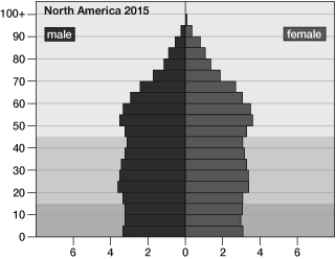
A measure of the ability of a population to grow under ideal circumstances (maximum birth rate and minimum death rate) is its .
(Short Answer)
4.8/5 (74)
(74) What term describes the maximum population size that the environment can support indefinitely?
(Short Answer)
4.8/5 (81)
(81) Floods and fires are examples of , which can dramatically and unpredictably reduce populations.
(Multiple Choice)
4.8/5 (85)
(85) A species that is transferred to a new environment where it has little environmental resistance and experiences an explosive population growth is called a(n) species.
(Short Answer)
4.9/5 (82)
(82) When mosquitoes are abundant, purple martins flock to the area and feed exclusively on them. When mosquito populations are not large, purple martins are similarly scarce and feed on other insects. This is an example of
(Multiple Choice)
5.0/5 (91)
(91) When resources are limited but spread evenly throughout a region, plants are likely to form a uniform distribution pattern.
(True/False)
4.7/5 (64)
(64) Human populations have continued to grow because humans have increased Earth's through agriculture, medicine, and technology.
(Short Answer)
4.9/5 (80)
(80) The different species within an ecosystem that interact in various ways make up a(n)
(Multiple Choice)
4.8/5 (76)
(76) If the individuals of a species are likely to live until old age, that species exhibits a(n) survivorship curve.
(Multiple Choice)
4.9/5 (84)
(84) Based on the data in the table, this population has a growth pattern. 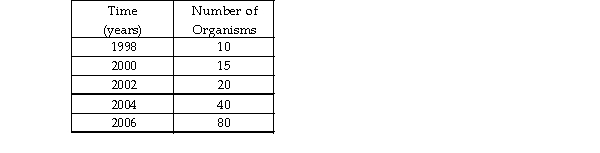
(Multiple Choice)
4.8/5 (79)
(79) The growth rate of a population is the difference between the population size and the death rate.
(True/False)
4.8/5 (65)
(65) An ecologist is studying the painted turtle population in a small pond. At the beginning of the year, there are 100 individuals. Over the course of a year, 40 turtles are born and 60 die. There is no migration. What is the birth rate per year for this population?
(Multiple Choice)
4.8/5 (83)
(83) In the United States today, there is a trend toward women having their first child in their late 30s or early 40s. In contrast, a few decades ago, most women started having children in their early 20s. What effect would you expect this change to have on population growth in the United States? Would it have any effect if the number of children per woman remains the same? Explain.
(Essay)
4.9/5 (79)
(79) 
Filters
- Essay(0)
- Multiple Choice(0)
- Short Answer(0)
- True False(0)
- Matching(0)