



 Chat with AI
Exam 27: Population Growth and Regulation

Exam 1: An Introduction to Life on Earth85 Questions
Exam 2: Atoms, Molecules, and Life90 Questions
Exam 3: Biological Molecules98 Questions
Exam 4: Cell Structure and Function90 Questions
Exam 5: Cell Membrane Structure and Function95 Questions
Exam 6: Energy Flow in the Life of a Cell90 Questions
Exam 7: Capturing Solar Energy: Photosynthesis102 Questions
Exam 8: Harvesting Energy: Glycolysis and Cellular Respiration97 Questions
Exam 9: Cellular Reproduction133 Questions
Exam 10: Meiosis: the Basis of Sexual Reproduction103 Questions
Exam 11: Patterns of Inheritance98 Questions
Exam 12: Dna: the Molecule of Heredity97 Questions
Exam 13: Gene Expression and Regulation93 Questions
Exam 14: Biotechnology91 Questions
Exam 15: Principles of Evolution97 Questions
Exam 16: How Populations Evolve109 Questions
Exam 17: The Origin of Species89 Questions
Exam 18: The History of Life125 Questions
Exam 19: Systematics: Seeking Order Amid Diversity90 Questions
Exam 20: The Diversity of Prokaryotes and Viruses97 Questions
Exam 21: The Diversity of Protists102 Questions
Exam 22: The Diversity of Plants115 Questions
Exam 23: The Diversity of Fungi107 Questions
Exam 24: Animal Diversity I: Invertebrates101 Questions
Exam 25: Animal Diversity II: Vertebrates118 Questions
Exam 26: Animal Behavior116 Questions
Exam 27: Population Growth and Regulation114 Questions
Exam 28: Community Interactions125 Questions
Exam 29: Energy Flow and Nutrient Cycling in Ecosystems122 Questions
Exam 30: Earths Diverse Ecosystems126 Questions
Exam 31: Conserving Earths Biodiversity109 Questions
Exam 32: Homeostasis and the Organization of the Animal Body95 Questions
Exam 33: Circulation89 Questions
Exam 34: Respiration92 Questions
Exam 35: Nutrition and Digestion91 Questions
Exam 36: The Urinary System99 Questions
Exam 37: Defenses Against Disease104 Questions
Exam 38: Chemical Control of the Animal Body: the Endocrine System133 Questions
Exam 39: The Nervous System118 Questions
Exam 40: The Senses94 Questions
Exam 41: Action and Support: the Muscles and Skeleton90 Questions
Exam 42: Animal Reproduction120 Questions
Exam 43: Animal Development122 Questions
Exam 44: Plant Anatomy and Nutrient Transport95 Questions
Exam 45: Plant Reproduction and Development90 Questions
Exam 46: Plant Responses to the Environment87 Questions
Select questions type


The United Nations estimates that by 2050, the world's population may reach over billion and still be growing.
(Multiple Choice)
4.8/5  (77)
(77) If a population of 100 birds increases to 120 birds in a year, what is the value of r?
(Multiple Choice)
4.9/5 (80)
(80) In the equation, population growth = r × N, the letter r stands for .
(Short Answer)
4.9/5 (79)
(79) Density- dependent factors become more effective at limiting population growth as the size of the population
.
(Short Answer)
4.9/5 (90)
(90) When predators and prey both have population cycles, the predator cycle tends to that of the prey cycle.
(Short Answer)
4.8/5 (82)
(82) 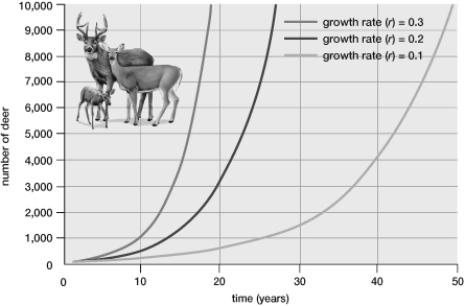 -Which population represented on the graph has the highest biotic potential?
 (Multiple Choice)
4.7/5 (69)
(69) Zebra mussels were introduced into Lake St. Clair around 1988. The table lists the population densities (in grams dry weight per square meter of lake bottom) of native unionid mussels and exotic zebra mussels in the lake before and after this introduction. Both groups feed by filtering small particles from the water. Based on the information given, which of the following best describes the likely relationship between zebra mussels and unionids? 
(Multiple Choice)
4.8/5 (80)
(80) All members of a species that reside within an ecosystem make up a(n)
(Multiple Choice)
4.8/5 (79)
(79) The is made up of the entire Earth and all of the living organisms that inhabit it.
(Short Answer)
4.8/5 (80)
(80) In countries where the number of children younger than 15 is approximately equal to the number between ages 15 and 45, the population is
(Multiple Choice)
4.9/5 (74)
(74) Logistic population growth is characteristic of a population that moves into a new habitat, experiences a rapid increase in number, and then stabilizes.
(True/False)
4.9/5 (86)
(86) The sum of all factors (living and nonliving) that limit the ability of a population to grow is known as .
(Short Answer)
4.7/5 (73)
(73) What is the term for regular population cycles of rapid growth followed by massive die- off?
(Short Answer)
4.7/5 (68)
(68) An ecologist is studying the painted turtle population in a small pond. At the beginning of the year, there are 100 individuals. Over the course of a year, 40 turtles are born and 60 die. There is no migration. What is the growth rate (r) of the painted turtle population?
(Multiple Choice)
4.8/5 (97)
(97) Within their territory, pack animals such as wolves exhibit a uniform distribution.
(True/False)
4.7/5 (86)
(86) A population of rabbits introduced into an island grew rapidly for a few years and then the growth slowed down and stabilized. Why did the population become stable?
(Multiple Choice)
4.7/5 (80)
(80) Invasive species can rapidly disrupt an ecosystem because they have a high biotic potential and face little environmental resistance.
(True/False)
4.7/5 (78)
(78) 
Filters
- Essay(0)
- Multiple Choice(0)
- Short Answer(0)
- True False(0)
- Matching(0)