



 Chat with AI
Exam 27: Population Growth and Regulation

Exam 1: An Introduction to Life on Earth85 Questions
Exam 2: Atoms, Molecules, and Life90 Questions
Exam 3: Biological Molecules98 Questions
Exam 4: Cell Structure and Function90 Questions
Exam 5: Cell Membrane Structure and Function95 Questions
Exam 6: Energy Flow in the Life of a Cell90 Questions
Exam 7: Capturing Solar Energy: Photosynthesis102 Questions
Exam 8: Harvesting Energy: Glycolysis and Cellular Respiration97 Questions
Exam 9: Cellular Reproduction133 Questions
Exam 10: Meiosis: the Basis of Sexual Reproduction103 Questions
Exam 11: Patterns of Inheritance98 Questions
Exam 12: Dna: the Molecule of Heredity97 Questions
Exam 13: Gene Expression and Regulation93 Questions
Exam 14: Biotechnology91 Questions
Exam 15: Principles of Evolution97 Questions
Exam 16: How Populations Evolve109 Questions
Exam 17: The Origin of Species89 Questions
Exam 18: The History of Life125 Questions
Exam 19: Systematics: Seeking Order Amid Diversity90 Questions
Exam 20: The Diversity of Prokaryotes and Viruses97 Questions
Exam 21: The Diversity of Protists102 Questions
Exam 22: The Diversity of Plants115 Questions
Exam 23: The Diversity of Fungi107 Questions
Exam 24: Animal Diversity I: Invertebrates101 Questions
Exam 25: Animal Diversity II: Vertebrates118 Questions
Exam 26: Animal Behavior116 Questions
Exam 27: Population Growth and Regulation114 Questions
Exam 28: Community Interactions125 Questions
Exam 29: Energy Flow and Nutrient Cycling in Ecosystems122 Questions
Exam 30: Earths Diverse Ecosystems126 Questions
Exam 31: Conserving Earths Biodiversity109 Questions
Exam 32: Homeostasis and the Organization of the Animal Body95 Questions
Exam 33: Circulation89 Questions
Exam 34: Respiration92 Questions
Exam 35: Nutrition and Digestion91 Questions
Exam 36: The Urinary System99 Questions
Exam 37: Defenses Against Disease104 Questions
Exam 38: Chemical Control of the Animal Body: the Endocrine System133 Questions
Exam 39: The Nervous System118 Questions
Exam 40: The Senses94 Questions
Exam 41: Action and Support: the Muscles and Skeleton90 Questions
Exam 42: Animal Reproduction120 Questions
Exam 43: Animal Development122 Questions
Exam 44: Plant Anatomy and Nutrient Transport95 Questions
Exam 45: Plant Reproduction and Development90 Questions
Exam 46: Plant Responses to the Environment87 Questions
Select questions type


The study of how organisms interact with one another and with their nonliving environment is
(Multiple Choice)
4.9/5  (79)
(79) 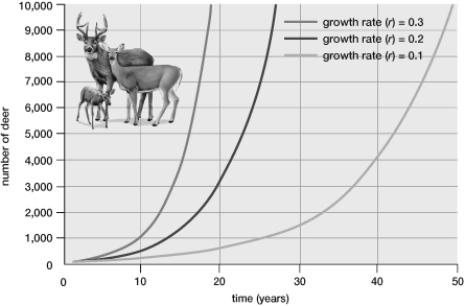 -According to the graph, how long does it take the population of deer that is experiencing moderate growth (r = 0.2) to reach 3,000 deer?
 (Multiple Choice)
4.7/5 (96)
(96) A population of birds migrating to winter nesting grounds is blown off course by a late- season hurricane and ends up on an island that is uninhabited by any animal species. Which of the following represents a density- independent factor that will limit the population size?
(Multiple Choice)
4.9/5 (78)
(78) Density- dependent factors become less effective as the population size increases.
(True/False)
4.8/5 (92)
(92) In a constant- loss population, an organism has an equal risk of dying at any time during its life span.
(True/False)
4.7/5 (84)
(84) If a caterpillar eats all of the seedlings in your garden, killing all of them, the caterpillar is acting as a
(Multiple Choice)
4.9/5 (78)
(78) According to the equation for population growth rate, if two populations have the same death rates, then the population with r = 2 will increase more rapidly than a population with r = 4.
(True/False)
4.9/5 (72)
(72) Populations that have been relatively undisturbed by humans normally grow, with no limits set by their environments.
(True/False)
4.7/5 (76)
(76) Parasites often kill their hosts, although they do not directly benefit from their hosts' death. Yet many ecologists believe that parasites may have beneficial effects on their host populations. Why?
(Essay)
4.7/5 (68)
(68) In areas that have a stable population, the number of children born in a period of time is
(Multiple Choice)
5.0/5 (69)
(69) A laboratory experiment followed the growth of a flour beetle (Tribolium sp.) population over time. At first, the population increased dramatically, but later the growth slowed and the population size leveled off. Although food (the wheat flour in which they live) was still abundant, the flour beetles resorted to eating their own eggs when population densities got high. What can we conclude about cannibalism in this species?
(Multiple Choice)
4.8/5 (74)
(74) All the members of a species that live within an ecosystem form a(n) _ .
(Short Answer)
4.8/5 (82)
(82) A complex, interrelated network of organisms and the surrounding nonliving environment in a defined area is a(n)
(Multiple Choice)
4.8/5 (92)
(92) Which of the following correctly describes the effect parasites have on their host's population size and on the host itself?
(Multiple Choice)
5.0/5 (83)
(83) Write an equation that describes a situation in which a population remains stable.
(Essay)
4.8/5 (74)
(74) 
Filters
- Essay(0)
- Multiple Choice(0)
- Short Answer(0)
- True False(0)
- Matching(0)