



 Chat with AI
Exam 42: Animal Reproduction

Exam 1: An Introduction to Life on Earth85 Questions
Exam 2: Atoms, Molecules, and Life90 Questions
Exam 3: Biological Molecules98 Questions
Exam 4: Cell Structure and Function90 Questions
Exam 5: Cell Membrane Structure and Function95 Questions
Exam 6: Energy Flow in the Life of a Cell90 Questions
Exam 7: Capturing Solar Energy: Photosynthesis102 Questions
Exam 8: Harvesting Energy: Glycolysis and Cellular Respiration97 Questions
Exam 9: Cellular Reproduction133 Questions
Exam 10: Meiosis: the Basis of Sexual Reproduction103 Questions
Exam 11: Patterns of Inheritance98 Questions
Exam 12: Dna: the Molecule of Heredity97 Questions
Exam 13: Gene Expression and Regulation93 Questions
Exam 14: Biotechnology91 Questions
Exam 15: Principles of Evolution97 Questions
Exam 16: How Populations Evolve109 Questions
Exam 17: The Origin of Species89 Questions
Exam 18: The History of Life125 Questions
Exam 19: Systematics: Seeking Order Amid Diversity90 Questions
Exam 20: The Diversity of Prokaryotes and Viruses97 Questions
Exam 21: The Diversity of Protists102 Questions
Exam 22: The Diversity of Plants115 Questions
Exam 23: The Diversity of Fungi107 Questions
Exam 24: Animal Diversity I: Invertebrates101 Questions
Exam 25: Animal Diversity II: Vertebrates118 Questions
Exam 26: Animal Behavior116 Questions
Exam 27: Population Growth and Regulation114 Questions
Exam 28: Community Interactions125 Questions
Exam 29: Energy Flow and Nutrient Cycling in Ecosystems122 Questions
Exam 30: Earths Diverse Ecosystems126 Questions
Exam 31: Conserving Earths Biodiversity109 Questions
Exam 32: Homeostasis and the Organization of the Animal Body95 Questions
Exam 33: Circulation89 Questions
Exam 34: Respiration92 Questions
Exam 35: Nutrition and Digestion91 Questions
Exam 36: The Urinary System99 Questions
Exam 37: Defenses Against Disease104 Questions
Exam 38: Chemical Control of the Animal Body: the Endocrine System133 Questions
Exam 39: The Nervous System118 Questions
Exam 40: The Senses94 Questions
Exam 41: Action and Support: the Muscles and Skeleton90 Questions
Exam 42: Animal Reproduction120 Questions
Exam 43: Animal Development122 Questions
Exam 44: Plant Anatomy and Nutrient Transport95 Questions
Exam 45: Plant Reproduction and Development90 Questions
Exam 46: Plant Responses to the Environment87 Questions
Select questions type


FSH stimulates interstitial cells in the testes to produce testosterone.

Free
(True/False)
4.8/5  (82)
(82) Correct Answer: Verified
False
Why do FSH levels drop after ovulation?
Free
(Essay)
4.9/5 (87)
(87) Correct Answer:Verified
VerifiedAfter ovulation, the corpus luteum begins to produce estrogen and progesterone, which inhibits GnRH production by negative feedback, reducing the release of FSH.
During an erection, blood pressure in the penis is decreased.
Free
(True/False)
4.9/5 (79)
(79) Correct Answer:Verified
VerifiedFalse
The lower end of the uterus is nearly closed by a ring of connective tissue called the .
(Short Answer)
4.8/5 (92)
(92) A single organism that produces both eggs and sperm, and can self- fertilize, is a _.
(Short Answer)
4.9/5 (76)
(76) Female salmon build nests in gravel river bottoms to lay eggs, which are then fertilized by male salmon that approach and deposit their sperm over the eggs. This is an example of
(Multiple Choice)
4.9/5 (79)
(79) 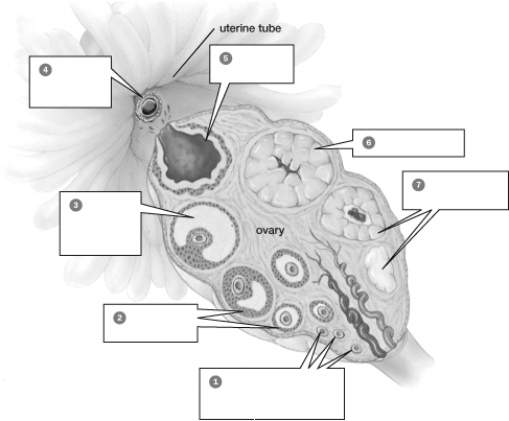 -To take advantage of ecotourism, a resort is built near a coral reef so that tourists can observe the spawning that occurs shortly after a full moon. As an added benefit, several species of colorful fishes are attracted to the area. Tour boats go out nightly and shine large spotlights to attract the fish. Tourists are enchanted by the display of fishes but have begun to question why spawning among the corals has ceased. What is the probable cause for the lack of spawning?
 (Multiple Choice)
4.8/5 (73)
(73) During the first half of the menstrual cycle, GnRH stimulates the release of FSH, which stimulates the growth of follicle cells to secrete increasing levels of , which then stimulates the release of more GnRH, creating a positive feedback loop.
(Short Answer)
5.0/5 (69)
(69) Why are the secretions of the seminal vesicles, prostate glands, and bulbourethral glands necessary for successful reproduction?
(Essay)
4.7/5 (69)
(69) Other than abstinence and sterilization, the most effective method of contraception is the
(Multiple Choice)
4.7/5 (76)
(76) Brittle stars can regrow a new arm if an existing one is broken off. This is an example of
(Multiple Choice)
4.9/5 (92)
(92) 
Filters
- Essay(0)
- Multiple Choice(0)
- Short Answer(0)
- True False(0)
- Matching(0)