



 Chat with AI
Exam 26: Animal Behavior

Exam 1: An Introduction to Life on Earth85 Questions
Exam 2: Atoms, Molecules, and Life90 Questions
Exam 3: Biological Molecules98 Questions
Exam 4: Cell Structure and Function90 Questions
Exam 5: Cell Membrane Structure and Function95 Questions
Exam 6: Energy Flow in the Life of a Cell90 Questions
Exam 7: Capturing Solar Energy: Photosynthesis102 Questions
Exam 8: Harvesting Energy: Glycolysis and Cellular Respiration97 Questions
Exam 9: Cellular Reproduction133 Questions
Exam 10: Meiosis: the Basis of Sexual Reproduction103 Questions
Exam 11: Patterns of Inheritance98 Questions
Exam 12: Dna: the Molecule of Heredity97 Questions
Exam 13: Gene Expression and Regulation93 Questions
Exam 14: Biotechnology91 Questions
Exam 15: Principles of Evolution97 Questions
Exam 16: How Populations Evolve109 Questions
Exam 17: The Origin of Species89 Questions
Exam 18: The History of Life125 Questions
Exam 19: Systematics: Seeking Order Amid Diversity90 Questions
Exam 20: The Diversity of Prokaryotes and Viruses97 Questions
Exam 21: The Diversity of Protists102 Questions
Exam 22: The Diversity of Plants115 Questions
Exam 23: The Diversity of Fungi107 Questions
Exam 24: Animal Diversity I: Invertebrates101 Questions
Exam 25: Animal Diversity II: Vertebrates118 Questions
Exam 26: Animal Behavior116 Questions
Exam 27: Population Growth and Regulation114 Questions
Exam 28: Community Interactions125 Questions
Exam 29: Energy Flow and Nutrient Cycling in Ecosystems122 Questions
Exam 30: Earths Diverse Ecosystems126 Questions
Exam 31: Conserving Earths Biodiversity109 Questions
Exam 32: Homeostasis and the Organization of the Animal Body95 Questions
Exam 33: Circulation89 Questions
Exam 34: Respiration92 Questions
Exam 35: Nutrition and Digestion91 Questions
Exam 36: The Urinary System99 Questions
Exam 37: Defenses Against Disease104 Questions
Exam 38: Chemical Control of the Animal Body: the Endocrine System133 Questions
Exam 39: The Nervous System118 Questions
Exam 40: The Senses94 Questions
Exam 41: Action and Support: the Muscles and Skeleton90 Questions
Exam 42: Animal Reproduction120 Questions
Exam 43: Animal Development122 Questions
Exam 44: Plant Anatomy and Nutrient Transport95 Questions
Exam 45: Plant Reproduction and Development90 Questions
Exam 46: Plant Responses to the Environment87 Questions
Select questions type


The ability to make changes in behavior based on experience is called _ .

Free
(Short Answer)
4.8/5  (87)
(87) Correct Answer: Verified
learning
Wolves are social animals that behave and communicate with each other through a variety of body movements. If a wolf who is initially aggressive as he moves through the pack encounters a more dominant individual, his behavior shifts. Which of the postures shown does he assume? 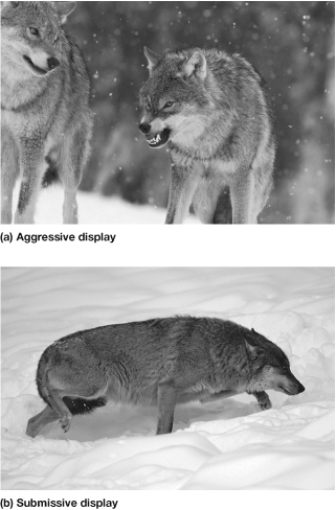
Free
(Multiple Choice)
4.7/5 (83)
(83) Correct Answer:Verified
VerifiedB
What is operant conditioning?
Free
(Essay)
4.7/5 (69)
(69) Correct Answer:Verified
VerifiedOperant conditioning is the process by which animals learn to perform a behavior to receive a reward or avoid punishment. Operant conditioning is also known as trial- and- error learning.
Baby ducks can be taught to behave as though a human investigator was their mother by providing the appropriate stimulus during a sensitive period. This form of learning is called
(Multiple Choice)
4.8/5 (75)
(75) Failure to respond to harmless, repetitive stimulation is an example of
(Multiple Choice)
4.8/5 (91)
(91) At the start of the breeding season, male stickleback fish undergo a number of significant changes. Their bellies become bright red and they become aggressive toward other males of the species, establishing and defending territories in which they build their nests. Although most male- male encounters consist solely of the resident lunging at an intruder, if this fails to drive off the intruder, the resident may bite. Females choose to mate with males that have large territories and well- constructed nests. What would you expect to happen as nest sites become scarcer?
(Multiple Choice)
4.8/5 (81)
(81) When you first move to a city, you can hardly sleep because of the nighttime traffic noise. Within a week, you don't notice it at all. This is an example of _ .
(Short Answer)
4.9/5 (84)
(84) Trial- and- error learning can be important in the development of a behavior.
(True/False)
4.9/5 (68)
(68) In a classic experiment from the 1930s, a biologist conducted selective breeding experiments involving maze- running behavior in rats. He repeatedly bred together males and females that made the fewest mistakes, and he also bred together males and females that made the most mistakes. After eight generations, all mice that descended from "maze- smart" parents were better at running the maze than all mice that descended from "maze- dumb" parents. This study indicates that
(Multiple Choice)
4.8/5 (59)
(59) Two cats getting ready to fight puff up their fur to make themselves look larger. This is an example of
(Multiple Choice)
4.8/5 (70)
(70) A newly hatched duck adopts the first large, moving object it sees as its mother. This is an example of _.
(Short Answer)
4.8/5 (78)
(78) When walking your male dog, you notice that he urinates on every vertical object in his path. His urine is used to "mark" his territory and serves as a chemical signal to other dogs. What does the urine contain?
(Multiple Choice)
4.9/5 (81)
(81) When a 1- month- old baby is shown a piece of white paper with two dark, eye- sized spots, the baby will
(Multiple Choice)
4.8/5 (81)
(81) A bird flashing white patches underneath its wings is an example of what type of communication?
(Multiple Choice)
4.7/5 (69)
(69) Which communication method is most effective over short distances?
(Multiple Choice)
4.7/5 (82)
(82) 
Filters
- Essay(0)
- Multiple Choice(0)
- Short Answer(0)
- True False(0)
- Matching(0)