



 Chat with AI
Exam 39: The Nervous System

Exam 1: An Introduction to Life on Earth85 Questions
Exam 2: Atoms, Molecules, and Life90 Questions
Exam 3: Biological Molecules98 Questions
Exam 4: Cell Structure and Function90 Questions
Exam 5: Cell Membrane Structure and Function95 Questions
Exam 6: Energy Flow in the Life of a Cell90 Questions
Exam 7: Capturing Solar Energy: Photosynthesis102 Questions
Exam 8: Harvesting Energy: Glycolysis and Cellular Respiration97 Questions
Exam 9: Cellular Reproduction133 Questions
Exam 10: Meiosis: the Basis of Sexual Reproduction103 Questions
Exam 11: Patterns of Inheritance98 Questions
Exam 12: Dna: the Molecule of Heredity97 Questions
Exam 13: Gene Expression and Regulation93 Questions
Exam 14: Biotechnology91 Questions
Exam 15: Principles of Evolution97 Questions
Exam 16: How Populations Evolve109 Questions
Exam 17: The Origin of Species89 Questions
Exam 18: The History of Life125 Questions
Exam 19: Systematics: Seeking Order Amid Diversity90 Questions
Exam 20: The Diversity of Prokaryotes and Viruses97 Questions
Exam 21: The Diversity of Protists102 Questions
Exam 22: The Diversity of Plants115 Questions
Exam 23: The Diversity of Fungi107 Questions
Exam 24: Animal Diversity I: Invertebrates101 Questions
Exam 25: Animal Diversity II: Vertebrates118 Questions
Exam 26: Animal Behavior116 Questions
Exam 27: Population Growth and Regulation114 Questions
Exam 28: Community Interactions125 Questions
Exam 29: Energy Flow and Nutrient Cycling in Ecosystems122 Questions
Exam 30: Earths Diverse Ecosystems126 Questions
Exam 31: Conserving Earths Biodiversity109 Questions
Exam 32: Homeostasis and the Organization of the Animal Body95 Questions
Exam 33: Circulation89 Questions
Exam 34: Respiration92 Questions
Exam 35: Nutrition and Digestion91 Questions
Exam 36: The Urinary System99 Questions
Exam 37: Defenses Against Disease104 Questions
Exam 38: Chemical Control of the Animal Body: the Endocrine System133 Questions
Exam 39: The Nervous System118 Questions
Exam 40: The Senses94 Questions
Exam 41: Action and Support: the Muscles and Skeleton90 Questions
Exam 42: Animal Reproduction120 Questions
Exam 43: Animal Development122 Questions
Exam 44: Plant Anatomy and Nutrient Transport95 Questions
Exam 45: Plant Reproduction and Development90 Questions
Exam 46: Plant Responses to the Environment87 Questions
Select questions type


Emotions and the responses to emotions are controlled by the limbic system.
(True/False)
4.8/5  (80)
(80) At a chemical synapse, the presynaptic and postsynaptic neurons touch and chemicals are exchanged through gap junctions.
(True/False)
4.8/5 (77)
(77) A neuron's resting potential is due in large part to the diffusion of K+ ions out of the cell, leaving the negatively charged DNA and proteins inside the cell.
(True/False)
4.9/5 (93)
(93) What happens when the resting potential reaches threshold voltage?
(Multiple Choice)
4.8/5 (82)
(82) Nicotine affects neurotransmission by causing more action potentials in the presynaptic neuron and by causing more neurotransmitter to be released per vesicle. This means your postsynaptic neurons
(Multiple Choice)
4.9/5 (81)
(81) Glutamate is the major excitatory neurotransmitter in the brain. Which drug produces a relaxing effect by blocking the receptors for glutamate?
(Multiple Choice)
4.9/5 (87)
(87) In an unstimulated neuron, the plasma membrane is most permeable to ions.
(Multiple Choice)
5.0/5 (65)
(65) When you hear a loud noise, you immediately turn your head and direct your eyes toward the sound. Which region of the brain directs this reflexive movement of your eyes?
(Multiple Choice)
4.9/5 (92)
(92) transmit signals from the central nervous system to the effector organs.
(Short Answer)
4.9/5 (87)
(87) Neurons receive, process, and transmit information; however, they cannot function without glia. What are glia, and how do they affect neuronal functioning?
(Essay)
4.9/5 (86)
(86) Which region of the brain is responsible for the intricate coordination of finger movements involved in playing the piano?
(Multiple Choice)
4.8/5 (71)
(71) The resting potential of an unstimulated neuron is between _ millivolts (mV).
(Multiple Choice)
5.0/5 (64)
(64) A(n) postsynaptic potential is initiated when neurotransmitter binding to receptor proteins causes the postsynaptic neuron to become less negative.
(Short Answer)
4.9/5 (85)
(85) 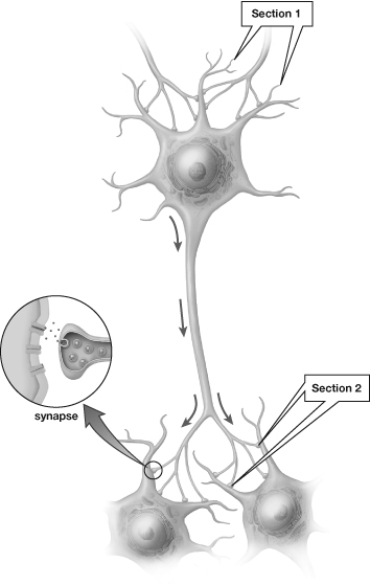 -Marta has been having terrible headaches. Now her hand feels like it is being gripped even though it is not actually being touched. She's also having a hard time interpreting sensations. For example, she blistered her hand on a hot pan because she interpreted the heat sensation as cold. Which portion of Marta's brain is most likely damaged?
 (Multiple Choice)
4.9/5 (90)
(90) Which portion of the brain is responsible for primitive emotions such as fear, rage, and sexual desire?
(Multiple Choice)
4.9/5 (86)
(86) 
Filters
- Essay(0)
- Multiple Choice(0)
- Short Answer(0)
- True False(0)
- Matching(0)