



 Chat with AI
Exam 2: Thinking Like an Economist

Exam 1: Ten Principles of Economics455 Questions
Exam 2: Thinking Like an Economist643 Questions
Exam 3: Interdependence and the Gains From Trade547 Questions
Exam 4: The Market Forces of Supply and Demand693 Questions
Exam 5: Elasticity and Its Application626 Questions
Exam 6: Supply, Demand, and Government Policies668 Questions
Exam 7: Consumers, Producers, and the Efficiency of Markets547 Questions
Exam 8: Applications: the Costs of Taxation509 Questions
Exam 9: Application: International Trade521 Questions
Exam 10: Externalities543 Questions
Exam 11: Public Goods and Common Resources452 Questions
Exam 12: The Design of the Tax System664 Questions
Exam 13: The Costs of Production649 Questions
Exam 14: Firms in Competitive Markets604 Questions
Exam 15: Monopoly662 Questions
Exam 16: Monopolistic Competition649 Questions
Exam 17: Oligopoly522 Questions
Exam 18: The Markets for the Factors of Production592 Questions
Exam 19: Earnings and Discrimination511 Questions
Exam 20: Income Inequality and Poverty478 Questions
Exam 21: The Theory of Consumer Choice570 Questions
Exam 22: Frontiers in Microeconomics461 Questions
Exam 23: Measuring a Nation S Income547 Questions
Exam 24: Measuring the Cost of Living565 Questions
Exam 25: Production and Growth527 Questions
Exam 26: Saving, Investment, and the Financial System637 Questions
Exam 27: Tools of Finance534 Questions
Exam 28: Unemployment and Its Natural Rate701 Questions
Exam 29: The Monetary System540 Questions
Exam 30: Money Growth and Inflation504 Questions
Exam 31: Open-Economy Macroeconomics: Basic Concepts540 Questions
Exam 32: A Macroeconomic Theory of the Open Economy511 Questions
Exam 33: Aggregate Demand and Aggregate Supply572 Questions
Exam 34: The Influence of Monetary and Fiscal Policy on Aggregate Demand523 Questions
Exam 35: The Short-Run Tradeoff Between Inflation and Unemployment536 Questions
Exam 36: Six Debates Over Macroeconomic Policy354 Questions
Select questions type


The slope of a line that passes through the points (20, 30) and (40, 14) is
(Multiple Choice)
4.8/5  (73)
(73) Figure 2-14  -Refer to Figure 2-14. The opportunity cost of moving from point B to point D is 15 doghouses.
 (True/False)
4.9/5 (80)
(80) An economic outcome is said to be efficient if the economy is
(Multiple Choice)
4.9/5 (76)
(76) The production possibilities frontier provides an illustration of the principle that
(Multiple Choice)
4.8/5 (80)
(80) Which of the following is an example of a positive, as opposed to normative, statement?
(Multiple Choice)
4.9/5 (78)
(78) Figure 2-14
-Refer to Figure 2-14. The opportunity cost of an additional doghouse increases as more doghouses are produced.
-Refer to Figure 2-14. The opportunity cost of an additional doghouse increases as more doghouses are produced. (True/False)
4.8/5 (82)
(82) Some, but not all, government economists are employed within the administrative branch of government. Which of the following government agencies employs economists outside of the administrative branch?
(Multiple Choice)
4.9/5 (80)
(80) When constructing a production possibilities frontier, which of the following assumptions is not made?
(Multiple Choice)
4.9/5 (80)
(80) Which of the following is not correct about most economic models?
(Multiple Choice)
4.8/5 (87)
(87) President Truman once said he wanted to find a one-armed economist because when he asked his economists for advice, they always answered, "On the one hand, ... On the other hand, ..." Truman's observation that economists' advice is not always straightforward
(Multiple Choice)
4.7/5 (73)
(73) Figure 2-17 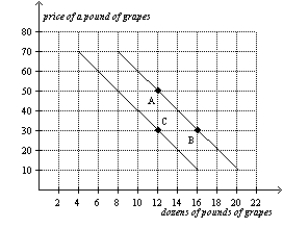 -Refer to Figure 2-17. The movement from point A to point B is a(n)
 (Multiple Choice)
4.8/5 (66)
(66) Figure 2-2 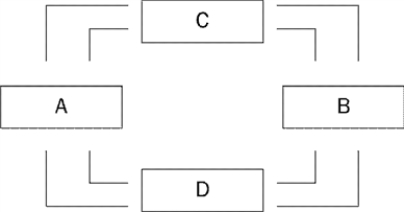 -Refer to Figure 2-2. Boxes C and D of this circular-flow diagram represent
 (Multiple Choice)
4.9/5 (75)
(75) One difference between a hypothetical benevolent king implementing the best policy and the president implementing the best policy in the real world is the president has to be concerned about
(Multiple Choice)
4.9/5 (86)
(86) 
Filters
- Essay(0)
- Multiple Choice(0)
- Short Answer(0)
- True False(0)
- Matching(0)