



 Chat with AI
Exam 2: Thinking Like an Economist

Exam 1: Ten Principles of Economics455 Questions
Exam 2: Thinking Like an Economist643 Questions
Exam 3: Interdependence and the Gains From Trade547 Questions
Exam 4: The Market Forces of Supply and Demand693 Questions
Exam 5: Elasticity and Its Application626 Questions
Exam 6: Supply, Demand, and Government Policies668 Questions
Exam 7: Consumers, Producers, and the Efficiency of Markets547 Questions
Exam 8: Applications: the Costs of Taxation509 Questions
Exam 9: Application: International Trade521 Questions
Exam 10: Externalities543 Questions
Exam 11: Public Goods and Common Resources452 Questions
Exam 12: The Design of the Tax System664 Questions
Exam 13: The Costs of Production649 Questions
Exam 14: Firms in Competitive Markets604 Questions
Exam 15: Monopoly662 Questions
Exam 16: Monopolistic Competition649 Questions
Exam 17: Oligopoly522 Questions
Exam 18: The Markets for the Factors of Production592 Questions
Exam 19: Earnings and Discrimination511 Questions
Exam 20: Income Inequality and Poverty478 Questions
Exam 21: The Theory of Consumer Choice570 Questions
Exam 22: Frontiers in Microeconomics461 Questions
Exam 23: Measuring a Nation S Income547 Questions
Exam 24: Measuring the Cost of Living565 Questions
Exam 25: Production and Growth527 Questions
Exam 26: Saving, Investment, and the Financial System637 Questions
Exam 27: Tools of Finance534 Questions
Exam 28: Unemployment and Its Natural Rate701 Questions
Exam 29: The Monetary System540 Questions
Exam 30: Money Growth and Inflation504 Questions
Exam 31: Open-Economy Macroeconomics: Basic Concepts540 Questions
Exam 32: A Macroeconomic Theory of the Open Economy511 Questions
Exam 33: Aggregate Demand and Aggregate Supply572 Questions
Exam 34: The Influence of Monetary and Fiscal Policy on Aggregate Demand523 Questions
Exam 35: The Short-Run Tradeoff Between Inflation and Unemployment536 Questions
Exam 36: Six Debates Over Macroeconomic Policy354 Questions
Select questions type


"Society would be better off if the welfare system were abolished" is a normative statement, not a positive statement.
(True/False)
4.9/5  (77)
(77) Who would be more likely to study the inflation rate in the United States, a macroeconomist or a microeconomist?
(Short Answer)
4.7/5 (75)
(75) There is only one explanation for why economists give conflicting advice on policy issues, and it is that they have different values about what policy should try to accomplish.
(True/False)
4.9/5 (91)
(91) Just like other scientific models, economic models simplify reality using
(Short Answer)
4.8/5 (83)
(83) Production is efficient if the economy is producing at a point
(Multiple Choice)
4.8/5 (59)
(59) When a variable that is not named on either axis of a graph changes, we read the change as a movement along the curve.
(True/False)
4.8/5 (83)
(83) Figure 2-6 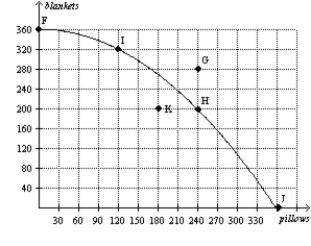 -Refer to Figure 2-6. If this economy moves from point F to point G, then which of the following statements is correct?
 (Multiple Choice)
4.8/5 (82)
(82) Which of the following is a positive, as opposed to a normative, statement?
(Multiple Choice)
4.8/5 (76)
(76) Figure 2-16  -Refer to Figure 2-16. The opportunity cost of obtaining approximately 20 additional gadgets by moving from point B to point C is
 (Multiple Choice)
4.9/5 (82)
(82) Figure 2-2 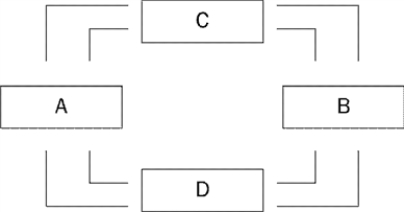 -Refer to Figure 2-2. If the outer loop of this circular-flow diagram represents flows of dollars, then the inner loop includes
 (Multiple Choice)
5.0/5 (70)
(70) "Prices rise when the quantity of money rises rapidly" is an example of a
(Multiple Choice)
4.9/5 (82)
(82) Figure 2-22 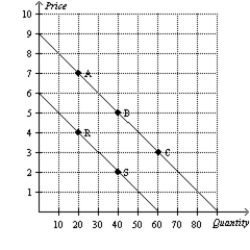 -Refer to Figure 2-22. What is the slope of the line with points A, B, and C?
 (Short Answer)
4.9/5 (82)
(82) Table 2-5 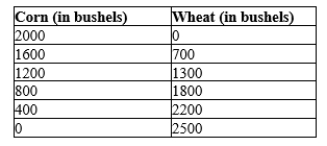 -Refer to Table 2-5. Table 2-5 shows one set of production possibilities. Which of the following statements is correct?
 (Multiple Choice)
4.9/5 (82)
(82) Figure 2-5  -Refer to Figure 2-5. Suppose this economy is producing at point D. Which of the following statements would best explain this situation?
 (Multiple Choice)
4.9/5 (73)
(73) If a major union goes on strike, then the country would be operating inside its production possibilities frontier.
(True/False)
5.0/5 (61)
(61) Who would be more likely to study the effects of government spending on the unemployment rate, a macroeconomist or a microeconomist?
(Short Answer)
4.9/5 (74)
(74) While the production possibilities frontier is a useful model, it cannot be used to illustrate economic growth.
(True/False)
4.9/5 (77)
(77) Which of the following statements applies to economics, as well as to other sciences such as physics?
(Multiple Choice)
4.8/5 (70)
(70) 
Filters
- Essay(0)
- Multiple Choice(0)
- Short Answer(0)
- True False(0)
- Matching(0)