



 Chat with AI
Exam 2: Thinking Like an Economist

Exam 1: Ten Principles of Economics455 Questions
Exam 2: Thinking Like an Economist643 Questions
Exam 3: Interdependence and the Gains From Trade547 Questions
Exam 4: The Market Forces of Supply and Demand693 Questions
Exam 5: Elasticity and Its Application626 Questions
Exam 6: Supply, Demand, and Government Policies668 Questions
Exam 7: Consumers, Producers, and the Efficiency of Markets547 Questions
Exam 8: Applications: the Costs of Taxation509 Questions
Exam 9: Application: International Trade521 Questions
Exam 10: Externalities543 Questions
Exam 11: Public Goods and Common Resources452 Questions
Exam 12: The Design of the Tax System664 Questions
Exam 13: The Costs of Production649 Questions
Exam 14: Firms in Competitive Markets604 Questions
Exam 15: Monopoly662 Questions
Exam 16: Monopolistic Competition649 Questions
Exam 17: Oligopoly522 Questions
Exam 18: The Markets for the Factors of Production592 Questions
Exam 19: Earnings and Discrimination511 Questions
Exam 20: Income Inequality and Poverty478 Questions
Exam 21: The Theory of Consumer Choice570 Questions
Exam 22: Frontiers in Microeconomics461 Questions
Exam 23: Measuring a Nation S Income547 Questions
Exam 24: Measuring the Cost of Living565 Questions
Exam 25: Production and Growth527 Questions
Exam 26: Saving, Investment, and the Financial System637 Questions
Exam 27: Tools of Finance534 Questions
Exam 28: Unemployment and Its Natural Rate701 Questions
Exam 29: The Monetary System540 Questions
Exam 30: Money Growth and Inflation504 Questions
Exam 31: Open-Economy Macroeconomics: Basic Concepts540 Questions
Exam 32: A Macroeconomic Theory of the Open Economy511 Questions
Exam 33: Aggregate Demand and Aggregate Supply572 Questions
Exam 34: The Influence of Monetary and Fiscal Policy on Aggregate Demand523 Questions
Exam 35: The Short-Run Tradeoff Between Inflation and Unemployment536 Questions
Exam 36: Six Debates Over Macroeconomic Policy354 Questions
Select questions type


Deciding that A causes B when in fact B causes A is a mistake called omitted variable bias.
(True/False)
4.8/5  (79)
(79) President Ronald Reagan once joked that a Trivial Pursuit game designed for economists would
(Multiple Choice)
4.9/5 (87)
(87) Evaluating normative statements involves values as well as facts.
(True/False)
4.8/5 (78)
(78) Figure 2-16 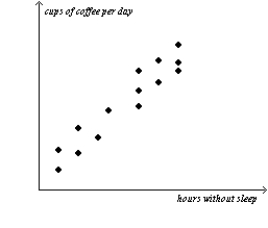 -Refer to Figure 2-16. The graph shown is known as a
 (Multiple Choice)
4.9/5 (87)
(87) Figure 2-15 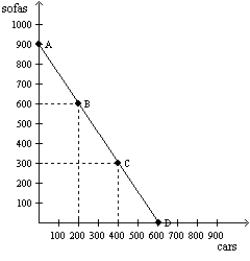 -Refer to Figure 2-15. Consider the production possibilities frontier for an economy that produces only sofas and cars. As the economy moves from point A to point D, is the opportunity cost of cars increasing, constant, or decreasing?
 (Short Answer)
4.8/5 (69)
(69) Figure 2-16
-Refer to Figure 2-16. Cups of coffee per day and the hours that someone can go without sleep appear to have
-Refer to Figure 2-16. Cups of coffee per day and the hours that someone can go without sleep appear to have (Multiple Choice)
4.8/5 (83)
(83) The circular flow model is not used anymore because it fails to perfectly replicate real world situations.
(True/False)
4.7/5 (72)
(72) Which of the following is an example of a normative, as opposed to positive, statement?
(Multiple Choice)
4.8/5 (63)
(63) The president of the United States receives tax policy advice from economists in the
(Multiple Choice)
4.9/5 (84)
(84) In the circular-flow diagram, which of the following items flows from households to firms through the markets for goods and services?
(Multiple Choice)
4.8/5 (70)
(70) The opportunity cost of something is what you give up to get it.
(True/False)
4.9/5 (75)
(75) Figure 2-17 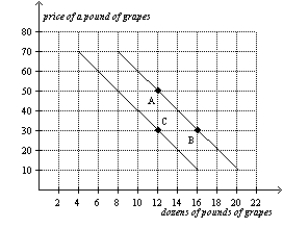 -Refer to Figure 2-17. The slope of the curve between points A and B is
 (Multiple Choice)
4.9/5 (76)
(76) Table 2-3
Production Possibilities for Footville 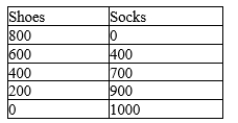 -Refer to Table 2-3. Which of the following statements is correct?
 (Multiple Choice)
4.9/5 (87)
(87) In the circular-flow diagram, which of the following items represents a payment for a factor of production?
(Multiple Choice)
4.9/5 (90)
(90) Figure 2-1  -Refer to Figure 2-1. Raymond buys a refrigerator for his new home. To which of the arrows does this transaction directly contribute?
 (Multiple Choice)
4.8/5 (78)
(78) 
Filters
- Essay(0)
- Multiple Choice(0)
- Short Answer(0)
- True False(0)
- Matching(0)