



 Chat with AI
Exam 2: Thinking Like an Economist

Exam 1: Ten Principles of Economics455 Questions
Exam 2: Thinking Like an Economist643 Questions
Exam 3: Interdependence and the Gains From Trade547 Questions
Exam 4: The Market Forces of Supply and Demand693 Questions
Exam 5: Elasticity and Its Application626 Questions
Exam 6: Supply, Demand, and Government Policies668 Questions
Exam 7: Consumers, Producers, and the Efficiency of Markets547 Questions
Exam 8: Applications: the Costs of Taxation509 Questions
Exam 9: Application: International Trade521 Questions
Exam 10: Externalities543 Questions
Exam 11: Public Goods and Common Resources452 Questions
Exam 12: The Design of the Tax System664 Questions
Exam 13: The Costs of Production649 Questions
Exam 14: Firms in Competitive Markets604 Questions
Exam 15: Monopoly662 Questions
Exam 16: Monopolistic Competition649 Questions
Exam 17: Oligopoly522 Questions
Exam 18: The Markets for the Factors of Production592 Questions
Exam 19: Earnings and Discrimination511 Questions
Exam 20: Income Inequality and Poverty478 Questions
Exam 21: The Theory of Consumer Choice570 Questions
Exam 22: Frontiers in Microeconomics461 Questions
Exam 23: Measuring a Nation S Income547 Questions
Exam 24: Measuring the Cost of Living565 Questions
Exam 25: Production and Growth527 Questions
Exam 26: Saving, Investment, and the Financial System637 Questions
Exam 27: Tools of Finance534 Questions
Exam 28: Unemployment and Its Natural Rate701 Questions
Exam 29: The Monetary System540 Questions
Exam 30: Money Growth and Inflation504 Questions
Exam 31: Open-Economy Macroeconomics: Basic Concepts540 Questions
Exam 32: A Macroeconomic Theory of the Open Economy511 Questions
Exam 33: Aggregate Demand and Aggregate Supply572 Questions
Exam 34: The Influence of Monetary and Fiscal Policy on Aggregate Demand523 Questions
Exam 35: The Short-Run Tradeoff Between Inflation and Unemployment536 Questions
Exam 36: Six Debates Over Macroeconomic Policy354 Questions
Select questions type


Suppose an economist develops a theory that higher food prices arise from higher gas prices. According to the scientific method, which of the following is the economist's next step?
(Multiple Choice)
4.8/5  (70)
(70) Figure 2-18
Relationship between Price and Restaurant Meals 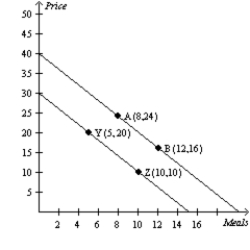 -Refer to Figure 2-18. The slope of the line containing points A and B is
 (Multiple Choice)
4.9/5 (77)
(77) Figure 2-15 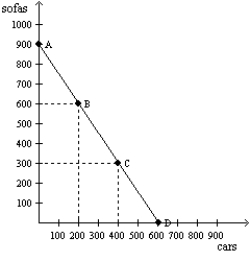 -Refer to Figure 2-15. Consider the production possibilities frontier for an economy that produces only sofas and cars. When society moves from point A to point B,
 (Multiple Choice)
5.0/5 (81)
(81) Figure 2-4  -Refer to Figure 2-4. This economy has the ability to produce at which point(s)?
 (Multiple Choice)
4.8/5 (75)
(75) As a substitute for laboratory experiments, economists use evidence available through history's
(Short Answer)
4.8/5 (88)
(88) Figure 2-16  -Refer to Figure 2-16. It is not possible for this economy to produce at point
 (Multiple Choice)
4.9/5 (78)
(78) The slope of a line that passes through the points (5, 8) and (12, 12) is
(Multiple Choice)
4.7/5 (78)
(78) If new government regulations designed to protect wetlands remove very productive farmland from production, then the production possibilities frontier will shift inward.
(True/False)
4.8/5 (78)
(78) A positive economic statement such as "Pollution taxes decrease the quantity of pollution firms generate"
(Multiple Choice)
4.7/5 (70)
(70) When two variables move in opposite directions, the curve relating them is
(Multiple Choice)
5.0/5 (75)
(75) Suppose a nation is currently producing at a point inside its production possibilities frontier. We know that
(Multiple Choice)
4.9/5 (83)
(83) Figure 2-18
Relationship between Price and Restaurant Meals
-Refer to Figure 2-18. A movement from point A to point B is called
-Refer to Figure 2-18. A movement from point A to point B is called (Multiple Choice)
4.8/5 (78)
(78) Figure 2-3 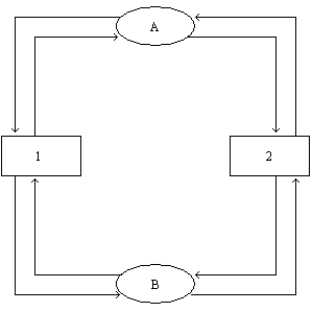 -Refer to Figure 2-3. Which of the following is an activity undertaken by the actors in rectangle 2?
 (Multiple Choice)
4.8/5 (85)
(85) Figure 2-13 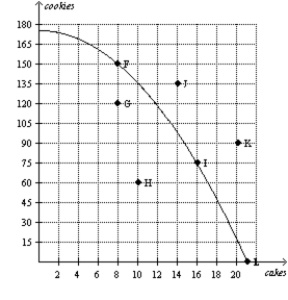 -Refer to Figure 2-13. Which of the following statements is true about point G for this economy?
 (Multiple Choice)
4.8/5 (81)
(81) Figure 2-8 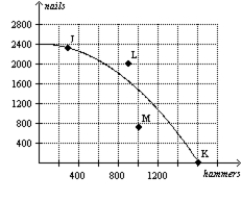 -Refer to Figure 2-8. For this economy, as more and more hammers are produced, the opportunity cost of an additional hammer produced, in terms of nails,
 (Multiple Choice)
4.8/5 (88)
(88) The trade-off between the production of one good and the production of another good can change over time because of technological advances.
(True/False)
4.9/5 (97)
(97) Figure 2-9
Panel (a)
Panel (b) 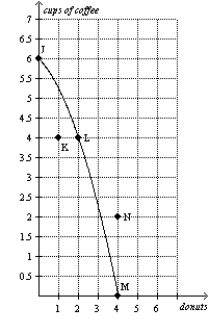
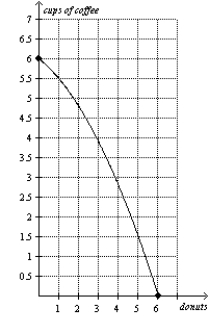 -Refer to Figure 2-9, Panel (a) and Panel (b). Which of the following is not a result of the shift of the economy's production possibilities frontier from Panel (a) to Panel (b)?
 (Multiple Choice)
4.8/5 (90)
(90) 
Filters
- Essay(0)
- Multiple Choice(0)
- Short Answer(0)
- True False(0)
- Matching(0)