



 Chat with AI
Exam 2: Thinking Like an Economist

Exam 1: Ten Principles of Economics455 Questions
Exam 2: Thinking Like an Economist643 Questions
Exam 3: Interdependence and the Gains From Trade547 Questions
Exam 4: The Market Forces of Supply and Demand693 Questions
Exam 5: Elasticity and Its Application626 Questions
Exam 6: Supply, Demand, and Government Policies668 Questions
Exam 7: Consumers, Producers, and the Efficiency of Markets547 Questions
Exam 8: Applications: the Costs of Taxation509 Questions
Exam 9: Application: International Trade521 Questions
Exam 10: Externalities543 Questions
Exam 11: Public Goods and Common Resources452 Questions
Exam 12: The Design of the Tax System664 Questions
Exam 13: The Costs of Production649 Questions
Exam 14: Firms in Competitive Markets604 Questions
Exam 15: Monopoly662 Questions
Exam 16: Monopolistic Competition649 Questions
Exam 17: Oligopoly522 Questions
Exam 18: The Markets for the Factors of Production592 Questions
Exam 19: Earnings and Discrimination511 Questions
Exam 20: Income Inequality and Poverty478 Questions
Exam 21: The Theory of Consumer Choice570 Questions
Exam 22: Frontiers in Microeconomics461 Questions
Exam 23: Measuring a Nation S Income547 Questions
Exam 24: Measuring the Cost of Living565 Questions
Exam 25: Production and Growth527 Questions
Exam 26: Saving, Investment, and the Financial System637 Questions
Exam 27: Tools of Finance534 Questions
Exam 28: Unemployment and Its Natural Rate701 Questions
Exam 29: The Monetary System540 Questions
Exam 30: Money Growth and Inflation504 Questions
Exam 31: Open-Economy Macroeconomics: Basic Concepts540 Questions
Exam 32: A Macroeconomic Theory of the Open Economy511 Questions
Exam 33: Aggregate Demand and Aggregate Supply572 Questions
Exam 34: The Influence of Monetary and Fiscal Policy on Aggregate Demand523 Questions
Exam 35: The Short-Run Tradeoff Between Inflation and Unemployment536 Questions
Exam 36: Six Debates Over Macroeconomic Policy354 Questions
Select questions type


When a production possibilities frontier is bowed outward, the opportunity cost of the second good in terms of the first good increases as more of the second good is produced.
(True/False)
4.8/5  (87)
(87) Figure 2-6 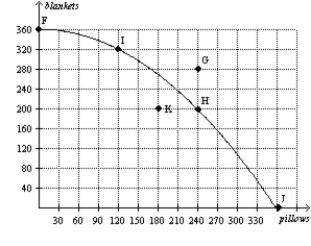 -Refer to Figure 2-6. If this economy devotes all of its resources to the production of blankets, then it will produce
 (Multiple Choice)
4.8/5 (79)
(79) Figure 2-22 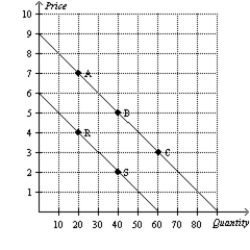 -Refer to Figure 2-22. Is a move from point A to point R considered a shift of the curve or a movement along the curve?
 (Short Answer)
4.8/5 (80)
(80) Congressman Dearmark justified spending $3 million on a new entertainment complex in his district because it will create 450 new jobs for his residents. As a student of economics, you know that
(Multiple Choice)
4.9/5 (89)
(89) Figure 2-16  -Refer to Figure 2-16. Inefficient production is represented by which point(s)?
 (Multiple Choice)
4.8/5 (87)
(87) Table 2-5 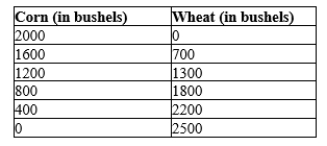 -Refer to Table 2-5. Table 2-5 shows one set of production possibilities. Which of the following combinations of corn and wheat is not currently attainable but would be attainable if there was an improvement in overall production technology?
 (Multiple Choice)
4.8/5 (70)
(70) Economists at the U.S. Department of the Treasury help design U.S. coins and paper money.
(True/False)
4.9/5 (69)
(69) Figure 2-20
Relationship Between Years of Education and Annual Income 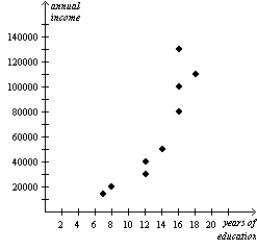 -Refer to Figure 2-20. Senator Smith observes the graph and concludes that people who earn higher incomes attend school for more years. Senator Jones observes the graph and concludes that people who attend school for more years earn higher incomes. Who is correct?
 (Multiple Choice)
5.0/5 (76)
(76) John Maynard Keynes described economics as an easy subject at which very few excel. Which of the following is not one of the reasons Keynes gave for why so few people excel at the study of economics?
(Multiple Choice)
4.8/5 (80)
(80) Figure 2-5  -Refer to Figure 2-5. It is possible for this economy to produce
 (Multiple Choice)
4.7/5 (83)
(83) Figure 2-11 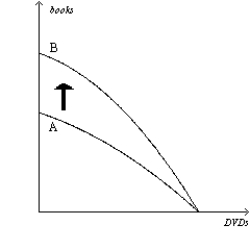 -Refer to Figure 2-11. Which of the following events would explain the shift of the production possibilities frontier from A to B?
 (Multiple Choice)
5.0/5 (79)
(79) Economists believe that production possibilities frontiers rarely have a bowed shape.
(True/False)
5.0/5 (84)
(84) The production possibilities frontier shows the opportunity cost of one good as measured in terms of the other good.
(True/False)
4.7/5 (92)
(92) Figure 2-5
-Refer to Figure 2-5. This economy cannot currently produce 70 washers and 70 dryers because
-Refer to Figure 2-5. This economy cannot currently produce 70 washers and 70 dryers because (Multiple Choice)
5.0/5 (86)
(86) 
Filters
- Essay(0)
- Multiple Choice(0)
- Short Answer(0)
- True False(0)
- Matching(0)