



 Chat with AI
Exam 2: Thinking Like an Economist

Exam 1: Ten Principles of Economics455 Questions
Exam 2: Thinking Like an Economist643 Questions
Exam 3: Interdependence and the Gains From Trade547 Questions
Exam 4: The Market Forces of Supply and Demand693 Questions
Exam 5: Elasticity and Its Application626 Questions
Exam 6: Supply, Demand, and Government Policies668 Questions
Exam 7: Consumers, Producers, and the Efficiency of Markets547 Questions
Exam 8: Applications: the Costs of Taxation509 Questions
Exam 9: Application: International Trade521 Questions
Exam 10: Externalities543 Questions
Exam 11: Public Goods and Common Resources452 Questions
Exam 12: The Design of the Tax System664 Questions
Exam 13: The Costs of Production649 Questions
Exam 14: Firms in Competitive Markets604 Questions
Exam 15: Monopoly662 Questions
Exam 16: Monopolistic Competition649 Questions
Exam 17: Oligopoly522 Questions
Exam 18: The Markets for the Factors of Production592 Questions
Exam 19: Earnings and Discrimination511 Questions
Exam 20: Income Inequality and Poverty478 Questions
Exam 21: The Theory of Consumer Choice570 Questions
Exam 22: Frontiers in Microeconomics461 Questions
Exam 23: Measuring a Nation S Income547 Questions
Exam 24: Measuring the Cost of Living565 Questions
Exam 25: Production and Growth527 Questions
Exam 26: Saving, Investment, and the Financial System637 Questions
Exam 27: Tools of Finance534 Questions
Exam 28: Unemployment and Its Natural Rate701 Questions
Exam 29: The Monetary System540 Questions
Exam 30: Money Growth and Inflation504 Questions
Exam 31: Open-Economy Macroeconomics: Basic Concepts540 Questions
Exam 32: A Macroeconomic Theory of the Open Economy511 Questions
Exam 33: Aggregate Demand and Aggregate Supply572 Questions
Exam 34: The Influence of Monetary and Fiscal Policy on Aggregate Demand523 Questions
Exam 35: The Short-Run Tradeoff Between Inflation and Unemployment536 Questions
Exam 36: Six Debates Over Macroeconomic Policy354 Questions
Select questions type


When two variables move in the same direction, the curve relating them is
(Multiple Choice)
4.9/5  (86)
(86) When two variables move in the same direction, the curve relating them is downward sloping, and we say the variables are negatively related.
(True/False)
4.7/5 (66)
(66) Figure 2-9
Panel (a)
Panel (b) 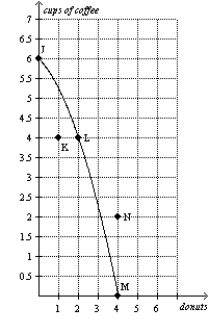
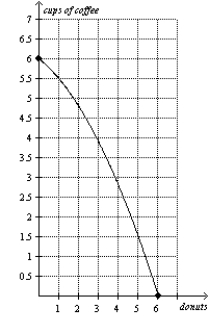 -Refer to Figure 2-9, Panel (a). The movement from point M to point K could be caused by
 (Multiple Choice)
4.8/5 (87)
(87) Suppose an economy produces two goods, food and machines. This economy always operates on its production possibilities frontier. Last year, it produced 1000 units of food and 47 machines. This year, it is producing 1050 units of food and 52 machines. Which of the following events could not explain the increase in output?
(Multiple Choice)
4.9/5 (81)
(81) Yi and Avik are both economists. Yi thinks that taxing consumption, rather than income, would result in higher household saving because income that is saved would not be taxed. Avik does not think that household saving would respond much to a change in the tax laws. In this example, Yi and Avik
(Multiple Choice)
4.8/5 (82)
(82) Economists may disagree about the validity of alternative positive theories about how the world works.
(True/False)
4.8/5 (74)
(74) Different values are not a reason for disagreement among economists.
(True/False)
4.9/5 (91)
(91) Figure 2-2 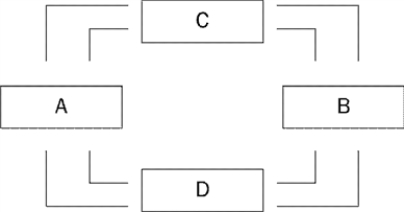 -Refer to Figure 2-2. Boxes A and B of this circular-flow diagram represent
 (Multiple Choice)
4.8/5 (87)
(87) The effects of borrowing by the federal government would be studied by a microeconomist rather than a macroeconomist.
(True/False)
4.8/5 (75)
(75) If an economy can produce more of one good without giving up any of another good, then the economy's current production point is inefficient.
(True/False)
4.9/5 (78)
(78) In the ordered pair (10,30), 10 is the y-coordinate and 30 is the z-coordinate.
(True/False)
4.9/5 (78)
(78) Figure 2-5  -Refer to Figure 2-5. It is not possible for this economy to produce at point
 (Multiple Choice)
4.8/5 (79)
(79) Which of the following statements about models is correct?
(Multiple Choice)
4.9/5 (79)
(79) In the markets for goods and services in the circular flow diagram, households act as
(Short Answer)
5.0/5 (86)
(86) When an economist evaluates a positive statement, he or she is primarily
(Multiple Choice)
4.7/5 (69)
(69) Changes in one variable on a graph might be caused by the other variable on the graph or by a third omitted variable.
(True/False)
4.8/5 (77)
(77) Which of the following is not held constant when looking at an individual's demand curve?
(Multiple Choice)
4.9/5 (81)
(81) Suppose an economist advises a city's mayor to begin charging drivers a fee to drive on a busy highway during congested times. The mayor does not implement the policy because it would not be popular with voters. Which of the following statements best describes the scenario?
(Multiple Choice)
4.8/5 (75)
(75) 
Filters
- Essay(0)
- Multiple Choice(0)
- Short Answer(0)
- True False(0)
- Matching(0)