



 Chat with AI
Exam 2: Thinking Like an Economist

Exam 1: Ten Principles of Economics455 Questions
Exam 2: Thinking Like an Economist643 Questions
Exam 3: Interdependence and the Gains From Trade547 Questions
Exam 4: The Market Forces of Supply and Demand693 Questions
Exam 5: Elasticity and Its Application626 Questions
Exam 6: Supply, Demand, and Government Policies668 Questions
Exam 7: Consumers, Producers, and the Efficiency of Markets547 Questions
Exam 8: Applications: the Costs of Taxation509 Questions
Exam 9: Application: International Trade521 Questions
Exam 10: Externalities543 Questions
Exam 11: Public Goods and Common Resources452 Questions
Exam 12: The Design of the Tax System664 Questions
Exam 13: The Costs of Production649 Questions
Exam 14: Firms in Competitive Markets604 Questions
Exam 15: Monopoly662 Questions
Exam 16: Monopolistic Competition649 Questions
Exam 17: Oligopoly522 Questions
Exam 18: The Markets for the Factors of Production592 Questions
Exam 19: Earnings and Discrimination511 Questions
Exam 20: Income Inequality and Poverty478 Questions
Exam 21: The Theory of Consumer Choice570 Questions
Exam 22: Frontiers in Microeconomics461 Questions
Exam 23: Measuring a Nation S Income547 Questions
Exam 24: Measuring the Cost of Living565 Questions
Exam 25: Production and Growth527 Questions
Exam 26: Saving, Investment, and the Financial System637 Questions
Exam 27: Tools of Finance534 Questions
Exam 28: Unemployment and Its Natural Rate701 Questions
Exam 29: The Monetary System540 Questions
Exam 30: Money Growth and Inflation504 Questions
Exam 31: Open-Economy Macroeconomics: Basic Concepts540 Questions
Exam 32: A Macroeconomic Theory of the Open Economy511 Questions
Exam 33: Aggregate Demand and Aggregate Supply572 Questions
Exam 34: The Influence of Monetary and Fiscal Policy on Aggregate Demand523 Questions
Exam 35: The Short-Run Tradeoff Between Inflation and Unemployment536 Questions
Exam 36: Six Debates Over Macroeconomic Policy354 Questions
Select questions type


Which of the following areas of study typifies microeconomics as opposed to macroeconomics?
(Multiple Choice)
4.8/5  (83)
(83) Production possibilities frontiers are usually bowed outward. This is because
(Multiple Choice)
5.0/5 (87)
(87) In the simple circular flow diagram, the flow of money from the firms to the markets for factors of production is called
(Multiple Choice)
4.9/5 (73)
(73) An example of a price that changes only infrequently is the price of
(Multiple Choice)
4.8/5 (77)
(77) A model that shows how dollars flow through markets among households and firms is called the
(Multiple Choice)
4.9/5 (75)
(75) Economists make use of assumptions, some of which are unrealistic, for the purpose of
(Multiple Choice)
4.9/5 (87)
(87) You know an economist has crossed the line from policy adviser to scientist when he or she
(Multiple Choice)
4.7/5 (68)
(68) A survey of professional economists revealed that more than three-fourths of them agreed with fourteen economic propositions. Which of the following is not one of those propositions?
(Multiple Choice)
4.8/5 (91)
(91) Figure 2-16  -Refer to Figure 2-16. Which of the following statements is true about the opportunity cost of obtaining approximately 20 additional gadgets by moving from point B to point C?
 (Multiple Choice)
4.7/5 (72)
(72) The design of tax policy is one of the responsibilities of economists who work at the
(Multiple Choice)
4.9/5 (80)
(80) Irregular fluctuations in economic activity are known as the
(Multiple Choice)
5.0/5 (82)
(82) In the circular-flow diagram, households and firms are the decision makers.
(True/False)
4.9/5 (77)
(77) Figure 2-2 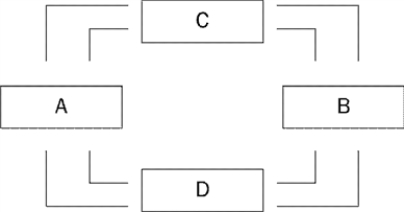 -Refer to Figure 2-2. If the flow of goods and services is part of what is represented by the inner loop of this circular-flow diagram, then
 (Multiple Choice)
4.9/5 (87)
(87) The argument that purchases of minivans cause large families is an example of
(Multiple Choice)
4.9/5 (78)
(78) 
Filters
- Essay(0)
- Multiple Choice(0)
- Short Answer(0)
- True False(0)
- Matching(0)