



 Chat with AI
Exam 2: Thinking Like an Economist

Exam 1: Ten Principles of Economics455 Questions
Exam 2: Thinking Like an Economist643 Questions
Exam 3: Interdependence and the Gains From Trade547 Questions
Exam 4: The Market Forces of Supply and Demand693 Questions
Exam 5: Elasticity and Its Application626 Questions
Exam 6: Supply, Demand, and Government Policies668 Questions
Exam 7: Consumers, Producers, and the Efficiency of Markets547 Questions
Exam 8: Applications: the Costs of Taxation509 Questions
Exam 9: Application: International Trade521 Questions
Exam 10: Externalities543 Questions
Exam 11: Public Goods and Common Resources452 Questions
Exam 12: The Design of the Tax System664 Questions
Exam 13: The Costs of Production649 Questions
Exam 14: Firms in Competitive Markets604 Questions
Exam 15: Monopoly662 Questions
Exam 16: Monopolistic Competition649 Questions
Exam 17: Oligopoly522 Questions
Exam 18: The Markets for the Factors of Production592 Questions
Exam 19: Earnings and Discrimination511 Questions
Exam 20: Income Inequality and Poverty478 Questions
Exam 21: The Theory of Consumer Choice570 Questions
Exam 22: Frontiers in Microeconomics461 Questions
Exam 23: Measuring a Nation S Income547 Questions
Exam 24: Measuring the Cost of Living565 Questions
Exam 25: Production and Growth527 Questions
Exam 26: Saving, Investment, and the Financial System637 Questions
Exam 27: Tools of Finance534 Questions
Exam 28: Unemployment and Its Natural Rate701 Questions
Exam 29: The Monetary System540 Questions
Exam 30: Money Growth and Inflation504 Questions
Exam 31: Open-Economy Macroeconomics: Basic Concepts540 Questions
Exam 32: A Macroeconomic Theory of the Open Economy511 Questions
Exam 33: Aggregate Demand and Aggregate Supply572 Questions
Exam 34: The Influence of Monetary and Fiscal Policy on Aggregate Demand523 Questions
Exam 35: The Short-Run Tradeoff Between Inflation and Unemployment536 Questions
Exam 36: Six Debates Over Macroeconomic Policy354 Questions
Select questions type


Sometimes economists disagree because their scientific judgments differ. Which of the following instances best reflects this source of disagreement?
(Multiple Choice)
4.8/5  (76)
(76) Figure 2-3  -Refer to Figure 2-3. What does the arrow going from oval B to rectangle 2 represent in the figure?
 (Short Answer)
4.8/5 (74)
(74) Most economists agree that a large federal budget deficit has what type of effect on the economy?
(Short Answer)
4.9/5 (76)
(76) Figure 2-2 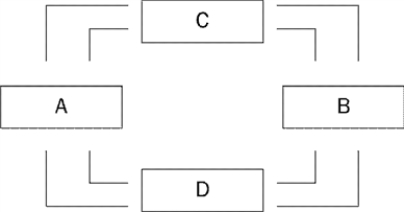 -Refer to Figure 2-2. If the owners of land, labor, and capital are represented by Box B of this circular-flow diagram, then
 (Multiple Choice)
4.8/5 (76)
(76) When a relevant variable that is not named on either axis changes,
(Multiple Choice)
4.9/5 (73)
(73) You know an economist has crossed the line from scientist to policy adviser when he or she
(Multiple Choice)
4.9/5 (89)
(89) Which of the following concepts cannot be illustrated by the production possibilities frontier?
(Multiple Choice)
4.9/5 (89)
(89) Among economic models, the circular-flow diagram is unusual in that it
(Multiple Choice)
4.8/5 (87)
(87) Figure 2-14 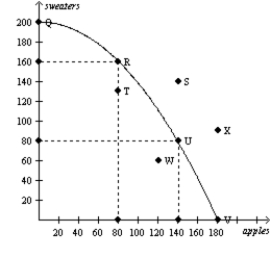 Consider the production possibilities curve for a country that can produce sweaters, apples (in bushels), or a combination of the two.
-Refer to Figure 2-14. Which point(s) on the graph is(are) unattainable given current resources and technology?
Consider the production possibilities curve for a country that can produce sweaters, apples (in bushels), or a combination of the two.
-Refer to Figure 2-14. Which point(s) on the graph is(are) unattainable given current resources and technology? (Short Answer)
4.9/5 (84)
(84) Figure 2-16 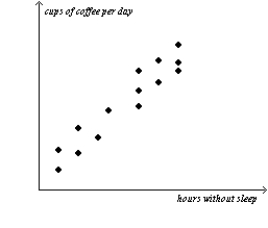 -Refer to Figure 2-16. Taking cause and effect into account, which of the following interpretations would be most reasonable regarding the relationship between coffee and hours without sleep?
 (Multiple Choice)
4.8/5 (89)
(89) Policies such as rent control and trade barriers persist in spite of the fact that economists are virtually united in their opposition to such policies, probably because
(Multiple Choice)
4.8/5 (91)
(91) Which of the following is not an example of a positive, as opposed to normative, statement?
(Multiple Choice)
4.7/5 (81)
(81) Economists, like mathematicians, physicists, and biologists,
(Multiple Choice)
4.9/5 (93)
(93) Figure 2-16  -Refer to Figure 2-16. Efficient production is represented by which point(s)?
 (Multiple Choice)
4.8/5 (82)
(82) Table 2-2
The following table contains some production possibilities for an economy for a given year: 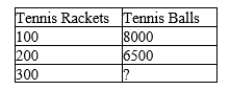 -Refer to Table 2-2. If the production possibilities frontier is bowed outward, then "?" could be
 (Multiple Choice)
4.8/5 (83)
(83) A production point is said to be efficient if there is no way for the economy to produce more of one good without producing less of another.
(True/False)
4.9/5 (78)
(78) 
Filters
- Essay(0)
- Multiple Choice(0)
- Short Answer(0)
- True False(0)
- Matching(0)