



 Chat with AI
Exam 2: Thinking Like an Economist

Exam 1: Ten Principles of Economics455 Questions
Exam 2: Thinking Like an Economist643 Questions
Exam 3: Interdependence and the Gains From Trade547 Questions
Exam 4: The Market Forces of Supply and Demand693 Questions
Exam 5: Elasticity and Its Application626 Questions
Exam 6: Supply, Demand, and Government Policies668 Questions
Exam 7: Consumers, Producers, and the Efficiency of Markets547 Questions
Exam 8: Applications: the Costs of Taxation509 Questions
Exam 9: Application: International Trade521 Questions
Exam 10: Externalities543 Questions
Exam 11: Public Goods and Common Resources452 Questions
Exam 12: The Design of the Tax System664 Questions
Exam 13: The Costs of Production649 Questions
Exam 14: Firms in Competitive Markets604 Questions
Exam 15: Monopoly662 Questions
Exam 16: Monopolistic Competition649 Questions
Exam 17: Oligopoly522 Questions
Exam 18: The Markets for the Factors of Production592 Questions
Exam 19: Earnings and Discrimination511 Questions
Exam 20: Income Inequality and Poverty478 Questions
Exam 21: The Theory of Consumer Choice570 Questions
Exam 22: Frontiers in Microeconomics461 Questions
Exam 23: Measuring a Nation S Income547 Questions
Exam 24: Measuring the Cost of Living565 Questions
Exam 25: Production and Growth527 Questions
Exam 26: Saving, Investment, and the Financial System637 Questions
Exam 27: Tools of Finance534 Questions
Exam 28: Unemployment and Its Natural Rate701 Questions
Exam 29: The Monetary System540 Questions
Exam 30: Money Growth and Inflation504 Questions
Exam 31: Open-Economy Macroeconomics: Basic Concepts540 Questions
Exam 32: A Macroeconomic Theory of the Open Economy511 Questions
Exam 33: Aggregate Demand and Aggregate Supply572 Questions
Exam 34: The Influence of Monetary and Fiscal Policy on Aggregate Demand523 Questions
Exam 35: The Short-Run Tradeoff Between Inflation and Unemployment536 Questions
Exam 36: Six Debates Over Macroeconomic Policy354 Questions
Select questions type


The inner loop of the circular-flow diagram represents the flows of inputs and outputs. Which of the following does not appear on the inner loop?
(Multiple Choice)
4.9/5  (78)
(78) Figure 2-17  -Refer to Figure 2-17. It is possible for this economy to produce 1000 shoes.
 (True/False)
4.8/5 (69)
(69) Figure 2-10
Panel (a)
Panel (b) 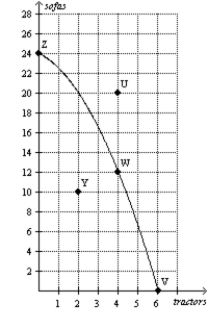
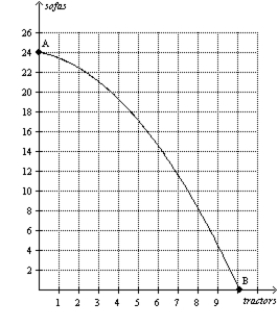 -Refer to Figure 2-10, Panel (a). The opportunity cost of one sofa is highest when the economy produces
 (Multiple Choice)
4.8/5 (68)
(68) Figure 2-7 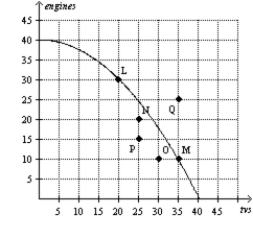 -Refer to Figure 2-7. This economy has the ability to produce at which point(s)?
 (Multiple Choice)
4.9/5 (81)
(81) In the circular-flow diagram, which of the following items does not flow from households to firms?
(Multiple Choice)
4.9/5 (82)
(82) Alfonso has noticed that increases in unemployment insurance claims are associated with recessions, and therefore he advocates limits on unemployment insurance so as to prevent recessions. Mary has noticed that most drug addicts once attended schools, and therefore she advocates getting rid of schools so as to prevent drug addiction.
(Multiple Choice)
4.9/5 (71)
(71) Figure 2-7
-Refer to Figure 2-7. If this economy devotes all of its resources to the production of engines, then it will produce
-Refer to Figure 2-7. If this economy devotes all of its resources to the production of engines, then it will produce (Multiple Choice)
4.9/5 (79)
(79) Table 2-6 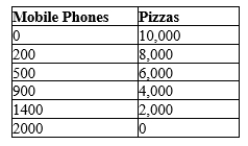 -Refer to Table 2-6. Consider the production possibilities table for an economy that produces only mobile phones and pizzas. What is the opportunity cost of increasing production of pizzas from 4,000 to 6,000?
 (Short Answer)
4.9/5 (90)
(90) In the markets for goods and services in the circular-flow diagram, households are buyers and firms are sellers.
(True/False)
4.7/5 (86)
(86) Which of the following would likely be studied by a microeconomist rather than a macroeconomist?
(Multiple Choice)
4.9/5 (63)
(63) Figure 2-3  -Refer to Figure 2-3. What are two elements not included in this figure that could be included in a more complex model?
 (Short Answer)
4.8/5 (86)
(86) A pie chart is a way to display information regarding two variables.
(True/False)
4.9/5 (74)
(74) It is difficult for economists to make observations and develop theories, but it is easy for economists to run experiments to generate data to test their theories.
(True/False)
4.9/5 (79)
(79) Which of the following is a correct statement about production possibilities frontiers?
(Multiple Choice)
4.7/5 (66)
(66) Figure 2-14 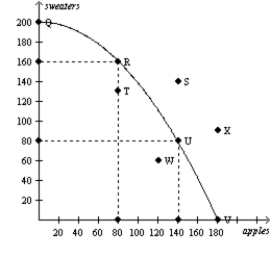 Consider the production possibilities curve for a country that can produce sweaters, apples (in bushels), or a combination of the two
-Refer to Figure 2-14. If this economy devotes all of its available resources to producing apples, then it will produce
Consider the production possibilities curve for a country that can produce sweaters, apples (in bushels), or a combination of the two
-Refer to Figure 2-14. If this economy devotes all of its available resources to producing apples, then it will produce (Multiple Choice)
4.8/5 (82)
(82) Figure 2-14  -Refer to Figure 2-14. When this economy produces 30 doghouses and 25 dishwashers there is full employment.
 (True/False)
4.8/5 (86)
(86) Figure 2-2 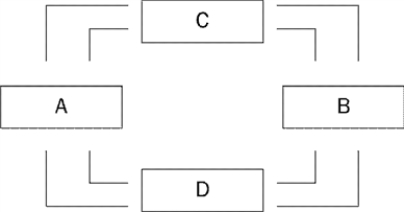 -Refer to Figure 2-2. If households are buyers in the markets represented by Box C of this circular-flow diagram, then
 (Multiple Choice)
4.8/5 (82)
(82) Historical episodes allow economists to illustrate and evaluate current economic theories.
(True/False)
5.0/5 (77)
(77) Which of the following is an example of a normative, as opposed to positive, statement?
(Multiple Choice)
4.9/5 (77)
(77) 
Filters
- Essay(0)
- Multiple Choice(0)
- Short Answer(0)
- True False(0)
- Matching(0)