



 Chat with AI
Exam 2: Thinking Like an Economist

Exam 1: Ten Principles of Economics455 Questions
Exam 2: Thinking Like an Economist643 Questions
Exam 3: Interdependence and the Gains From Trade547 Questions
Exam 4: The Market Forces of Supply and Demand693 Questions
Exam 5: Elasticity and Its Application626 Questions
Exam 6: Supply, Demand, and Government Policies668 Questions
Exam 7: Consumers, Producers, and the Efficiency of Markets547 Questions
Exam 8: Applications: the Costs of Taxation509 Questions
Exam 9: Application: International Trade521 Questions
Exam 10: Externalities543 Questions
Exam 11: Public Goods and Common Resources452 Questions
Exam 12: The Design of the Tax System664 Questions
Exam 13: The Costs of Production649 Questions
Exam 14: Firms in Competitive Markets604 Questions
Exam 15: Monopoly662 Questions
Exam 16: Monopolistic Competition649 Questions
Exam 17: Oligopoly522 Questions
Exam 18: The Markets for the Factors of Production592 Questions
Exam 19: Earnings and Discrimination511 Questions
Exam 20: Income Inequality and Poverty478 Questions
Exam 21: The Theory of Consumer Choice570 Questions
Exam 22: Frontiers in Microeconomics461 Questions
Exam 23: Measuring a Nation S Income547 Questions
Exam 24: Measuring the Cost of Living565 Questions
Exam 25: Production and Growth527 Questions
Exam 26: Saving, Investment, and the Financial System637 Questions
Exam 27: Tools of Finance534 Questions
Exam 28: Unemployment and Its Natural Rate701 Questions
Exam 29: The Monetary System540 Questions
Exam 30: Money Growth and Inflation504 Questions
Exam 31: Open-Economy Macroeconomics: Basic Concepts540 Questions
Exam 32: A Macroeconomic Theory of the Open Economy511 Questions
Exam 33: Aggregate Demand and Aggregate Supply572 Questions
Exam 34: The Influence of Monetary and Fiscal Policy on Aggregate Demand523 Questions
Exam 35: The Short-Run Tradeoff Between Inflation and Unemployment536 Questions
Exam 36: Six Debates Over Macroeconomic Policy354 Questions
Select questions type


The slope of a line passing through the points (15, 3) and (10, 6) is
(Multiple Choice)
4.9/5  (80)
(80) The duties of the Council of Economic Advisers are to advise the president of the United States and to determine U.S. monetary policy.
(True/False)
4.7/5 (78)
(78) Which of the following is not an example of a graph of a single variable?
(Multiple Choice)
4.9/5 (64)
(64) In the markets for goods and services in the circular-flow diagram,
(Multiple Choice)
4.9/5 (81)
(81) Figure 2-11 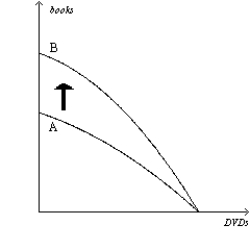 -Refer to Figure 2-11. The shift of the production possibilities frontier from A to B illustrates
 (Multiple Choice)
4.9/5 (83)
(83) Figure 2-22 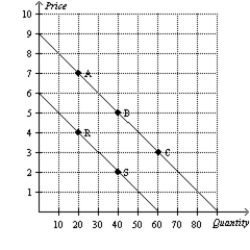 -Refer to Figure 2-22. How are price and quantity related in this graph?
 (Short Answer)
4.9/5 (86)
(86) Table 2-5 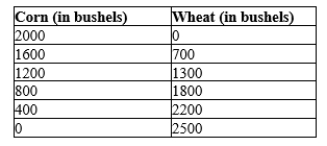 -Refer to Table 2-5. Table 2-5 shows one set of production possibilities. What is the opportunity cost of an increase in the production of wheat from 700 bushels to 1300 bushels?
 (Multiple Choice)
4.9/5 (91)
(91) In the early 19th century, the Russian government sent doctors to southern Russian villages to provide assistance during a cholera epidemic. The villagers noticed that wherever doctors appeared, people died. Therefore, many doctors were chased away from villages, and some were even killed. This reaction to the correlation between doctors and deaths is most likely a problem of
(Multiple Choice)
4.9/5 (79)
(79) For an economist, the idea of making assumptions is regarded generally as a
(Multiple Choice)
4.8/5 (83)
(83) Which of the following is not something that John Maynard Keynes used to describe an economist?
(Multiple Choice)
4.8/5 (76)
(76) Figure 2-8 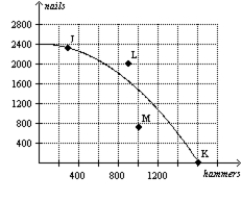 -Refer to Figure 2-8. Which point on the graph best represents the fact that, because resources are scarce, not every conceivable outcome is feasible?
 (Multiple Choice)
4.8/5 (86)
(86) Figure 2-9
Panel (a)
Panel (b) 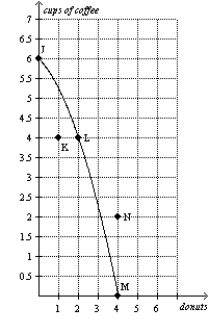
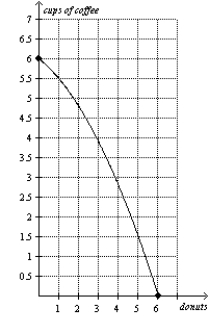 -Refer to Figure 2-9, Panel (a). The opportunity cost of moving from point J to point L is
 (Multiple Choice)
4.8/5 (84)
(84) Which of the following statements about economic models is correct?
(Multiple Choice)
4.9/5 (65)
(65) Economists devise theories, collect data, and then analyze these data in an attempt to verify or refute their theories.
(True/False)
4.8/5 (93)
(93) Figure 2-15 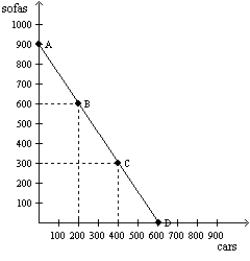 -Refer to Figure 2-15. Consider the production possibilities frontier for an economy that produces only sofas and cars. The opportunity cost of one car is
 (Short Answer)
4.8/5 (76)
(76) Figure 2-12 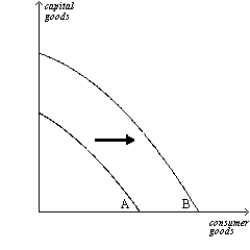 -Refer to Figure 2-12. The shift of the production possibilities frontier from A to B can best be described as
 (Multiple Choice)
4.8/5 (86)
(86) If a line passes through the points (20,5) and (10,10), then the slope of the line is 1/2.
(True/False)
4.9/5 (75)
(75) Which of the following is an example of a normative - as opposed to a positive - statement?
(Multiple Choice)
4.8/5 (67)
(67) Figure 2-14  -Refer to Figure 2-14. Point B represents an inefficient outcome for this economy.
 (True/False)
4.8/5 (88)
(88) 
Filters
- Essay(0)
- Multiple Choice(0)
- Short Answer(0)
- True False(0)
- Matching(0)