



 Chat with AI
Exam 2: Thinking Like an Economist

Exam 1: Ten Principles of Economics455 Questions
Exam 2: Thinking Like an Economist643 Questions
Exam 3: Interdependence and the Gains From Trade547 Questions
Exam 4: The Market Forces of Supply and Demand693 Questions
Exam 5: Elasticity and Its Application626 Questions
Exam 6: Supply, Demand, and Government Policies668 Questions
Exam 7: Consumers, Producers, and the Efficiency of Markets547 Questions
Exam 8: Applications: the Costs of Taxation509 Questions
Exam 9: Application: International Trade521 Questions
Exam 10: Externalities543 Questions
Exam 11: Public Goods and Common Resources452 Questions
Exam 12: The Design of the Tax System664 Questions
Exam 13: The Costs of Production649 Questions
Exam 14: Firms in Competitive Markets604 Questions
Exam 15: Monopoly662 Questions
Exam 16: Monopolistic Competition649 Questions
Exam 17: Oligopoly522 Questions
Exam 18: The Markets for the Factors of Production592 Questions
Exam 19: Earnings and Discrimination511 Questions
Exam 20: Income Inequality and Poverty478 Questions
Exam 21: The Theory of Consumer Choice570 Questions
Exam 22: Frontiers in Microeconomics461 Questions
Exam 23: Measuring a Nation S Income547 Questions
Exam 24: Measuring the Cost of Living565 Questions
Exam 25: Production and Growth527 Questions
Exam 26: Saving, Investment, and the Financial System637 Questions
Exam 27: Tools of Finance534 Questions
Exam 28: Unemployment and Its Natural Rate701 Questions
Exam 29: The Monetary System540 Questions
Exam 30: Money Growth and Inflation504 Questions
Exam 31: Open-Economy Macroeconomics: Basic Concepts540 Questions
Exam 32: A Macroeconomic Theory of the Open Economy511 Questions
Exam 33: Aggregate Demand and Aggregate Supply572 Questions
Exam 34: The Influence of Monetary and Fiscal Policy on Aggregate Demand523 Questions
Exam 35: The Short-Run Tradeoff Between Inflation and Unemployment536 Questions
Exam 36: Six Debates Over Macroeconomic Policy354 Questions
Select questions type


The Congressional Budget Office, which is staffed by economists, provides Congress with independent evaluations of policy proposals.
(True/False)
5.0/5  (87)
(87) Figure 2-10
Panel (a)
Panel (b) 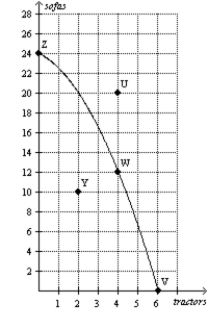
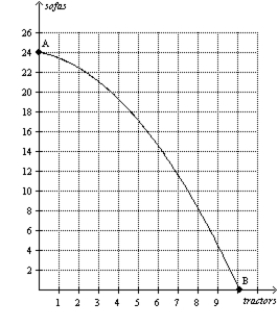 -Refer to Figure 2-10, Panel (a) and Panel (b). Which of the following is not a result of the shift of the economy's production possibilities frontier from Panel (a) to Panel (b)?
 (Multiple Choice)
4.8/5 (75)
(75) The field of economics is traditionally divided into two broad subfields,
(Multiple Choice)
4.9/5 (76)
(76) "Other things equal, an increase in supply causes a decrease in price" is a normative statement, not a positive statement.
(True/False)
5.0/5 (91)
(91) Figure 2-21 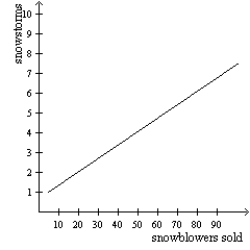 -Refer to Figure 2-21. Your friend John created the graph above to illustrate that snowstorms are caused by more snowblowers being sold. You inform him that his interpretation is incorrect due to
 (Multiple Choice)
4.8/5 (69)
(69) Studying which of the following is helpful in learning to think like an economist?
(Multiple Choice)
5.0/5 (93)
(93) The art in scientific thinking -- whether in chemistry, economics, or biology -- is
(Multiple Choice)
4.9/5 (75)
(75) When a production possibilities frontier is bowed outward, the opportunity cost of producing an additional unit of a good
(Multiple Choice)
4.8/5 (78)
(78) Figure 2-6 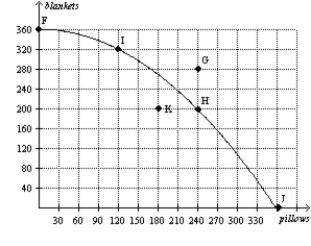 -Refer to Figure 2-6. The opportunity cost of this economy moving from point I to point H is
 (Multiple Choice)
4.7/5 (65)
(65) In the circular-flow diagram, which of the following items flows from firms to households through the markets for goods and services?
(Multiple Choice)
4.9/5 (88)
(88) Production possibilities frontiers can be used to illustrate scarcity, trade-offs, opportunity cost, efficiency, unemployment, technological advances, and economic growth.
(True/False)
4.7/5 (75)
(75) Economists believe that production possibilities frontiers
(Multiple Choice)
4.9/5 (89)
(89) Table 2-5 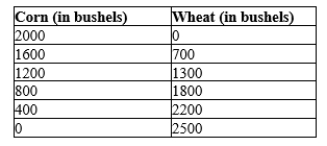 -Refer to Table 2-5. Table 2-5 shows one set of production possibilities. Based on the values in the table, the production possibilities frontier is
 (Multiple Choice)
4.9/5 (93)
(93) Examples of graphs of a single variable include pie charts, bar graphs, and time-series graphs.
(True/False)
4.9/5 (89)
(89) When a production possibilities frontier is bowed outward, the opportunity cost of one good in terms of the other depends on how much of each good is being produced.
(True/False)
4.8/5 (93)
(93) Figure 2-5  -Refer to Figure 2-5. If this economy devotes all of its resources to the production of dryers, then it will produce
 (Multiple Choice)
4.8/5 (74)
(74) Economists try to address their subject with a scientist's objectivity.
(True/False)
4.8/5 (78)
(78) 
Filters
- Essay(0)
- Multiple Choice(0)
- Short Answer(0)
- True False(0)
- Matching(0)