



 Chat with AI
Exam 2: Thinking Like an Economist

Exam 1: Ten Principles of Economics455 Questions
Exam 2: Thinking Like an Economist643 Questions
Exam 3: Interdependence and the Gains From Trade547 Questions
Exam 4: The Market Forces of Supply and Demand693 Questions
Exam 5: Elasticity and Its Application626 Questions
Exam 6: Supply, Demand, and Government Policies668 Questions
Exam 7: Consumers, Producers, and the Efficiency of Markets547 Questions
Exam 8: Applications: the Costs of Taxation509 Questions
Exam 9: Application: International Trade521 Questions
Exam 10: Externalities543 Questions
Exam 11: Public Goods and Common Resources452 Questions
Exam 12: The Design of the Tax System664 Questions
Exam 13: The Costs of Production649 Questions
Exam 14: Firms in Competitive Markets604 Questions
Exam 15: Monopoly662 Questions
Exam 16: Monopolistic Competition649 Questions
Exam 17: Oligopoly522 Questions
Exam 18: The Markets for the Factors of Production592 Questions
Exam 19: Earnings and Discrimination511 Questions
Exam 20: Income Inequality and Poverty478 Questions
Exam 21: The Theory of Consumer Choice570 Questions
Exam 22: Frontiers in Microeconomics461 Questions
Exam 23: Measuring a Nation S Income547 Questions
Exam 24: Measuring the Cost of Living565 Questions
Exam 25: Production and Growth527 Questions
Exam 26: Saving, Investment, and the Financial System637 Questions
Exam 27: Tools of Finance534 Questions
Exam 28: Unemployment and Its Natural Rate701 Questions
Exam 29: The Monetary System540 Questions
Exam 30: Money Growth and Inflation504 Questions
Exam 31: Open-Economy Macroeconomics: Basic Concepts540 Questions
Exam 32: A Macroeconomic Theory of the Open Economy511 Questions
Exam 33: Aggregate Demand and Aggregate Supply572 Questions
Exam 34: The Influence of Monetary and Fiscal Policy on Aggregate Demand523 Questions
Exam 35: The Short-Run Tradeoff Between Inflation and Unemployment536 Questions
Exam 36: Six Debates Over Macroeconomic Policy354 Questions
Select questions type


The Council of Economic Advisers' Economic Report of the President discusses recent developments in the economy and presents the council's analysis of current policy issues.
(True/False)
4.7/5  (69)
(69) Economists hold many positions advising the president and Congress including
(Multiple Choice)
4.7/5 (86)
(86) Which of the following allows you to provide information about the relationship between two variables?
(Multiple Choice)
4.7/5 (82)
(82) With the resources it has, an economy can produce at any point on or outside the production possibilities frontier, but it cannot produce at points inside the frontier.
(True/False)
4.8/5 (71)
(71) "Minimum wage laws result in unemployment" is a normative statement, while "the minimum wage should be higher" is a positive statement.
(True/False)
4.8/5 (96)
(96) Suppose an economy produces two goods, food and machines. This economy always operates on its production possibilities frontier. Last year, it produced 1000 units of food and 47 machines. This year it experienced a technological advance in its machine-making industry. As a result, this year the society wants to produce 1050 units of food and 47 machines. Which of the following statements is correct?
(Multiple Choice)
4.7/5 (77)
(77) Figure 2-14 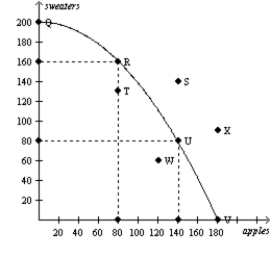 Consider the production possibilities curve for a country that can produce sweaters, apples (in bushels), or a combination of the two
-Refer to Figure 2-14. The opportunity cost of moving from point U to point R is
Consider the production possibilities curve for a country that can produce sweaters, apples (in bushels), or a combination of the two
-Refer to Figure 2-14. The opportunity cost of moving from point U to point R is (Multiple Choice)
4.9/5 (80)
(80) In the markets for the factors of production in the circular-flow diagram,
(Multiple Choice)
4.7/5 (81)
(81) Positive statements can be evaluated using data alone, but normative statements cannot.
(True/False)
4.8/5 (76)
(76) The most common data for testing economic theories come from
(Multiple Choice)
4.7/5 (90)
(90) Figure 2-8 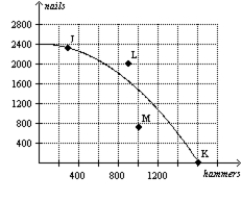 -Refer to Figure 2-8. Inefficient production is represented by which point(s)?
 (Multiple Choice)
4.9/5 (84)
(84) While the scientific method is applicable to studying natural sciences, it is not applicable to studying a nation's economy.
(True/False)
5.0/5 (71)
(71) Suppose that someone makes the argument that because empty alcohol containers are found at many accidents, the containers cause accidents. This would be an example of
(Multiple Choice)
4.7/5 (84)
(84) Positive statements are descriptive, while normative statements are prescriptive.
(True/False)
4.8/5 (73)
(73) Joe and Fred are economists. Joe thinks that the wealthiest 10% of the US population should be taxed a rate higher than the rest of society because they can better afford it. Fred thinks that everyone should be taxed at the same rate because that is the fairest scenario and the wealthy should not be penalized for their success. In this example, Joe and Fred
(Multiple Choice)
4.9/5 (78)
(78) Figure 2-16  -Refer to Figure 2-16. The opportunity cost of obtaining 20 additional widgets by moving from point C to point D is
 (Multiple Choice)
4.7/5 (81)
(81) Figure 2-14  -Refer to Figure 2-14. This economy fully employs its resources when it produces 35 dishwashers and zero doghouses.
 (True/False)
4.8/5 (77)
(77) 
Filters
- Essay(0)
- Multiple Choice(0)
- Short Answer(0)
- True False(0)
- Matching(0)