



 Chat with AI
Exam 2: Thinking Like an Economist

Exam 1: Ten Principles of Economics455 Questions
Exam 2: Thinking Like an Economist643 Questions
Exam 3: Interdependence and the Gains From Trade547 Questions
Exam 4: The Market Forces of Supply and Demand693 Questions
Exam 5: Elasticity and Its Application626 Questions
Exam 6: Supply, Demand, and Government Policies668 Questions
Exam 7: Consumers, Producers, and the Efficiency of Markets547 Questions
Exam 8: Applications: the Costs of Taxation509 Questions
Exam 9: Application: International Trade521 Questions
Exam 10: Externalities543 Questions
Exam 11: Public Goods and Common Resources452 Questions
Exam 12: The Design of the Tax System664 Questions
Exam 13: The Costs of Production649 Questions
Exam 14: Firms in Competitive Markets604 Questions
Exam 15: Monopoly662 Questions
Exam 16: Monopolistic Competition649 Questions
Exam 17: Oligopoly522 Questions
Exam 18: The Markets for the Factors of Production592 Questions
Exam 19: Earnings and Discrimination511 Questions
Exam 20: Income Inequality and Poverty478 Questions
Exam 21: The Theory of Consumer Choice570 Questions
Exam 22: Frontiers in Microeconomics461 Questions
Exam 23: Measuring a Nation S Income547 Questions
Exam 24: Measuring the Cost of Living565 Questions
Exam 25: Production and Growth527 Questions
Exam 26: Saving, Investment, and the Financial System637 Questions
Exam 27: Tools of Finance534 Questions
Exam 28: Unemployment and Its Natural Rate701 Questions
Exam 29: The Monetary System540 Questions
Exam 30: Money Growth and Inflation504 Questions
Exam 31: Open-Economy Macroeconomics: Basic Concepts540 Questions
Exam 32: A Macroeconomic Theory of the Open Economy511 Questions
Exam 33: Aggregate Demand and Aggregate Supply572 Questions
Exam 34: The Influence of Monetary and Fiscal Policy on Aggregate Demand523 Questions
Exam 35: The Short-Run Tradeoff Between Inflation and Unemployment536 Questions
Exam 36: Six Debates Over Macroeconomic Policy354 Questions
Select questions type


Figure 2-1  -Refer to Figure 2-1. Harvey receives his first paycheck for working as an ice cream vendor. To which of the arrows does this transaction directly contribute?
 (Multiple Choice)
4.9/5  (80)
(80) Points inside the production possibilities frontier represent feasible levels of production.
(True/False)
4.8/5 (85)
(85) Figure 2-20
Relationship Between Years of Education and Annual Income 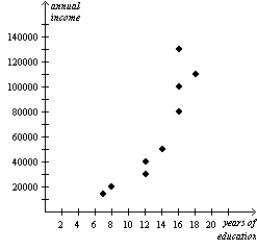 -Refer to Figure 2-20. The graph above is a
 (Multiple Choice)
4.8/5 (91)
(91) When studying the effects of changes in public policy, economists believe that
(Multiple Choice)
4.7/5 (78)
(78) Sometimes economists disagree because their values differ. Which of the following instances best reflects this source of disagreement?
(Multiple Choice)
4.8/5 (87)
(87) What type of statement is a prescriptive statement about how the world ought to be?
(Short Answer)
4.9/5 (75)
(75) Is the following a positive or normative statement? The federal minimum wage is lower than many state minimum wages.
(Short Answer)
4.9/5 (93)
(93) Figure 2-18
Relationship between Price and Restaurant Meals 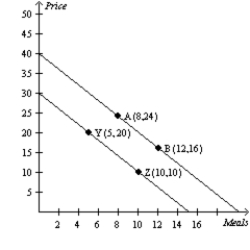 -Refer to Figure 2-18. Which of the following could result in a movement from point B to point Z?
 (Multiple Choice)
4.8/5 (73)
(73) Which of the following is an example of a normative, as opposed to positive, statement?
(Multiple Choice)
4.8/5 (72)
(72) Figure 2-17  -Refer to Figure 2-17. This economy fully employs its resources when it produces 4000 shoes and zero t-shirts.
 (True/False)
4.9/5 (83)
(83) In addition to advising the president, one duty of the Council of Economic Advisers is to
(Multiple Choice)
4.8/5 (77)
(77) Figure 2-14  -Refer to Figure 2-14. If this economy uses all its resources in the dishwasher industry, it produces 35 dishwashers and no doghouses.
 (True/False)
5.0/5 (79)
(79) According to John Maynard Keynes, an economist must possess a rare combination of skills including being a mathematician, historian, statesman, and philosopher.
(True/False)
4.8/5 (81)
(81) On a bowed production possibilities frontier, as you move down along the curve
(Multiple Choice)
4.7/5 (87)
(87) Figure 2-5  -Refer to Figure 2-5. The opportunity cost of obtaining 40 additional dryers by moving from point D to point C is
 (Multiple Choice)
4.7/5 (83)
(83) Who would be more likely to study the effects of rent control on housing in New York City, a macroeconomist or a microeconomist?
(Short Answer)
4.8/5 (87)
(87) Figure 2-14
-Refer to Figure 2-14. The opportunity cost of moving from point B to point A is zero.
-Refer to Figure 2-14. The opportunity cost of moving from point B to point A is zero. (True/False)
4.9/5 (75)
(75) 
Filters
- Essay(0)
- Multiple Choice(0)
- Short Answer(0)
- True False(0)
- Matching(0)