



 Chat with AI
Exam 2: Thinking Like an Economist

Exam 1: Ten Principles of Economics455 Questions
Exam 2: Thinking Like an Economist643 Questions
Exam 3: Interdependence and the Gains From Trade547 Questions
Exam 4: The Market Forces of Supply and Demand693 Questions
Exam 5: Elasticity and Its Application626 Questions
Exam 6: Supply, Demand, and Government Policies668 Questions
Exam 7: Consumers, Producers, and the Efficiency of Markets547 Questions
Exam 8: Applications: the Costs of Taxation509 Questions
Exam 9: Application: International Trade521 Questions
Exam 10: Externalities543 Questions
Exam 11: Public Goods and Common Resources452 Questions
Exam 12: The Design of the Tax System664 Questions
Exam 13: The Costs of Production649 Questions
Exam 14: Firms in Competitive Markets604 Questions
Exam 15: Monopoly662 Questions
Exam 16: Monopolistic Competition649 Questions
Exam 17: Oligopoly522 Questions
Exam 18: The Markets for the Factors of Production592 Questions
Exam 19: Earnings and Discrimination511 Questions
Exam 20: Income Inequality and Poverty478 Questions
Exam 21: The Theory of Consumer Choice570 Questions
Exam 22: Frontiers in Microeconomics461 Questions
Exam 23: Measuring a Nation S Income547 Questions
Exam 24: Measuring the Cost of Living565 Questions
Exam 25: Production and Growth527 Questions
Exam 26: Saving, Investment, and the Financial System637 Questions
Exam 27: Tools of Finance534 Questions
Exam 28: Unemployment and Its Natural Rate701 Questions
Exam 29: The Monetary System540 Questions
Exam 30: Money Growth and Inflation504 Questions
Exam 31: Open-Economy Macroeconomics: Basic Concepts540 Questions
Exam 32: A Macroeconomic Theory of the Open Economy511 Questions
Exam 33: Aggregate Demand and Aggregate Supply572 Questions
Exam 34: The Influence of Monetary and Fiscal Policy on Aggregate Demand523 Questions
Exam 35: The Short-Run Tradeoff Between Inflation and Unemployment536 Questions
Exam 36: Six Debates Over Macroeconomic Policy354 Questions
Select questions type


The bowed shape of the production possibilities frontier can be explained by the fact that
(Multiple Choice)
4.9/5  (89)
(89) A microeconomist - as opposed to a macroeconomist - might study
(Multiple Choice)
4.8/5 (91)
(91) When studying the effects of public policy changes, economists
(Multiple Choice)
4.7/5 (93)
(93) Which markets are represented in the simple circular-flow diagram?
(Multiple Choice)
4.7/5 (72)
(72) In the circular-flow diagram, another name for goods and services produced by firms is
(Multiple Choice)
4.8/5 (68)
(68) Economists at which administrative department help design tax policy?
(Short Answer)
4.7/5 (69)
(69) The prairie dog has always been considered a problem for American cattle ranchers. They dig holes that cattle and horses can step in, and they eat grass necessary for cattle. Recently, ranchers have discovered that there is a demand for prairie dogs as pets. In some areas, prairie dogs can sell for as high as $150 each. Cattlemen are now fencing off prairie dog towns on their land so these towns will not be disturbed by their cattle.
Draw a rancher's production possibilities frontier showing increasing opportunity cost of cattle production in terms of prairie dog production. Using a separate graph for each situation, show what would happen to the initial production possibilities frontier in each of the following situations:
a.The outcome is efficient, with ranchers choosing to produce equal numbers of cattle and prairie dogs.
b.As a protest against the government introducing the gray wolf back into the wild in their state, ranchers decide to withhold 25 percent of the available grassland for grazing.
c.The price of prairie dogs increases to $200 each, so ranchers decide to allot additional land for prairie dogs.
d.The government grants new leases to ranchers, giving them 10,000 new acres of grassland each for grazing.
e.
A drought destroys most of the available grass for grazing of cattle, but not for prairie dogs since they also eat plant roots.
(Essay)
4.7/5 (77)
(77) Which of the following transactions does not take place in the markets for factors of production in the circular-flow diagram?
(Multiple Choice)
4.9/5 (65)
(65) Figure 2-14  -Refer to Figure 2-14. It is possible for this economy to produce 75 doghouses.
 (True/False)
4.9/5 (75)
(75) Economists believe that production possibilities frontiers are often bowed because
(Multiple Choice)
4.8/5 (86)
(86) For economists, conducting experiments is often difficult and sometimes impossible.
(True/False)
5.0/5 (69)
(69) Figure 2-19
In the following graph the x-axis shows the number of times a commuter rail train stops at a station per hour and the y-axis shows the number of commuter rail passengers per hour.
Commuter Rail Passengers by Frequency of Service 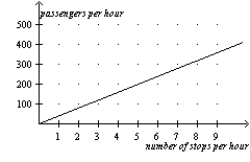 -Refer to Figure 2-19. A policymaker observes this graph and concludes that increasing the frequency of commuter rail service is a certain way to get more commuters to choose the commuter rail instead of driving their own cars. You warn the policymaker about making a reverse causality mistake with which of the following statements?
 (Multiple Choice)
4.8/5 (82)
(82) In the circular-flow diagram, which of the following items flows from firms to households through the markets for the factors of production?
(Multiple Choice)
4.9/5 (66)
(66) The scientific method can be applied to the study of economics.
(True/False)
5.0/5 (74)
(74) Figure 2-8 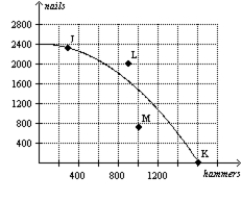 -Refer to Figure 2-8. Efficient production is represented by which point(s)?
 (Multiple Choice)
4.9/5 (71)
(71) Because it is difficult for economists to use experiments to generate data, they generally must
(Multiple Choice)
4.8/5 (81)
(81) Which of the following statements best captures the relationship between microeconomics and macroeconomics?
(Multiple Choice)
4.7/5 (83)
(83) 
Filters
- Essay(0)
- Multiple Choice(0)
- Short Answer(0)
- True False(0)
- Matching(0)