



 Chat with AI
Exam 17: Thermodynamics: Spontaneous and Nonspontaneous Reactions and Processes

Exam 1: Matter and Energy: The Origin of the Universe103 Questions
Exam 2: Atoms, Ions, and Molecules: Matter Starts Here144 Questions
Exam 3: Stoichiometry: Mass, Formulas, and Reactions141 Questions
Exam 4: Solution Chemistry: The Hydrosphere148 Questions
Exam 5: Thermochemistry: Energy Changes in Reactions139 Questions
Exam 6: Properties of Gases: The Air We Breathe164 Questions
Exam 7: A Quantum Model of Atoms: Waves and Particles166 Questions
Exam 8: Chemical Bonds: What Makes a Gas a Greenhouse Gas156 Questions
Exam 9: Molecular Geometry: Shape Determines Function188 Questions
Exam 10: Intermolecular Forces: The Uniqueness of Water165 Questions
Exam 11: Solutions: Properties and Behavior150 Questions
Exam 12: Solids: Crystals, Alloys, and Polymers130 Questions
Exam 13: Chemical Kinetics: Reactions in the Atmosphere155 Questions
Exam 14: Chemical Equilibrium: How Much Product Does a Reaction Really Make111 Questions
Exam 15: Acidbase Equilibria: Proton Transfer in Biological Systems122 Questions
Exam 16: Additional Aqueous Equilibria: Chemistry and the Oceans127 Questions
Exam 17: Thermodynamics: Spontaneous and Nonspontaneous Reactions and Processes186 Questions
Exam 18: Electrochemistry: The Quest for Clean Energy167 Questions
Exam 19: Nuclear Chemistry: Applications to Energy and Medicine165 Questions
Exam 20: Organic and Biological Molecules: the Compounds of Life168 Questions
Exam 21: The Main Group Elements: Life and the Periodic Table96 Questions
Exam 22: Transition Metals: Biological and Medical Applications142 Questions
Select questions type


Carbon monoxide has a very weak dipole moment. In the formation of solid carbon monoxide some molecules will be reversed in their orientation from
C  O - - - C
 O to C
 O - - - O
 C. What do you expect the absolute entropy of carbon monoxide solid to be at 0 K, and why?
O - - - C O to C O - - - O C. What do you expect the absolute entropy of carbon monoxide solid to be at 0 K, and why? (Essay)
4.9/5  (87)
(87) What type of motion is depicted in the following before-and-after pictures? 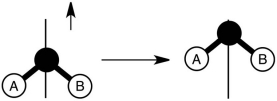
(Multiple Choice)
4.9/5 (88)
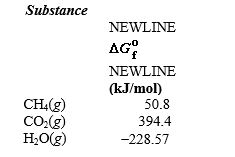
(88) What is the maximum amount of work that can be done by the reaction 


(Multiple Choice)
4.7/5 (70)
(70) For a particular hypothetical reaction,  , the value of G is 250 kJ/mol. What is the value of G for this reaction at 298 K when [A] 0.60 M, [B] 0.10 M, and [C] 4.0 103 M ?
 (Multiple Choice)
4.9/5 (82)
(82) The entropy change in the surroundings (Ssurr) during a spontaneous process must be ________
(Multiple Choice)
4.9/5 (71)
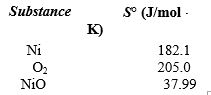
(71) If 3.500 g of Ni are reacted with excess oxygen to form nickel oxide (NiO) under standard state conditions, what is the entropy change for the reaction? 


(Multiple Choice)
4.9/5 (73)
(73) The following figures represent distributions of two types of gas molecules between two containers connected by an open tube. In which figure is the entropy of the system maximized?
(Multiple Choice)
4.8/5 (60)
(60) The symbol  (MgSO4, s) refers to which of the following reactions?
 (Multiple Choice)
4.8/5 (85)
(85) A perturbation or stress to a chemical reaction at equilibrium ________
(Multiple Choice)
4.7/5 (81)
(81) NO gas is converted to NO2 gas according to the following reaction: 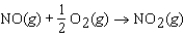 What is the standard entropy change when 0.5 mol of NO gas reacts with 0.5 mol of O2 gas?
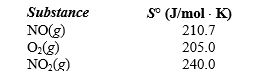
What is the standard entropy change when 0.5 mol of NO gas reacts with 0.5 mol of O2 gas? (Multiple Choice)
4.8/5 (87)
(87) Benzene is a liquid under standard conditions. The standard free-energy change for the evaporation of liquid benzene to form benzene vapor is 5.2 kJ/mol. If liquid benzene is placed in an open container under standard conditions, ________
(Multiple Choice)
5.0/5 (83)
(83) In a spontaneous process, the entropy of the universe ________
(Multiple Choice)
4.9/5 (74)
(74) A sealed tube containing an equilibrium mixture of NO2(g) (brown) and N2O4(g) (colorless) is subjected to a variety of temperatures. For the equilibrium reaction shown, the values of the  and
 are also shown. What is observed in the tube with increasing temperature?


 H 58.02 kJ/mol, S176.5 J/mol K
and are also shown. What is observed in the tube with increasing temperature? H 58.02 kJ/mol, S176.5 J/mol K (Multiple Choice)
5.0/5 (73)
(73) Heat transfer from the system to the surroundings has a large effect on Ssurr ________
(Multiple Choice)
4.8/5 (95)
(95) If 1 mol of ice melts at its melting point of 273 K, the entropy change for the ice is 22.0 J/K. If the ice melts in someone's hand at 34C, what is the change in the entropy of the universe? Assume a final temperature for the water of 0C. The enthalpy of fusion for ice is 6.01 kJ/mol.
(Multiple Choice)
4.9/5 (89)
(89) The standard entropy of nitrogen gas in air is 192 J/(mol K). Estimate how many states are accessible to a nitrogen molecule in air.
(Multiple Choice)
4.8/5 (68)
(68) Determine the change in the standard entropy of the universe for the given reaction from the given data. 
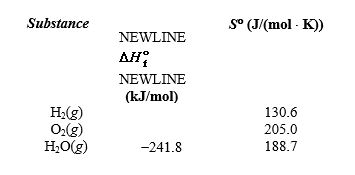
(Short Answer)
4.8/5 (82)
(82) As the temperature of a reaction with S 0 is increased, the equilibrium constant ________
(Multiple Choice)
4.8/5 (84)
(84) The equilibrium vapor pressure for benzene is 94.4 mm Hg. When liquid benzene is in equilibrium with its vapor, we must have ________
(Multiple Choice)
4.9/5 (71)
(71) The gas above the liquid in a sealed bottle of soda is primarily carbon dioxide. Carbon dioxide is also dissolved in the soda. When the distribution of carbon dioxide between the gas and liquid is at equilibrium, molecules of carbon dioxide in the gas phase can still dissolve in the liquid phase if they strike the surface and are captured. Similarly, molecules of carbon dioxide can escape from the liquid phase. What is the entropy change of the universe, Suni v, for the dissolution of carbon dioxide under these conditions?
(Multiple Choice)
4.8/5 (66)
(66) 
Filters
- Essay(0)
- Multiple Choice(0)
- Short Answer(0)
- True False(0)
- Matching(0)