



 Chat with AI
Exam 16: Additional Aqueous Equilibria: Chemistry and the Oceans

Exam 1: Matter and Energy: The Origin of the Universe103 Questions
Exam 2: Atoms, Ions, and Molecules: Matter Starts Here144 Questions
Exam 3: Stoichiometry: Mass, Formulas, and Reactions141 Questions
Exam 4: Solution Chemistry: The Hydrosphere148 Questions
Exam 5: Thermochemistry: Energy Changes in Reactions139 Questions
Exam 6: Properties of Gases: The Air We Breathe164 Questions
Exam 7: A Quantum Model of Atoms: Waves and Particles166 Questions
Exam 8: Chemical Bonds: What Makes a Gas a Greenhouse Gas156 Questions
Exam 9: Molecular Geometry: Shape Determines Function188 Questions
Exam 10: Intermolecular Forces: The Uniqueness of Water165 Questions
Exam 11: Solutions: Properties and Behavior150 Questions
Exam 12: Solids: Crystals, Alloys, and Polymers130 Questions
Exam 13: Chemical Kinetics: Reactions in the Atmosphere155 Questions
Exam 14: Chemical Equilibrium: How Much Product Does a Reaction Really Make111 Questions
Exam 15: Acidbase Equilibria: Proton Transfer in Biological Systems122 Questions
Exam 16: Additional Aqueous Equilibria: Chemistry and the Oceans127 Questions
Exam 17: Thermodynamics: Spontaneous and Nonspontaneous Reactions and Processes186 Questions
Exam 18: Electrochemistry: The Quest for Clean Energy167 Questions
Exam 19: Nuclear Chemistry: Applications to Energy and Medicine165 Questions
Exam 20: Organic and Biological Molecules: the Compounds of Life168 Questions
Exam 21: The Main Group Elements: Life and the Periodic Table96 Questions
Exam 22: Transition Metals: Biological and Medical Applications142 Questions
Select questions type


Identify the dominant species that determine the pH at the following points in the titration of a monoprotic weak acid with a strong base, NaOH, and write the relevant reaction equation for each that produces hydronium ion or hydroxide ion.
(1) at the beginning
(2) halfway to the equivalence point
(3) at the equivalence point
(4) past the equivalence point

Free
(Essay)
4.9/5  (70)
(70) Correct Answer: Verified
(1) At the beginning, ionization of the weak acid determines the pH.
HA H2O A H3O
(2) Halfway to the equivalence point, half the acid has been converted into its conjugate base.
The pH can be directly determined by the equilibrium involving acid ionization.
HA H2O A H3O pH pKa since [HA] [A]
(3) At the equivalence point, all the acid essentially has been converted into its conjugate base. The pH is determined by base ionization.
A H2O HA OH
(4) Past the equivalence point, excess strong base has been added. The pH is determined by the concentration of excess hydroxide in the solution.
As the pH increases, the solubility of ________ would increase.
Free
(Multiple Choice)
4.9/5 (76)
(76) Correct Answer:Verified
VerifiedE
Which of the following can be mixed together in water to produce a buffer solution?
Free
(Multiple Choice)
4.8/5 (69)
(69) Correct Answer:Verified
VerifiedD
A solution of nitrous acid (0.15 M, 20.00 mL) was titrated with 0.12 M sodium hydroxide (Ka of nitrous acid 4.00 104). What is the pH after addition of the following volumes of sodium hydroxide?
a) 15 mL
b) 25 mL
c) 27 mL
(Short Answer)
4.8/5 (82)
(82) Which of the following is not a buffer system? A solution containing roughly equal concentrations of ________
(Multiple Choice)
4.8/5 (69)
(69) What are the characteristics of a pH indicator? A pH indicator ________
I. is a weak acid.
II. has different characteristic colors in protonated and unprotonated forms.
III. changes color when the pH is near its pKa.
(Multiple Choice)
4.8/5 (73)
(73) Purveyors of salts from the Dead Sea advertise that it is healthy to bathe in a saturated solution of magnesium chloride (MgCl2, 95.21 g/mol, Ksp 740). How much magnesium chloride would you have to purchase to make up 10.0 L of bathwater saturated with magnesium chloride?
(Multiple Choice)
4.9/5 (76)
(76) How many moles of sodium acetate must be added to 500 mL of 0.25 M acetic acid solution to produce a buffer with a pH of 4.94? The pKa of acetic acid is 4.74. You can neglect the change in volume when sodium acetate dissolves in the acetic acid solution.
(Multiple Choice)
4.8/5 (79)
(79) A solution of nitrous acid (0.13 M, 20.00 mL) was titrated with 18.0 mL of 0.12 M sodium hydroxide (Ka of nitrous acid 4.00 104). What is the final pH of this solution?
(Multiple Choice)
4.8/5 (75)
(75) When Ni(NH3)6Cl2 dissolves in water, which of the following species form the inner coordination sphere around the Ni2 ions?
(Multiple Choice)
4.7/5 (68)
(68) Calculate the Ksp for Li3PO4 if at equilibrium the concentration of PO43 ion is 3.30 103 M.
(Multiple Choice)
4.8/5 (83)
(83) Determine the molar concentration of Cl ions in an equilibrium mixture containing 1.00 M PbCl42 and 0.0010 M Pb2 ions. Given: Kf 2.5 101 for PbCl42.
(Multiple Choice)
4.8/5 (88)
(88) In a titration of monoprotic acids and bases, there is a large change in pH ________
(Multiple Choice)
4.9/5 (82)
(82) Which combination of solutions is the best choice for making a buffer solution?
(Multiple Choice)
4.9/5 (79)
(79) Lead poisoning used to be treated by injections of ethylenediaminetetraacetic acid, EDTA. If the concentration of EDTA in the blood of a patient is 3.0 109 M and the formation constant for Pb(EDTA)2 is 2.0 1018, what is the concentration ratio of free toxic Pb2 to lead-EDTA complex in the blood?
(Multiple Choice)
4.8/5 (91)
(91) At what point in the following titration curve for a weak acid being titrated with a strong base is the pH equal to the pKa of the acid? The x-axis scale goes from 0.0 mL to 20.0 mL. The sharp rise is at 10.0 mL. 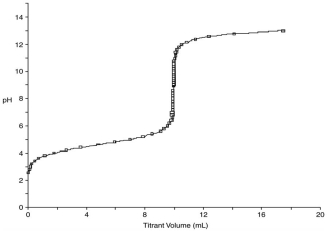
(Multiple Choice)
4.8/5 (73)
(73) A ligand is any ________ forming a coordinate bond to a metal cation.
(Multiple Choice)
4.9/5 (91)
(91) A phosphate buffer solution (25.00 mL sample) used for a growth medium was titrated with 0.1000 M hydrochloric acid. The components of the buffer were sodium monohydrogen phosphate and sodium dihydrogen phosphate. The first endpoint occurred at a volume of 10.32 mL; the second occurred after an additional 18.62 mL was added, for a total volume of 28.94 mL. What was the approximate ratio of HPO42 to H2PO4 in the buffer?
(Multiple Choice)
4.8/5 (70)
(70) 
Filters
- Essay(0)
- Multiple Choice(0)
- Short Answer(0)
- True False(0)
- Matching(0)