



 Chat with AI
Exam 14: Chemical Equilibrium: How Much Product Does a Reaction Really Make

Exam 1: Matter and Energy: The Origin of the Universe103 Questions
Exam 2: Atoms, Ions, and Molecules: Matter Starts Here144 Questions
Exam 3: Stoichiometry: Mass, Formulas, and Reactions141 Questions
Exam 4: Solution Chemistry: The Hydrosphere148 Questions
Exam 5: Thermochemistry: Energy Changes in Reactions139 Questions
Exam 6: Properties of Gases: The Air We Breathe164 Questions
Exam 7: A Quantum Model of Atoms: Waves and Particles166 Questions
Exam 8: Chemical Bonds: What Makes a Gas a Greenhouse Gas156 Questions
Exam 9: Molecular Geometry: Shape Determines Function188 Questions
Exam 10: Intermolecular Forces: The Uniqueness of Water165 Questions
Exam 11: Solutions: Properties and Behavior150 Questions
Exam 12: Solids: Crystals, Alloys, and Polymers130 Questions
Exam 13: Chemical Kinetics: Reactions in the Atmosphere155 Questions
Exam 14: Chemical Equilibrium: How Much Product Does a Reaction Really Make111 Questions
Exam 15: Acidbase Equilibria: Proton Transfer in Biological Systems122 Questions
Exam 16: Additional Aqueous Equilibria: Chemistry and the Oceans127 Questions
Exam 17: Thermodynamics: Spontaneous and Nonspontaneous Reactions and Processes186 Questions
Exam 18: Electrochemistry: The Quest for Clean Energy167 Questions
Exam 19: Nuclear Chemistry: Applications to Energy and Medicine165 Questions
Exam 20: Organic and Biological Molecules: the Compounds of Life168 Questions
Exam 21: The Main Group Elements: Life and the Periodic Table96 Questions
Exam 22: Transition Metals: Biological and Medical Applications142 Questions
Select questions type


The chemical equilibrium constant for the following reaction is 14.5. CH3OH(g)  CO(g) 2H2(g)
What is the value of the equilibrium constant for the following reaction?


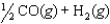
CO(g) 2H2(g)
What is the value of the equilibrium constant for the following reaction? 
Free
(Multiple Choice)
4.8/5  (75)
(75) Correct Answer: Verified
A
Which of the following can be predicted from the law of mass action?
I. At equilibrium, the ratio of concentrations of products to reactants, each raised to a power corresponding to the stoichiometric coefficient in the balanced reaction equation, will have a constant value at a given temperature.
II. The direction of the reaction given values for the reactant and product concentrations and the equilibrium constant.
III. The amounts of products that can be produced from a given amount of reactants.
Free
(Multiple Choice)
4.9/5 (87)
(87) Correct Answer:Verified
VerifiedC
Which expression corresponds to the equilibrium constant for the reaction written as 2H2(g) O2(g)  2H2O2(g)?
Free
(Multiple Choice)
4.9/5 (85)
(85) Correct Answer:Verified
VerifiedC
Consider the equilibrium A B  C. What is significant about the equilibrium state in which [B] [C]?
 (Multiple Choice)
4.8/5 (69)
(69) The equilibrium constant for the reaction below is 17.5. S(s) 3 O2(g)  2 SO3(g)
What is the value of the equilibrium constant for the following reaction?
6 SO3(g)
 3S(s) 9 O2(g)
2 SO3(g)
What is the value of the equilibrium constant for the following reaction?
6 SO3(g) 3S(s) 9 O2(g) (Multiple Choice)
4.8/5 (73)
(73) Which statement about an equilibrium constant, K, and a reaction quotient, Q, for a reaction is correct?
(Multiple Choice)
4.9/5 (69)
(69) If Q for a reaction is greater than K, the reaction will be ________. If Q for a reaction is less than K, the reaction will be ________. If Q for a reaction is equal to K, the reaction will be ________.
(Short Answer)
4.9/5 (75)
(75) Which of the following reactions will not shift toward the reactants products when the pressure of the system is altered by changing the volume?
(Multiple Choice)
4.9/5 (90)
(90) In the following reaction, which of the statements is true, given the concentrations of each species? C6H6(g) 3H2(g)  C6H12(g) K 1.23103
[C6H6] [H2] 0.170 M and [C6H12] 0.025 M
C6H12(g) K 1.23103
[C6H6] [H2] 0.170 M and [C6H12] 0.025 M (Multiple Choice)
4.9/5 (66)
(66) One mole of solid ammonium carbamate (NH4CO2NH2) decomposes to form gaseous ammonia (NH3) and carbon dioxide. Write an expression for the equilibrium constant for this reaction.
(Essay)
5.0/5 (75)
(75) How and why are the expressions for homogeneous equilibrium constants different from the expressions for heterogeneous equilibrium constants?
(Essay)
4.7/5 (90)
(90) Calculate K for the following reaction, provided the concentration versus time graph shown below. 2A  2B 3C
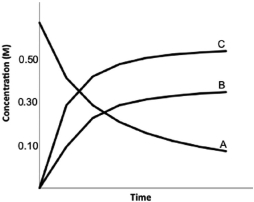
2B 3C (Multiple Choice)
4.9/5 (78)
(78) Given the reaction below, which of the following would cause an increase in the concentration of reactants? 2HF(g)  F2(g) H2(g)
 H° 12.0 kJ/mol
I. removal of hydrogen
II. addition of HF
III. increasing the temperature of the reaction
IV. an increase in the volume of the container
F2(g) H2(g) H° 12.0 kJ/mol
I. removal of hydrogen
II. addition of HF
III. increasing the temperature of the reaction
IV. an increase in the volume of the container (Multiple Choice)
4.7/5 (76)
(76) The equilibrium constants for the two reactions are known: Mm 4L  [ML4]m4 Ka
HL
 H L Kb
What must be the value of the equilibrium constant, Koverall for the following overall reaction?
Mm 4HL
 [ML4]m4 4H Koverall
[ML4]m4 Ka
HL H L Kb
What must be the value of the equilibrium constant, Koverall for the following overall reaction?
Mm 4HL [ML4]m4 4H Koverall (Multiple Choice)
4.8/5 (78)
(78) Which of the following is true regarding the effect of a catalyst on chemical equilibrium?
(Multiple Choice)
5.0/5 (70)
(70) A student determined the equilibrium concentration in the following equation by neglecting the x term in the denominator. Was she justified or not in this approximation and why? K 4.0 102 
(Multiple Choice)
4.9/5 (83)
(83) The reaction of bromine gas with chlorine gas, shown here, has a Kp value of 7.20. If a closed vessel was charged with the two reactants, each at an initial partial pressure of 0.500 atm, what would be the equilibrium partial pressure of BrCl(g)?
Br2(g) Cl2(g)  2BrCl(g)
 (Short Answer)
4.8/5 (82)
(82) What happens to the equilibrium between NO2(g) and N2O4(g) in inert argon when the volume is increased and additional argon is added to maintain a constant total pressure?
(Multiple Choice)
4.7/5 (75)
(75) When can an x be ignored in solving an equilibrium expression derived from a RICE table?
(Multiple Choice)
4.9/5 (87)
(87) 
Filters
- Essay(0)
- Multiple Choice(0)
- Short Answer(0)
- True False(0)
- Matching(0)