



 Chat with AI
Exam 14: Chemical Equilibrium: How Much Product Does a Reaction Really Make

Exam 1: Matter and Energy: The Origin of the Universe103 Questions
Exam 2: Atoms, Ions, and Molecules: Matter Starts Here144 Questions
Exam 3: Stoichiometry: Mass, Formulas, and Reactions141 Questions
Exam 4: Solution Chemistry: The Hydrosphere148 Questions
Exam 5: Thermochemistry: Energy Changes in Reactions139 Questions
Exam 6: Properties of Gases: The Air We Breathe164 Questions
Exam 7: A Quantum Model of Atoms: Waves and Particles166 Questions
Exam 8: Chemical Bonds: What Makes a Gas a Greenhouse Gas156 Questions
Exam 9: Molecular Geometry: Shape Determines Function188 Questions
Exam 10: Intermolecular Forces: The Uniqueness of Water165 Questions
Exam 11: Solutions: Properties and Behavior150 Questions
Exam 12: Solids: Crystals, Alloys, and Polymers130 Questions
Exam 13: Chemical Kinetics: Reactions in the Atmosphere155 Questions
Exam 14: Chemical Equilibrium: How Much Product Does a Reaction Really Make111 Questions
Exam 15: Acidbase Equilibria: Proton Transfer in Biological Systems122 Questions
Exam 16: Additional Aqueous Equilibria: Chemistry and the Oceans127 Questions
Exam 17: Thermodynamics: Spontaneous and Nonspontaneous Reactions and Processes186 Questions
Exam 18: Electrochemistry: The Quest for Clean Energy167 Questions
Exam 19: Nuclear Chemistry: Applications to Energy and Medicine165 Questions
Exam 20: Organic and Biological Molecules: the Compounds of Life168 Questions
Exam 21: The Main Group Elements: Life and the Periodic Table96 Questions
Exam 22: Transition Metals: Biological and Medical Applications142 Questions
Select questions type


For the following reaction, Kp = 137 at 3.50 102K. What is the value of Kc? 2C4H10(l) 3O2(g)  8CO2(g) 10H2O(g)
 (Multiple Choice)
4.9/5  (90)
(90) Solid mercury(II) oxide decomposes when heated to produce liquid mercury and oxygen. 2HgO(s)  2Hg(l) O2(g)
An amount of mercury(II) oxide is placed in a vessel at a particular temperature and allowed to reach equilibrium. How could the amount of liquid mercury in the vessel be increased?
I. adding more mercury(II) oxide
II. removing some oxygen
III. increasing the volume of the vessel
2Hg(l) O2(g)
An amount of mercury(II) oxide is placed in a vessel at a particular temperature and allowed to reach equilibrium. How could the amount of liquid mercury in the vessel be increased?
I. adding more mercury(II) oxide
II. removing some oxygen
III. increasing the volume of the vessel (Multiple Choice)
4.8/5 (69)
(69) Carbon dioxide and argon, which is a noble or inert gas, are placed in a vessel and heated. Equilibrium is reached at some particular temperature. Carbon dioxide dissociates by the following reaction. 2CO2(g)  2CO(g) O2(g)
What is the result of increasing the pressure by adding more argon?
I. The equilibrium shifts to produce more carbon dioxide and reduce the pressure.
II. The equilibrium shifts to remove carbon dioxide and reduce the pressure.
III. The equilibrium does not change because argon is not involved in the reaction.
IV. The equilibrium does not change because the concentrations are not affected.
2CO(g) O2(g)
What is the result of increasing the pressure by adding more argon?
I. The equilibrium shifts to produce more carbon dioxide and reduce the pressure.
II. The equilibrium shifts to remove carbon dioxide and reduce the pressure.
III. The equilibrium does not change because argon is not involved in the reaction.
IV. The equilibrium does not change because the concentrations are not affected. (Multiple Choice)
4.8/5 (81)
(81) A series of four equilibrium steps can be defined for the following overall reaction: Cu2 4NH3  [Cu(NH3)4]2Koverall
Cu2 NH3
 [Cu(NH3)]2K1
[Cu(NH3)]2 NH3
 [Cu(NH3)2]2K2
Etc)
What is true about K4?
[Cu(NH3)4]2Koverall
Cu2 NH3 [Cu(NH3)]2K1
[Cu(NH3)]2 NH3 [Cu(NH3)2]2K2
Etc)
What is true about K4? (Multiple Choice)
4.8/5 (78)
(78) The sulfide ion, S2, reacts with water as a weak base: S2 H2O  SH OH K 1.0
If sodium sulfide were dissolved in water to make a solution of 0.50 M, what would be the resulting concentration of OH?
SH OH K 1.0
If sodium sulfide were dissolved in water to make a solution of 0.50 M, what would be the resulting concentration of OH? (Multiple Choice)
4.9/5 (83)
(83) Given the following reactions and associated equilibrium constants 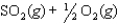

 K1 3.1


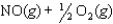 K2 4.5 what is the equilibrium constant for the following reaction?
SO3(g) NO(g)
 SO2(g) NO2(g) Knew ?
K1 3.1 K2 4.5 what is the equilibrium constant for the following reaction?
SO3(g) NO(g) SO2(g) NO2(g) Knew ? (Multiple Choice)
4.8/5 (89)
(89) Which of the following is true for a chemical reaction at equilibrium?
(Multiple Choice)
4.7/5 (91)
(91) Coal (C) can be heated with steam (H2O) at high temperatures to produce a mixture of hydrogen and carbon monoxide gases. Methanol, which is a useful fuel, can be produced from these gases by the reaction below. At a particular high temperature, the equilibrium concentrations are the following: [H2] 0.095 mol/L, [CO] 0.035 mol/L, and [CH3OH] 0.065 mol/L. What is the value of the equilibrium constant, Kc, for this reaction at this temperature?
2H2(g) CO(g)  CH3OH(g)
 (Multiple Choice)
4.7/5 (74)
(74) Identify whether or not perturbations A-D will affect the equilibrium concentrations of reactants and products in a gas-phase endothermic chemical reaction that involves one or more gases. If all have an effect on the equilibrium concentrations, select response E. Otherwise, identify the one that does not affect the equilibrium concentrations.
(Multiple Choice)
4.9/5 (83)
(83) Water can decompose at an elevated temperature to give hydrogen and oxygen according to the equation below. At a particular temperature, the partial pressures of H2O, H2, and O2 are 0.055 atm, 0.0065 atm, and 0.0045 atm, respectively, at equilibrium. What is the value of the equilibrium constant, KP, for this reaction at this temperature? 2H2O(g)  2H2(g) O2(g)
 (Multiple Choice)
4.9/5 (69)
(69) Which of the listed perturbations will change the position of equilibrium for the following reaction? List those that do as a sequence of letters (e.g., ACE).
NH4CO2NH2(s)  2NH3(g) CO2(g)
 (Multiple Choice)
4.8/5 (86)
(86) How would an increase in temperature affect the following equilibrium? N2(g) 3H2(g)  2NH3(g)
 H° 92.0 kJ/mol
2NH3(g) H° 92.0 kJ/mol (Multiple Choice)
4.8/5 (84)
(84) If the reaction quotient Q has a larger value than the related equilibrium constant, K, ________
(Multiple Choice)
4.8/5 (87)
(87) The forward rate constant, kf, and reverse rate constant, kr, for a chemical reaction are not equal. Which of the following must be true?
(Multiple Choice)
4.8/5 (81)
(81) Hydrofluoric acid, HF, dissociates in water according to the following reaction.
HF(aq)  H(aq) F(aq)
Kc 3.5 104
What is the concentration of H in a 0.0100 M solution of HF?
H(aq) F(aq)
Kc 3.5 104
What is the concentration of H in a 0.0100 M solution of HF? (Essay)
4.9/5 (98)
(98) For the reaction of hydrogen and nitrogen gases at 30°C to form two moles of ammonia gas (NH3), the value of Kp is 4.5 1012. What is the value of Kc for the same reaction?
(Short Answer)
4.8/5 (67)
(67) In the following reaction, which of the statements is true, given the concentrations of each species? N2(g) 3 H2(g)  2 NH3(g) K 9.60
[N2] [H2] 0.100 M and [NH3] 0.352 M
2 NH3(g) K 9.60
[N2] [H2] 0.100 M and [NH3] 0.352 M (Multiple Choice)
4.7/5 (75)
(75) Under what conditions are the values of Kc and Kp for a given gas-phase equilibrium the same?
(Multiple Choice)
4.8/5 (85)
(85) Equilibrium constants can be expressed in terms of molar concentration, Kc, or partial pressure, KP. To relate these two equilibrium constants to each other, ________
(Multiple Choice)
4.9/5 (82)
(82) If the reaction quotient Q has a smaller value than the related equilibrium constant, K, ________
(Multiple Choice)
4.8/5 (68)
(68) 
Filters
- Essay(0)
- Multiple Choice(0)
- Short Answer(0)
- True False(0)
- Matching(0)