



 Chat with AI
Exam 17: Thermodynamics: Spontaneous and Nonspontaneous Reactions and Processes

Exam 1: Matter and Energy: The Origin of the Universe103 Questions
Exam 2: Atoms, Ions, and Molecules: Matter Starts Here144 Questions
Exam 3: Stoichiometry: Mass, Formulas, and Reactions141 Questions
Exam 4: Solution Chemistry: The Hydrosphere148 Questions
Exam 5: Thermochemistry: Energy Changes in Reactions139 Questions
Exam 6: Properties of Gases: The Air We Breathe164 Questions
Exam 7: A Quantum Model of Atoms: Waves and Particles166 Questions
Exam 8: Chemical Bonds: What Makes a Gas a Greenhouse Gas156 Questions
Exam 9: Molecular Geometry: Shape Determines Function188 Questions
Exam 10: Intermolecular Forces: The Uniqueness of Water165 Questions
Exam 11: Solutions: Properties and Behavior150 Questions
Exam 12: Solids: Crystals, Alloys, and Polymers130 Questions
Exam 13: Chemical Kinetics: Reactions in the Atmosphere155 Questions
Exam 14: Chemical Equilibrium: How Much Product Does a Reaction Really Make111 Questions
Exam 15: Acidbase Equilibria: Proton Transfer in Biological Systems122 Questions
Exam 16: Additional Aqueous Equilibria: Chemistry and the Oceans127 Questions
Exam 17: Thermodynamics: Spontaneous and Nonspontaneous Reactions and Processes186 Questions
Exam 18: Electrochemistry: The Quest for Clean Energy167 Questions
Exam 19: Nuclear Chemistry: Applications to Energy and Medicine165 Questions
Exam 20: Organic and Biological Molecules: the Compounds of Life168 Questions
Exam 21: The Main Group Elements: Life and the Periodic Table96 Questions
Exam 22: Transition Metals: Biological and Medical Applications142 Questions
Select questions type


If  for a reaction is 2.03 kJ/mol, what is K for the reaction at 300 K?
Free
(Multiple Choice)
4.9/5  (66)
(66) Correct Answer: Verified
D
Indicate which of the following has the largest standard molar entropy (S ).
Free
(Multiple Choice)
5.0/5 (83)
(83) Correct Answer:Verified
VerifiedA
The entropy of fusion for ice at 0C and 1 atm is 22 J/mol K. How many joules of heat are required to melt a typical ice cube at 0C and 1 atm? Assume an ice cube is about 1 oz or 28
g.
Free
(Short Answer)
5.0/5 (73)
(73) Correct Answer:Verified
Verified9,300 J
Determine the entropy change for the reaction  given the following information:
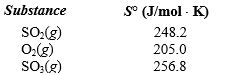
given the following information: (Multiple Choice)
4.9/5 (72)
(72) Which of the following is/are true for a reversible process at equilibrium?
I. Suniv 0
II. Ssys 0
III. Gsys 0
(Multiple Choice)
4.8/5 (77)
(77) Consider a closed container containing a 1 M solution of HCl, above which is air that contains water vapor at its equilibrium vapor pressure. Assume the pressure of the air and water vapor is 1 bar and the temperature of the system is 298 K. Which of the following is/are in its their thermodynamic standard state?
I. the liquid water
II. the HCl solution
III. the water vapor
(Multiple Choice)
4.7/5 (92)
(92) What is the standard entropy change when 10.0 g of methane reacts with 10.0 g of oxygen? 
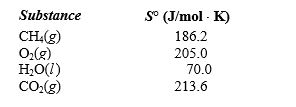
(Multiple Choice)
4.8/5 (80)
(80) Calculate the equilibrium constant at 500 K for the following reaction given the data below:
N2(g) 3H2(g)  2NH3(g)
Kc (298 K) 6.1 105
 (NH3, g) 16.5 kJ/mol
 (NH3, g) 46.1 kJ/mol
2NH3(g)
Kc (298 K) 6.1 105 (NH3, g) 16.5 kJ/mol (NH3, g) 46.1 kJ/mol (Short Answer)
4.7/5 (93)
(93) Before class, students were seated at three tables. When the school alarm went off suddenly, all the students distributed throughout the room to collect their belongings. The entropy of the class ________
(Multiple Choice)
5.0/5 (87)
(87) Which statement about the reaction below, where en ethylenediamine (H2NCH2CH2NH2), is not correct? 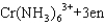

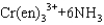
(Multiple Choice)
4.7/5 (75)
(75) Indicate which one of the following reactions results in a positive Ssys.
(Multiple Choice)
4.9/5 (83)
(83) Which of the following is in the correct order of standard state entropy?
I. diamond graphite
II. liquid water solid water
III. NH3 H2
(Multiple Choice)
4.8/5 (77)
(77) The symbol  (CH4, g) refers to which of the following reactions?
 (Multiple Choice)
4.8/5 (73)
(73) A sketch of the free energy for a hypothetical chemical equilibrium is shown here. What part of the plot on the axis representing the relative quantities of reactants and products corresponds to a value of Q that is less than K? 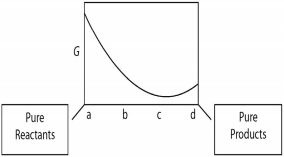
(Multiple Choice)
4.9/5 (73)
(73) A reaction is not spontaneous at any temperature. What are the signs for H and S , respectively?
(Multiple Choice)
4.9/5 (83)
(83) Care must be taken when dissolving solid pellets of sodium hydroxide (NaOH) in water, because the temperature of the water can rise dramatically. Taking NaOH as the system, what can you deduce about the signs of the entropy change of the system (Ssys) and surroundings (Ssurr) from this?
(Multiple Choice)
4.8/5 (84)
(84) In an experiment, 1.00 atm of N2(g) in a 10.0 L container at 25C was reacted under standard state conditions with a stoichiometric quantity of H2(g) to form ammonia:  . What is the entropy change for the reaction?
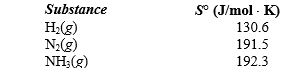
. What is the entropy change for the reaction? (Multiple Choice)
4.8/5 (89)
(89) Because the triple point of water is 273 K, what must be true of the change in enthalpy and the change in entropy for ice converting to water at this temperature?
(Multiple Choice)
4.8/5 (80)
(80) Given the following two measurements of the equilibrium constant for a reaction, calculate H for the reaction. 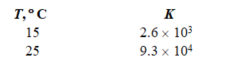
(Multiple Choice)
4.9/5 (72)
(72) 
Filters
- Essay(0)
- Multiple Choice(0)
- Short Answer(0)
- True False(0)
- Matching(0)