



 Chat with AI
Exam 17: Thermodynamics: Spontaneous and Nonspontaneous Reactions and Processes

Exam 1: Matter and Energy: The Origin of the Universe103 Questions
Exam 2: Atoms, Ions, and Molecules: Matter Starts Here144 Questions
Exam 3: Stoichiometry: Mass, Formulas, and Reactions141 Questions
Exam 4: Solution Chemistry: The Hydrosphere148 Questions
Exam 5: Thermochemistry: Energy Changes in Reactions139 Questions
Exam 6: Properties of Gases: The Air We Breathe164 Questions
Exam 7: A Quantum Model of Atoms: Waves and Particles166 Questions
Exam 8: Chemical Bonds: What Makes a Gas a Greenhouse Gas156 Questions
Exam 9: Molecular Geometry: Shape Determines Function188 Questions
Exam 10: Intermolecular Forces: The Uniqueness of Water165 Questions
Exam 11: Solutions: Properties and Behavior150 Questions
Exam 12: Solids: Crystals, Alloys, and Polymers130 Questions
Exam 13: Chemical Kinetics: Reactions in the Atmosphere155 Questions
Exam 14: Chemical Equilibrium: How Much Product Does a Reaction Really Make111 Questions
Exam 15: Acidbase Equilibria: Proton Transfer in Biological Systems122 Questions
Exam 16: Additional Aqueous Equilibria: Chemistry and the Oceans127 Questions
Exam 17: Thermodynamics: Spontaneous and Nonspontaneous Reactions and Processes186 Questions
Exam 18: Electrochemistry: The Quest for Clean Energy167 Questions
Exam 19: Nuclear Chemistry: Applications to Energy and Medicine165 Questions
Exam 20: Organic and Biological Molecules: the Compounds of Life168 Questions
Exam 21: The Main Group Elements: Life and the Periodic Table96 Questions
Exam 22: Transition Metals: Biological and Medical Applications142 Questions
Select questions type


Hydrogen reacts with nitrogen to form ammonia (NH3) according to the reaction 

 The value of H is 92.38 kJ/mol, and that of S is 198.2 J/(mol K). Determine G at 25C.
 (Multiple Choice)
4.9/5  (75)
(75) Which statement characterizes the following table? Temperature Dependence of Reaction Spontaneity 
(Multiple Choice)
4.8/5 (79)
(79) Indicate which one of the following reactions results in a negative Ssys.
(Multiple Choice)
4.8/5 (62)
(62) Calcium sulfate is a desiccant used for storage of samples and equipment in a dry atmosphere because it absorbs water from air. The relevant thermodynamic reaction equation is given below. At what temperature will this reaction reverse to release the water and regenerate the dry desiccant?  H 104.9 kJ/mol, S 291.2 J/(mol K)
 (Multiple Choice)
4.8/5 (88)
(88) Which of the following processes will lead to a decrease in the entropy of the system?
(Multiple Choice)
4.7/5 (73)
(73) A reaction is at equilibrium at a given temperature and constant pressure when ________
(Multiple Choice)
4.7/5 (88)
(88) Indicate which one of the following reactions most certainly results in a negative Ssys.
(Multiple Choice)
4.9/5 (76)
(76) The entropy change of the surroundings, Ssurr, is related to heat transfer, q, with respect to the system and temperature T by ________
(Multiple Choice)
4.9/5 (78)
(78) What is the value of the equilibrium constant at 500 K for a chemical equilibrium that has a H value of 250 kJ/mol and a S value of 48 J/mol K?
(Multiple Choice)
4.9/5 (72)
(72) Dinitrogen tetroxide (N2O4) decomposes to nitrogen dioxide (NO2). If H 58.02 kJ/mol and S 176.1 J/mol · K, at what temperature are reactants and products in their standard states at equilibrium?
(Multiple Choice)
4.8/5 (77)
(77) A sketch of the free energy for a hypothetical chemical equilibrium is shown here. Which sketch shows the equilibrium position labeled with an asterisk (*)?
(Multiple Choice)
4.8/5 (86)
(86)  for


 given the following information:
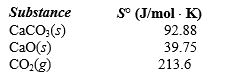
What is the entropy change if 4.500 g of CaCO3(s) is placed in a container and allowed to decompose to CaO(s) and CO2(g) according to the following reaction? 


(Multiple Choice)
4.9/5 (69)
(69) For a particular hypothetical reaction,  , the value of G is 125 kJ/mol.
What is the value of G for this reaction at 35C when [A] 0.10 M, [B] 0.05 M, and [C] 2.0 101 M ?
, the value of G is 125 kJ/mol.
What is the value of G for this reaction at 35C when [A] 0.10 M, [B] 0.05 M, and [C] 2.0 101 M ? (Short Answer)
4.9/5 (82)
(82) Which of the following must be true for a spontaneous exothermic process?
(Multiple Choice)
4.9/5 (81)
(81) Which of the following graphs best depicts the entropy of a pure substance as the temperature is raised from its solid form through its liquid and gaseous forms?
(Multiple Choice)
4.7/5 (84)
(84) Which of the following will have the greatest standard molar entropy (S)?
(Multiple Choice)
4.9/5 (71)
(71) Consider substances that exist as liquids under standard state conditions. What must be the relationship between the enthalpy and free energy of formation for the liquid and the gaseous form of such a substance? (Read as more negative and as less negative.)
(Multiple Choice)
4.9/5 (73)
(73) When a solution of DNA in water is heated, the double helix separates into two single strands. This process is called melting. What can be deduced from this information about the signs of the enthalpy and entropy changes for DNA melting?
(Multiple Choice)
4.8/5 (85)
(85) Which of the following must be true for a reaction to proceed to form products?
(Multiple Choice)
4.8/5 (77)
(77) 
Filters
- Essay(0)
- Multiple Choice(0)
- Short Answer(0)
- True False(0)
- Matching(0)