



 Chat with AI
Exam 17: Thermodynamics: Spontaneous and Nonspontaneous Reactions and Processes

Exam 1: Matter and Energy: The Origin of the Universe103 Questions
Exam 2: Atoms, Ions, and Molecules: Matter Starts Here144 Questions
Exam 3: Stoichiometry: Mass, Formulas, and Reactions141 Questions
Exam 4: Solution Chemistry: The Hydrosphere148 Questions
Exam 5: Thermochemistry: Energy Changes in Reactions139 Questions
Exam 6: Properties of Gases: The Air We Breathe164 Questions
Exam 7: A Quantum Model of Atoms: Waves and Particles166 Questions
Exam 8: Chemical Bonds: What Makes a Gas a Greenhouse Gas156 Questions
Exam 9: Molecular Geometry: Shape Determines Function188 Questions
Exam 10: Intermolecular Forces: The Uniqueness of Water165 Questions
Exam 11: Solutions: Properties and Behavior150 Questions
Exam 12: Solids: Crystals, Alloys, and Polymers130 Questions
Exam 13: Chemical Kinetics: Reactions in the Atmosphere155 Questions
Exam 14: Chemical Equilibrium: How Much Product Does a Reaction Really Make111 Questions
Exam 15: Acidbase Equilibria: Proton Transfer in Biological Systems122 Questions
Exam 16: Additional Aqueous Equilibria: Chemistry and the Oceans127 Questions
Exam 17: Thermodynamics: Spontaneous and Nonspontaneous Reactions and Processes186 Questions
Exam 18: Electrochemistry: The Quest for Clean Energy167 Questions
Exam 19: Nuclear Chemistry: Applications to Energy and Medicine165 Questions
Exam 20: Organic and Biological Molecules: the Compounds of Life168 Questions
Exam 21: The Main Group Elements: Life and the Periodic Table96 Questions
Exam 22: Transition Metals: Biological and Medical Applications142 Questions
Select questions type


Which of the following statements is/are correct? A large negative free-energy change for a reaction means that ________
I. the equilibrium constant for the reaction is large.
II. the equilibrium constant for the reaction is small.
III. the reaction greatly favors formation of the products.
IV. only a small amount of product is produced at equilibrium.
(Multiple Choice)
4.8/5  (78)
(78) Which of the processes A-D will lead to a positive change in the entropy of the system?
(Multiple Choice)
4.7/5 (79)
(79) One of the following statements A-D may be incorrect. If so, identify it.
(Multiple Choice)
4.8/5 (74)
(74) Which of the relationships between the free-energy change of a system and associated entropy changes is true?
(Multiple Choice)
4.8/5 (76)
(76) Given the following data relevant to the combustion of ethanol, determine the free energy of formation for liquid ethanol, C2H5OH.  (C2H5OH, l)930.7 kJ/mol
 (CO2, g)394.4 kJ/mol
 (H2O, g)105.6 kJ/mol
(C2H5OH, l)930.7 kJ/mol (CO2, g)394.4 kJ/mol (H2O, g)105.6 kJ/mol (Multiple Choice)
4.9/5 (93)
(93) Give an example of a spontaneous and a nonspontaneous chemical process and the sign of the entropy change for the universe for each.
(Essay)
4.9/5 (79)
(79) The dissolution of ammonium nitrate in water is a spontaneous endothermic process. It is spontaneous because the system undergoes ________
(Multiple Choice)
4.9/5 (77)
(77) If for a given chemical reaction at 298 K, both the change in free energy, G, and the change in the standard free energy, G , are positive with G G , then ________
(Multiple Choice)
4.8/5 (94)
(94) Draw a graph of entropy versus temperature for a typical substance. Be sure to clearly label phases and phase transitions on the graph.
(Essay)
4.7/5 (82)
(82) Which of the following figures illustrates best the sequence of the free-energy values (shown with the star) for a chemical reaction at equilibrium to the removal of products, followed by the response of the equilibrium to this stress?
(Multiple Choice)
4.7/5 (90)
(90) Nitrogen monoxide molecules can react to form dinitrogen oxide and nitrogen dioxide. Determine the equilibrium constant for this reaction under standard conditions from the following data and note whether the reaction is product-favored or reactant-favored.G(NO, g) 86.6 kJ/molG(N2O, g) 104.2 kJ/molG(NO2, g) 51.3 kJ/mol
(Short Answer)
4.9/5 (67)
(67) Some pure metals can be obtained from their ores simply by heating to a high temperature to drive off the oxygen, but iron ore usually is refined by reacting it with carbon monoxide. Use the information in the following table to determine whether or not iron ore could be refined by heating to a high temperature and, if so, how high the temperature must be. The oxidation reaction producing iron ore is given below.  Thermodynamic Properties
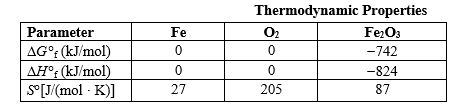
Thermodynamic Properties (Multiple Choice)
4.8/5 (83)
(83) Which of the listed perturbations would change the value of the equilibrium constant for the following reaction? List those that do as a sequence of letters, for example, ACE.
NH4CO2NH2(s)  2NH3(g) CO2(g)
 (Multiple Choice)
4.7/5 (81)
(81) What is a microstate and how are microstates quantitatively related to entropy?
(Essay)
5.0/5 (92)
(92) Indicate which of the following has the smallest standard molar entropy (S).
(Multiple Choice)
4.9/5 (71)
(71) Which of the following processes is/are reversible in the thermodynamic sense?
I. Iron in the open air rusts.
II. NaCl is dissolved in water and then recovered by the evaporation of the water.
III. The ice in a mixture of ice and water at 0C and 1 atm melts.
(Multiple Choice)
4.9/5 (84)
(84) In a biochemical reaction, A B C with  30 kJ/mol. Which of the following reactions might be effectively coupled to this reaction so that it becomes more spontaneous?
I.C D B E
 40 kJ/mol
II.C D B E
 40 kJ/mol
30 kJ/mol. Which of the following reactions might be effectively coupled to this reaction so that it becomes more spontaneous?
I.C D B E 40 kJ/mol
II.C D B E 40 kJ/mol (Multiple Choice)
4.7/5 (84)
(84) At what temperature does the Fe(s)  Fe(g) phase transition occur?H 415.5 kJ/mol; S 153.4 J/mol · K.
 (Multiple Choice)
4.9/5 (72)
(72) An ice cube at 0C melts in a swimming pool at 25C. What is the change in the entropy of the universe as a result? The ice cube was 2.00 inches on a side. Assume ice has a density of 0.917 g/cm3 and that the enthalpy of fusion of water is 6.01 kJ/mol.
(Multiple Choice)
4.9/5 (95)
(95) Determine the value of G for the reaction at 298 K.  Given
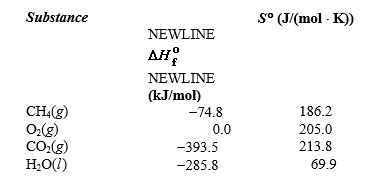
Given (Multiple Choice)
4.8/5 (97)
(97) 
Filters
- Essay(0)
- Multiple Choice(0)
- Short Answer(0)
- True False(0)
- Matching(0)