



 Chat with AI
Exam 17: Thermodynamics: Spontaneous and Nonspontaneous Reactions and Processes

Exam 1: Matter and Energy: The Origin of the Universe103 Questions
Exam 2: Atoms, Ions, and Molecules: Matter Starts Here144 Questions
Exam 3: Stoichiometry: Mass, Formulas, and Reactions141 Questions
Exam 4: Solution Chemistry: The Hydrosphere148 Questions
Exam 5: Thermochemistry: Energy Changes in Reactions139 Questions
Exam 6: Properties of Gases: The Air We Breathe164 Questions
Exam 7: A Quantum Model of Atoms: Waves and Particles166 Questions
Exam 8: Chemical Bonds: What Makes a Gas a Greenhouse Gas156 Questions
Exam 9: Molecular Geometry: Shape Determines Function188 Questions
Exam 10: Intermolecular Forces: The Uniqueness of Water165 Questions
Exam 11: Solutions: Properties and Behavior150 Questions
Exam 12: Solids: Crystals, Alloys, and Polymers130 Questions
Exam 13: Chemical Kinetics: Reactions in the Atmosphere155 Questions
Exam 14: Chemical Equilibrium: How Much Product Does a Reaction Really Make111 Questions
Exam 15: Acidbase Equilibria: Proton Transfer in Biological Systems122 Questions
Exam 16: Additional Aqueous Equilibria: Chemistry and the Oceans127 Questions
Exam 17: Thermodynamics: Spontaneous and Nonspontaneous Reactions and Processes186 Questions
Exam 18: Electrochemistry: The Quest for Clean Energy167 Questions
Exam 19: Nuclear Chemistry: Applications to Energy and Medicine165 Questions
Exam 20: Organic and Biological Molecules: the Compounds of Life168 Questions
Exam 21: The Main Group Elements: Life and the Periodic Table96 Questions
Exam 22: Transition Metals: Biological and Medical Applications142 Questions
Select questions type


Which of the following is the best definition of a microstate as it pertains to entropy on the molecular level?
(Multiple Choice)
4.9/5  (73)
(73) According to the second law of thermodynamics, the change in the entropy of the universe (Suniv) during a spontaneous reaction is ________
(Multiple Choice)
4.8/5 (83)
(83) Perfect crystals of carbon monoxide (CO) are difficult to prepare because the very small dipole moment allows a few molecules to align in a pattern such as CO OC CO instead of CO CO CO. If such disordered crystals were cooled to 0 K, what would be the value of their absolute entropy?
(Multiple Choice)
4.8/5 (77)
(77) If for a given chemical reaction at 298 K, the change in free energy, G, is more negative than the change in the standard free energy, G , then ________
(Multiple Choice)
4.8/5 (77)
(77) The values of  and
 are shown for the following equilibrium reaction. What makes the equilibrium constant larger at low temperature?


 H 58.02 kJ/mol, S 176.5 J/mol K
and are shown for the following equilibrium reaction. What makes the equilibrium constant larger at low temperature? H 58.02 kJ/mol, S 176.5 J/mol K (Multiple Choice)
4.7/5 (78)
(78) Which statement is true of the ideal gas constant, R, and the Boltzmann constant, kB?
(Multiple Choice)
4.8/5 (81)
(81) Given the following data, determine the molar free energy of combustion for propane gas, C3H8.  (C3H8, g)23.5 kJ/mol
 (CO2, g)394.4 kJ/mol
 (H2O, g)105.6 kJ/mol
(C3H8, g)23.5 kJ/mol (CO2, g)394.4 kJ/mol (H2O, g)105.6 kJ/mol (Short Answer)
4.7/5 (81)
(81) Suppose G is 25.0 kJ/mol for a hypothetical reaction in which A converts into B. Which of the following statements describes an equilibrium mixture of A and B?
(Multiple Choice)
4.9/5 (84)
(84) Hydrochloric acid (HCl) reacts with sodium hydroxide (NaOH) to form sodium chloride (NaCl) and water. If H 56.13 kJ/mol and S 79.11 J/mol K, what is the temperature of the reaction if G 80.89 kJ/mol?
(Multiple Choice)
5.0/5 (82)
(82) What type of motion is depicted in the following before-and-after pictures? 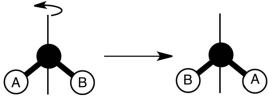
(Multiple Choice)
4.9/5 (82)
(82) Alcohols for use as biofuels can be produced from glucose that is obtained from starch and cellulose in plants. Use the information in the table below to determine the temperature range, if any, at which the following reaction is spontaneous. 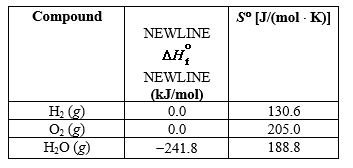
(Multiple Choice)
4.9/5 (91)
(91) The enthalpy of fusion for benzene (C6H6) is 127.40 kJ/kg, and its melting point is 5.5C. What is the entropy change when 1 mole of benzene melts at 5.5C?
(Multiple Choice)
4.9/5 (80)
(80) In a spontaneous process, which of the following always increases?
(Multiple Choice)
4.8/5 (81)
(81) A reaction with a low enthalpy of reaction value is spontaneous at high temperature but becomes not spontaneous at low temperature. What are the signs for H and S , respectively?
(Multiple Choice)
4.8/5 (77)
(77) The following figures represent distributions of gas molecules between two containers connected by an open tube. In which figure is the entropy of the system maximized?
(Multiple Choice)
4.7/5 (80)
(80) Alcohols for use as biofuels can be produced from glucose that is obtained from starch and cellulose in plants. Use the information in the table below to determine the free-energy change and whether or not this reaction is spontaneous at 78C, which is the boiling point of an ethanolwater azeotrope. 
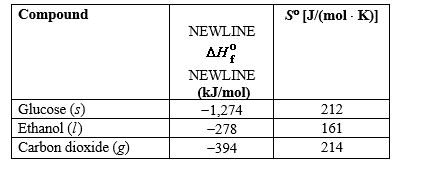
(Multiple Choice)
4.9/5 (83)
(83) For a chemical reaction that is not spontaneous, it is found that Ssys 0. Which of the following could be true?
(Multiple Choice)
4.8/5 (73)
(73) 
Filters
- Essay(0)
- Multiple Choice(0)
- Short Answer(0)
- True False(0)
- Matching(0)