



 Chat with AI
Exam 17: Thermodynamics: Spontaneous and Nonspontaneous Reactions and Processes

Exam 1: Matter and Energy: The Origin of the Universe103 Questions
Exam 2: Atoms, Ions, and Molecules: Matter Starts Here144 Questions
Exam 3: Stoichiometry: Mass, Formulas, and Reactions141 Questions
Exam 4: Solution Chemistry: The Hydrosphere148 Questions
Exam 5: Thermochemistry: Energy Changes in Reactions139 Questions
Exam 6: Properties of Gases: The Air We Breathe164 Questions
Exam 7: A Quantum Model of Atoms: Waves and Particles166 Questions
Exam 8: Chemical Bonds: What Makes a Gas a Greenhouse Gas156 Questions
Exam 9: Molecular Geometry: Shape Determines Function188 Questions
Exam 10: Intermolecular Forces: The Uniqueness of Water165 Questions
Exam 11: Solutions: Properties and Behavior150 Questions
Exam 12: Solids: Crystals, Alloys, and Polymers130 Questions
Exam 13: Chemical Kinetics: Reactions in the Atmosphere155 Questions
Exam 14: Chemical Equilibrium: How Much Product Does a Reaction Really Make111 Questions
Exam 15: Acidbase Equilibria: Proton Transfer in Biological Systems122 Questions
Exam 16: Additional Aqueous Equilibria: Chemistry and the Oceans127 Questions
Exam 17: Thermodynamics: Spontaneous and Nonspontaneous Reactions and Processes186 Questions
Exam 18: Electrochemistry: The Quest for Clean Energy167 Questions
Exam 19: Nuclear Chemistry: Applications to Energy and Medicine165 Questions
Exam 20: Organic and Biological Molecules: the Compounds of Life168 Questions
Exam 21: The Main Group Elements: Life and the Periodic Table96 Questions
Exam 22: Transition Metals: Biological and Medical Applications142 Questions
Select questions type


Considering the tabulated values for the thermodynamic properties of oxygen gas, why is the standard entropy nonzero but the standard enthalpy and free energy of formation are zero?
(Essay)
5.0/5  (88)
(88) What is the entropy change to the surroundings when 1 mol of ice melts in someone's hand if the hand temperature is 32C? Assume a final temperature for the water of 0C. The heat of fusion of ice is 6.01 kJ/mol.
(Multiple Choice)
4.9/5 (75)
(75) For a chemical reaction with a positive enthalpy and negative entropy, predict under which conditions the reaction will be spontaneous.
(Multiple Choice)
4.9/5 (93)
(93) A reaction with a low enthalpy of reaction value is not spontaneous at low temperature but becomes spontaneous at high temperature. What are the signs for H and S , respectively?
(Multiple Choice)
4.9/5 (91)
(91) Carbon atoms can be found in a variety of elemental forms. At sufficiently high temperature, carbon is an atomic gas. At room temperature, both tetrahedral networks in diamond and trigonal planar networks in graphite can be found. Trigonal planar networks of carbon atoms are also found in Buckminsterfullerene (C60). How does the standard entropy of these forms vary per mole of carbon?
(Essay)
4.8/5 (80)
(80) At body temperature, many proteins have a well-defined structure that is essential to their function. However, as the temperature is raised, the structure changes and the protein is no longer functional. This process is referred to as protein denaturation. What can be deduced from this information about the signs of the enthalpy and entropy changes for denaturation?
(Multiple Choice)
4.7/5 (88)
(88) If  for a reaction is 13.4 kJ/mol, what is K for the reaction at 2C?
 (Multiple Choice)
4.7/5 (83)
(83) Alcohols for use as biofuels can be produced from glucose that is obtained from starch and cellulose in plants. Use the information in the table below to determine the temperature range, if any, at which this reaction is spontaneous. 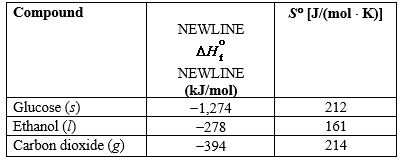
(Multiple Choice)
4.9/5 (77)
(77) During a spontaneous chemical reaction, it is found that Ssys 0. Which of the following could not be true?
(Multiple Choice)
4.9/5 (80)
(80) The standard molar entropy of magnesium fluoride (MgF2) is 57.2 J/(mol K). What is the entropy of 4.75 g of MgF2?
(Multiple Choice)
4.7/5 (85)
(85) Determine the value of G for the reaction at 298 K. 

 Given
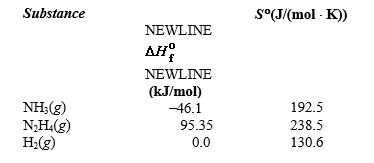
Given (Multiple Choice)
5.0/5 (88)
(88) The enthalpy of vaporization for toluene (C7H8) is 380.00 kJ/kg, and its boiling point is 110.6C. What is the entropy change when 0.75 mole of toluene vaporizes at 110.6C?
(Multiple Choice)
4.9/5 (86)
(86) Determine the standard entropy of N2(g) given the following information: 
 = -198.3 J/K
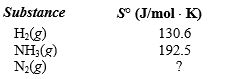
= -198.3 J/K (Multiple Choice)
4.8/5 (89)
(89) Using the thermodynamic data below, determine the equilibrium constant for the conversion of oxygen to ozone at 2,000 K.
Substance  (kJ/mol)
 (kJ/mol) S (J/mol · K)
O2(g) 0 0 205.0
O3(g) 142.3 163.4 237.6
3O2(g)
 2O3(g)
(kJ/mol) (kJ/mol) S (J/mol · K)
O2(g) 0 0 205.0
O3(g) 142.3 163.4 237.6
3O2(g) 2O3(g) (Short Answer)
4.9/5 (79)
(79) Hydrogen iodide can theoretically be made by the reaction of hydrogen gas and iodine by the following reaction:
H2(g) I2(s) 2HI(g)
What temperature conditions are required for the formation of HI to be favored at standard pressure?
S (H2, g) 130.6 J/(mol K)
S (I2, s) 116.1 J/(mol K)
S (HI, g) 206.6 J/(mol K)  (HI, g) 26.5 kJ/mol
 (Short Answer)
4.9/5 (79)
(79) The standard molar enthalpy of fusion for xenon is 2.30 kJ mol1. Calculate the standard molar entropy for the freezing of liquid xenon given that its normal freezing point is 112C.
(Short Answer)
4.8/5 (96)
(96) Which of the following states of motion have the highest number of occupied excited states at room temperature-rotational, vibrational, or translational?
(Multiple Choice)
4.9/5 (85)
(85) The reaction 

 where en represents ethylenediamine, has a small value for the enthalpy change, Hrxn, yet the free-energy change is large because ________
 (Multiple Choice)
4.9/5 (70)
(70) 
Filters
- Essay(0)
- Multiple Choice(0)
- Short Answer(0)
- True False(0)
- Matching(0)