



 Chat with AI
Exam 17: Thermodynamics: Spontaneous and Nonspontaneous Reactions and Processes

Exam 1: Matter and Energy: The Origin of the Universe103 Questions
Exam 2: Atoms, Ions, and Molecules: Matter Starts Here144 Questions
Exam 3: Stoichiometry: Mass, Formulas, and Reactions141 Questions
Exam 4: Solution Chemistry: The Hydrosphere148 Questions
Exam 5: Thermochemistry: Energy Changes in Reactions139 Questions
Exam 6: Properties of Gases: The Air We Breathe164 Questions
Exam 7: A Quantum Model of Atoms: Waves and Particles166 Questions
Exam 8: Chemical Bonds: What Makes a Gas a Greenhouse Gas156 Questions
Exam 9: Molecular Geometry: Shape Determines Function188 Questions
Exam 10: Intermolecular Forces: The Uniqueness of Water165 Questions
Exam 11: Solutions: Properties and Behavior150 Questions
Exam 12: Solids: Crystals, Alloys, and Polymers130 Questions
Exam 13: Chemical Kinetics: Reactions in the Atmosphere155 Questions
Exam 14: Chemical Equilibrium: How Much Product Does a Reaction Really Make111 Questions
Exam 15: Acidbase Equilibria: Proton Transfer in Biological Systems122 Questions
Exam 16: Additional Aqueous Equilibria: Chemistry and the Oceans127 Questions
Exam 17: Thermodynamics: Spontaneous and Nonspontaneous Reactions and Processes186 Questions
Exam 18: Electrochemistry: The Quest for Clean Energy167 Questions
Exam 19: Nuclear Chemistry: Applications to Energy and Medicine165 Questions
Exam 20: Organic and Biological Molecules: the Compounds of Life168 Questions
Exam 21: The Main Group Elements: Life and the Periodic Table96 Questions
Exam 22: Transition Metals: Biological and Medical Applications142 Questions
Select questions type


When plotting ln K vs. 1/T, a linear relationship is obtained ________
(Multiple Choice)
4.9/5  (86)
(86) Which of the following must be true for the microstates of a system?
I.The energy of each microstate equals the energy of the system.
II.The entropy of each microstate equals the entropy of the system.
III.The number of microstates equals the entropy of the system.
(Multiple Choice)
4.8/5 (70)
(70) Of the three modes of molecular motion-vibration, rotation, and translation-which requires the greatest amount of energy to cause an excitation from the ground state to the first excited state?
(Multiple Choice)
4.8/5 (83)
(83) Before class, students were distributed throughout a classroom. When the bell rang, all the students sat down at three tables in the center of the room. The entropy of the class ________
(Multiple Choice)
4.9/5 (89)
(89) Indicate which of the following has the highest entropy at 298 K.
(Multiple Choice)
4.8/5 (70)
(70) A chemist is planning to study a chemical equilibrium for which no measured explicit thermodynamic values are available. However, the reaction involves common chemical species. What information could a chemist use to make predictions about the equilibrium?
(Multiple Choice)
4.7/5 (82)
(82) The standard entropy of N2(g) is 191.5 J/mol K. Calculate the entropy per nitrogen molecule and the number of microstates for each molecule. Discuss the number of microstates in terms of the molecular motions accessible to each molecule.
(Essay)
4.9/5 (87)
(87)  for


 given the following information:
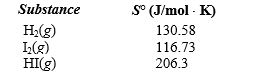


 given the following information:
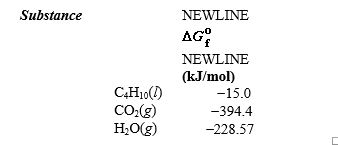
Jane can accept that G RT ln K, but she cannot reconcile the relationship between S and ln K. Please explain it to her.
(Multiple Choice)
4.8/5 (80)
(80) Using the thermodynamic data below, determine the equilibrium constant for the conversion of oxygen to ozone at 2,000 K. Substance  (kJ/mol)
 (kJ/mol) S (J/mol · K)
O2(g) 0 0 205.0
O3(g) 142.3 163.4 237.6


(kJ/mol) (kJ/mol) S (J/mol · K)
O2(g) 0 0 205.0
O3(g) 142.3 163.4 237.6 (Multiple Choice)
4.9/5 (74)
(74) Noxious NO gas can form from N2 and O2 gases in automobile engines at high temperatures. If the value of the equilibrium constant, Kc, for this reaction at 25C is 1.95 1031, what is the value at 2,000C? 

 Thermodynamic Properties of Nitrogen Monoxide

 S87.6 kJ/mol 90.3 kJ/mol
211 J/(mol K)
Thermodynamic Properties of Nitrogen Monoxide S87.6 kJ/mol 90.3 kJ/mol
211 J/(mol K) (Multiple Choice)
4.9/5 (81)
(81) What is the standard entropy change when 10.0 g of methane reacts with 10.0 g of oxygen? 
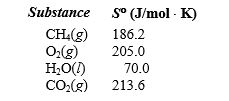
(Short Answer)
4.8/5 (84)
(84) When you increase the volume of a gas, the energy separation between microstates ________
(Multiple Choice)
4.7/5 (82)
(82) The symbol  (CH3OH, l) refers to which of the following reactions?
 (Multiple Choice)
4.9/5 (70)
(70) The standard molar entropy of lead(II) bromide (PbBr2) is 161 J/(mol K). What is the entropy of 2.45 g of PbBr2?
(Multiple Choice)
4.9/5 (76)
(76) For the following exothermic reaction, predict under which conditions the reaction will be spontaneous. 
(Multiple Choice)
4.8/5 (85)
(85) If for a given chemical reaction at 298 K, the change in free energy, G, is positive and the change in the standard free energy, G , is negative, then ________
(Multiple Choice)
4.8/5 (76)
(76) If a reaction  has
 0, then when the reaction is at equilibrium there will be ________
has 0, then when the reaction is at equilibrium there will be ________ (Multiple Choice)
4.7/5 (67)
(67) Values for H and S for a reaction can be determined experimentally by fitting a linear equation to a plot of ________ on the x-axis and ________ on the y-axis. The slope of this equation is equal to ________ and the intercept allows us to calculate ________.
(Short Answer)
4.9/5 (67)
(67) 
Filters
- Essay(0)
- Multiple Choice(0)
- Short Answer(0)
- True False(0)
- Matching(0)