



 Chat with AI
Exam 2: Atoms, Ions, and Molecules: Matter Starts Here

Exam 1: Matter and Energy: The Origin of the Universe103 Questions
Exam 2: Atoms, Ions, and Molecules: Matter Starts Here144 Questions
Exam 3: Stoichiometry: Mass, Formulas, and Reactions141 Questions
Exam 4: Solution Chemistry: The Hydrosphere148 Questions
Exam 5: Thermochemistry: Energy Changes in Reactions139 Questions
Exam 6: Properties of Gases: The Air We Breathe164 Questions
Exam 7: A Quantum Model of Atoms: Waves and Particles166 Questions
Exam 8: Chemical Bonds: What Makes a Gas a Greenhouse Gas156 Questions
Exam 9: Molecular Geometry: Shape Determines Function188 Questions
Exam 10: Intermolecular Forces: The Uniqueness of Water165 Questions
Exam 11: Solutions: Properties and Behavior150 Questions
Exam 12: Solids: Crystals, Alloys, and Polymers130 Questions
Exam 13: Chemical Kinetics: Reactions in the Atmosphere155 Questions
Exam 14: Chemical Equilibrium: How Much Product Does a Reaction Really Make111 Questions
Exam 15: Acidbase Equilibria: Proton Transfer in Biological Systems122 Questions
Exam 16: Additional Aqueous Equilibria: Chemistry and the Oceans127 Questions
Exam 17: Thermodynamics: Spontaneous and Nonspontaneous Reactions and Processes186 Questions
Exam 18: Electrochemistry: The Quest for Clean Energy167 Questions
Exam 19: Nuclear Chemistry: Applications to Energy and Medicine165 Questions
Exam 20: Organic and Biological Molecules: the Compounds of Life168 Questions
Exam 21: The Main Group Elements: Life and the Periodic Table96 Questions
Exam 22: Transition Metals: Biological and Medical Applications142 Questions
Select questions type


Give an example of a molecular compound (a.k.a. a covalent compound).

Free
(Short Answer)
4.8/5  (78)
(78) Correct Answer: Verified
Carbon dioxide, CO2; answers will vary.
A cation has a ________ charge, and an anion has a ________ charge.
Free
(Short Answer)
4.8/5 (64)
(64) Correct Answer:Verified
Verifiedpositive ; negative
Potassium is best described as a ________
Free
(Multiple Choice)
4.8/5 (77)
(77) Correct Answer:Verified
VerifiedB
Identify the letter that corresponds to each of the following groups of the periodic table:
a) chalcogens b) noble gases c) alkaline earth metals d) halogens 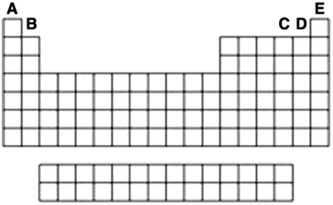
(Short Answer)
4.9/5 (69)
(69) Which of the following is most likely to exhibit covalent bonding?
(Multiple Choice)
5.0/5 (99)
(99) According to the Big Bang theory, which statement about the origin of the elements is not correct?
(Multiple Choice)
4.8/5 (68)
(68) Manganese(IV) oxide is a brown insoluble solid often found as a product of reactions of potassium permanganate. What is the formula of manganese(IV) oxide?
(Multiple Choice)
4.9/5 (87)
(87) Based on the element's position in the periodic table, which statement below is not correct?
(Multiple Choice)
4.9/5 (83)
(83) Which particle-level diagram is the best representation of a  ion?

ion? (Multiple Choice)
4.7/5 (75)
(75) Titanium forms different ionic oxides. One, TiO2, is a white oxide used in paints. What is the proper name for TiO2?
(Multiple Choice)
4.8/5 (85)
(85) 
Filters
- Essay(0)
- Multiple Choice(0)
- Short Answer(0)
- True False(0)
- Matching(0)