



 Chat with AI
Exam 2: Atoms, Ions, and Molecules: Matter Starts Here

Exam 1: Matter and Energy: The Origin of the Universe103 Questions
Exam 2: Atoms, Ions, and Molecules: Matter Starts Here144 Questions
Exam 3: Stoichiometry: Mass, Formulas, and Reactions141 Questions
Exam 4: Solution Chemistry: The Hydrosphere148 Questions
Exam 5: Thermochemistry: Energy Changes in Reactions139 Questions
Exam 6: Properties of Gases: The Air We Breathe164 Questions
Exam 7: A Quantum Model of Atoms: Waves and Particles166 Questions
Exam 8: Chemical Bonds: What Makes a Gas a Greenhouse Gas156 Questions
Exam 9: Molecular Geometry: Shape Determines Function188 Questions
Exam 10: Intermolecular Forces: The Uniqueness of Water165 Questions
Exam 11: Solutions: Properties and Behavior150 Questions
Exam 12: Solids: Crystals, Alloys, and Polymers130 Questions
Exam 13: Chemical Kinetics: Reactions in the Atmosphere155 Questions
Exam 14: Chemical Equilibrium: How Much Product Does a Reaction Really Make111 Questions
Exam 15: Acidbase Equilibria: Proton Transfer in Biological Systems122 Questions
Exam 16: Additional Aqueous Equilibria: Chemistry and the Oceans127 Questions
Exam 17: Thermodynamics: Spontaneous and Nonspontaneous Reactions and Processes186 Questions
Exam 18: Electrochemistry: The Quest for Clean Energy167 Questions
Exam 19: Nuclear Chemistry: Applications to Energy and Medicine165 Questions
Exam 20: Organic and Biological Molecules: the Compounds of Life168 Questions
Exam 21: The Main Group Elements: Life and the Periodic Table96 Questions
Exam 22: Transition Metals: Biological and Medical Applications142 Questions
Select questions type


Boron, which has an average atomic mass of 10.81 amu, has two stable isotopes: boron-10 (19.78%) and boron-11 (80.22%). Boron-10 has an atomic mass of 10.0129 amu; what is the atomic mass of boron-11?
(Short Answer)
4.8/5  (78)
(78) What is the correct formula for the compound formed between sodium and iodine based on their positions in the periodic table?
(Multiple Choice)
4.9/5 (72)
(72) In one sentence, describe the picture of the atom that emerged from the Rutherford-Geiger-Marsden experiment with alpha particles.
(Essay)
4.8/5 (91)
(91) Which statement regarding the organization of the periodic table is not correct?
(Multiple Choice)
4.9/5 (78)
(78) Copper(II) sulfate is a common fungicide. What is the correct formula for copper(II) sulfate?
(Multiple Choice)
4.7/5 (78)
(78) A  Cl atom has ________ protons, ________ neutrons, and ________ electrons.
 (Multiple Choice)
4.9/5 (88)
(88) For each of the elements below, there are only two naturally occurring isotopes. Using information in your periodic table, identify the pair in which the heavier isotope is the more abundant one.
(Multiple Choice)
4.8/5 (82)
(82) What is the symbol of the ion having 17 protons and 18 electrons?
(Multiple Choice)
4.8/5 (72)
(72) An unknown element is found to contain isotopes with the following masses and natural abundances: 38.9637 amu (93.08%), 39.9640 amu (0.012%), and 40.9618 amu (6.91%). Using these data, identify the element.
(Multiple Choice)
4.8/5 (87)
(87) Write the complete atomic symbol with both a superscript and a subscript for a sodium ion that contains 11 protons, 10 electrons, and 12 neutrons.
(Short Answer)
4.8/5 (81)
(81) Which element labeled A-E in the periodic table below will have an ionic charge of +2? 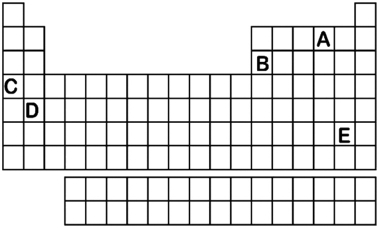
(Multiple Choice)
4.8/5 (68)
(68) Name the following oxides of nitrogen in this sequence: NO, N2O, NO2, N2O4.
(Multiple Choice)
4.8/5 (92)
(92) Identify the letter of the group that contains the most nonmetals. 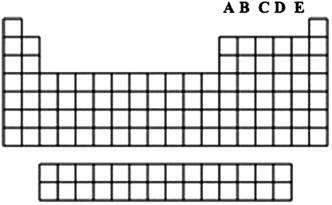
(Multiple Choice)
4.9/5 (68)
(68) 
Filters
- Essay(0)
- Multiple Choice(0)
- Short Answer(0)
- True False(0)
- Matching(0)