



 Chat with AI
Exam 13: Chemical Kinetics: Reactions in the Atmosphere

Exam 1: Matter and Energy: The Origin of the Universe103 Questions
Exam 2: Atoms, Ions, and Molecules: Matter Starts Here144 Questions
Exam 3: Stoichiometry: Mass, Formulas, and Reactions141 Questions
Exam 4: Solution Chemistry: The Hydrosphere148 Questions
Exam 5: Thermochemistry: Energy Changes in Reactions139 Questions
Exam 6: Properties of Gases: The Air We Breathe164 Questions
Exam 7: A Quantum Model of Atoms: Waves and Particles166 Questions
Exam 8: Chemical Bonds: What Makes a Gas a Greenhouse Gas156 Questions
Exam 9: Molecular Geometry: Shape Determines Function188 Questions
Exam 10: Intermolecular Forces: The Uniqueness of Water165 Questions
Exam 11: Solutions: Properties and Behavior150 Questions
Exam 12: Solids: Crystals, Alloys, and Polymers130 Questions
Exam 13: Chemical Kinetics: Reactions in the Atmosphere155 Questions
Exam 14: Chemical Equilibrium: How Much Product Does a Reaction Really Make111 Questions
Exam 15: Acidbase Equilibria: Proton Transfer in Biological Systems122 Questions
Exam 16: Additional Aqueous Equilibria: Chemistry and the Oceans127 Questions
Exam 17: Thermodynamics: Spontaneous and Nonspontaneous Reactions and Processes186 Questions
Exam 18: Electrochemistry: The Quest for Clean Energy167 Questions
Exam 19: Nuclear Chemistry: Applications to Energy and Medicine165 Questions
Exam 20: Organic and Biological Molecules: the Compounds of Life168 Questions
Exam 21: The Main Group Elements: Life and the Periodic Table96 Questions
Exam 22: Transition Metals: Biological and Medical Applications142 Questions
Select questions type


The rate law of a particular reaction was determined to be Rate k. What is the unit of the rate constant for the reaction?

Free
(Multiple Choice)
4.8/5  (76)
(76) Correct Answer: Verified
A
If the rate of formation of nitrogen monoxide is 0.413 M/s, what is the rate of disappearance of SO2? 
Free
(Multiple Choice)
4.8/5 (83)
(83) Correct Answer:Verified
VerifiedD
The order in which ozone, nitrogen monoxide, and nitrogen dioxide build up in the atmosphere over the course of the day is ________, then ________, then ________.
Free
(Multiple Choice)
4.7/5 (84)
(84) Correct Answer:Verified
VerifiedA
A proposed mechanism for the decomposition of ozone in the atmosphere is: Step 1:  Step 2:
 Which of the following species is an intermediate?
Step 2: Which of the following species is an intermediate? (Multiple Choice)
4.8/5 (71)
(71) Given the following data for the reaction A B, determine the activation energy, Ea, of the reaction.
k (M/s)
T (K)
2.04 104
250
6.78 103
400
(Short Answer)
4.8/5 (80)
(80) A scientist conducts an experiment to determine the rate of NO formation in the reaction:  If the initial concentration of N2 was 0.500 M and the concentration of N2 was 0.450 M after 0.100 s, what is the average rate of NO formation?
 (Multiple Choice)
4.9/5 (83)
(83) Given the following data for the reaction A  B, determine the activation energy, Ea, of the reaction. k (M/s)
T (K)
0)730
250
0)739
450
B, determine the activation energy, Ea, of the reaction. k (M/s)
T (K)
0)730
250
0)739
450 (Multiple Choice)
4.8/5 (80)
(80) A scientist conducts an experiment to determine the rate of the following reaction:  If the initial concentration of NO2 was 0.250 M and the concentration of NO2 was 0.200 M after
0.200 s, what is the average rate of the reaction?
If the initial concentration of NO2 was 0.250 M and the concentration of NO2 was 0.200 M after
0.200 s, what is the average rate of the reaction? (Short Answer)
4.8/5 (77)
(77) If the rate of the reaction:  is 0.870 M/s over the first 12.25 s, how much hydrogen sulfide will be consumed during this time?
 (Multiple Choice)
4.9/5 (74)
(74) The linear form of the Arrhenius equation is very useful, as a plot of ________ versus ________ allows us to calculate the activation energy from the slope and the frequency factor from the intercept.
(Short Answer)
4.8/5 (87)
(87) HI dissociates to form I2 and H2:  If the concentration of HI changes at a rate of 0.45 M/s, what is the rate of appearance of I2(g)?
 (Multiple Choice)
4.8/5 (81)
(81) One reaction that occurs in an automobile catalytic converter is the conversion of nitrogen monoxide to nitrogen and oxygen. How is the rate of this reaction related to the rate at which the concentration of a reactant or product changes? 2NO(g) →N2(g) O2(g)
I. Rate  II. Rate
 III. Rate
 IV. Rate

II. Rate
III. Rate IV. Rate (Multiple Choice)
4.7/5 (69)
(69) Which plot would provide the activation energy for a reaction?
(Multiple Choice)
4.8/5 (72)
(72) In an elementary step of a reaction mechanism, the molecularities are determined by ________
(Multiple Choice)
4.7/5 (69)
(69) The rate at which popcorn pops was measured at two different temperatures. How many times faster does the popcorn pop at 250°C compared with that at 210°C when the activation energy is 53.8 kJ/mol?
(Multiple Choice)
4.9/5 (78)
(78) For the following energy profile:
a) identify any reaction intermediates,
b) identify any transition states,
c) state the number of steps,
d) state whether the reaction is endo- or exothermic,
e) indicate which step is rate determining. 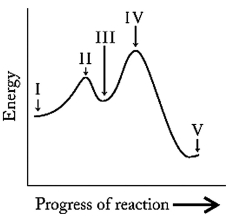
(Essay)
4.8/5 (74)
(74) In a first-order reaction, the initial concentration of A is 0.40 M. What is the concentration of A after 15 seconds if the half-life of the reaction is 3 seconds?
(Short Answer)
4.9/5 (74)
(74) If the rate of formation of ammonia is 0.345 M/s, what is the rate of disappearance of N2? 
(Multiple Choice)
4.8/5 (66)
(66) For the reaction 2A  4B 3D, the rate of the reaction in terms of B would be written as ________
 (Multiple Choice)
4.8/5 (82)
(82) The following figure shows Arrhenius plots for four different reactions. Which reaction has the largest frequency factor? 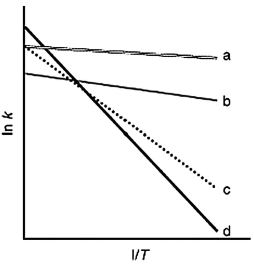
(Multiple Choice)
4.9/5 (85)
(85) 
Filters
- Essay(0)
- Multiple Choice(0)
- Short Answer(0)
- True False(0)
- Matching(0)