



 Chat with AI
Exam 13: Chemical Kinetics: Reactions in the Atmosphere

Exam 1: Matter and Energy: The Origin of the Universe103 Questions
Exam 2: Atoms, Ions, and Molecules: Matter Starts Here144 Questions
Exam 3: Stoichiometry: Mass, Formulas, and Reactions141 Questions
Exam 4: Solution Chemistry: The Hydrosphere148 Questions
Exam 5: Thermochemistry: Energy Changes in Reactions139 Questions
Exam 6: Properties of Gases: The Air We Breathe164 Questions
Exam 7: A Quantum Model of Atoms: Waves and Particles166 Questions
Exam 8: Chemical Bonds: What Makes a Gas a Greenhouse Gas156 Questions
Exam 9: Molecular Geometry: Shape Determines Function188 Questions
Exam 10: Intermolecular Forces: The Uniqueness of Water165 Questions
Exam 11: Solutions: Properties and Behavior150 Questions
Exam 12: Solids: Crystals, Alloys, and Polymers130 Questions
Exam 13: Chemical Kinetics: Reactions in the Atmosphere155 Questions
Exam 14: Chemical Equilibrium: How Much Product Does a Reaction Really Make111 Questions
Exam 15: Acidbase Equilibria: Proton Transfer in Biological Systems122 Questions
Exam 16: Additional Aqueous Equilibria: Chemistry and the Oceans127 Questions
Exam 17: Thermodynamics: Spontaneous and Nonspontaneous Reactions and Processes186 Questions
Exam 18: Electrochemistry: The Quest for Clean Energy167 Questions
Exam 19: Nuclear Chemistry: Applications to Energy and Medicine165 Questions
Exam 20: Organic and Biological Molecules: the Compounds of Life168 Questions
Exam 21: The Main Group Elements: Life and the Periodic Table96 Questions
Exam 22: Transition Metals: Biological and Medical Applications142 Questions
Select questions type


Ammonia gas (NH3) is produced from hydrogen and nitrogen gas according to the following reaction:  If the rate of production of ammonia is R(NH3), what is the rate of loss of hydrogen and nitrogen gas, respectively?
 (Multiple Choice)
4.7/5  (75)
(75) The following graph shows the kinetics curves for the reaction of oxygen with hydrogen to form water:  . Which curve is hydrogen?
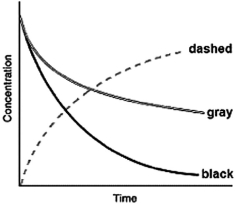
. Which curve is hydrogen? (Multiple Choice)
4.8/5 (80)
(80) Which of the following is a possible graph of concentration versus time for a reaction product?
(Multiple Choice)
4.8/5 (84)
(84) Assuming that each of the following graphs has the same concentration and time axes, which has the greatest initial rate of disappearance of reactant?
(Multiple Choice)
4.9/5 (94)
(94) The first-order reaction A  B, has k 5.67 s1. If [A]0 0.500 M, how long will it take to reach [A] 0.124 M ?
 (Multiple Choice)
4.9/5 (81)
(81) Chlorine dioxide formed from chlorofluorocarbons was found to catalyze the decomposition of atmospheric ozone. In laboratory experiments, the rate of the catalyzed reaction was measured at different temperatures with the following results. What is the activation energy of this reaction? T (K)
K (M1 s1)
193
34)0
208
197
(Multiple Choice)
4.9/5 (77)
(77) A proposed mechanism for the decomposition of ozone in the stratosphere is: Step 1:  Step 2:
 What is the molecularity of step 1?
Step 2: What is the molecularity of step 1? (Multiple Choice)
4.9/5 (87)
(87) Which of the following plots indicates that the reaction is zero order?
(Multiple Choice)
4.9/5 (77)
(77) The following figure shows Arrhenius plots for four different reactions. Which reaction has the least temperature dependence? 
(Multiple Choice)
4.7/5 (85)
(85) A reaction mechanism consists of a series of ________ steps.
(Multiple Choice)
4.7/5 (70)
(70) Which of these could be the units of the rate constant for a first-order reaction?
(Multiple Choice)
4.9/5 (94)
(94) The reaction 2NO(g) O2(g)  2NO2(g) has the following rate law: Rate k[O2][NO]2. If the concentration of NO is reduced by a factor of two, the rate will ________
 (Multiple Choice)
4.7/5 (83)
(83) The following figure shows Arrhenius plots for four different reactions. Which reaction has the greatest activation energy? 
(Multiple Choice)
4.8/5 (71)
(71) For the reaction A  2B 3C, the rate of the reaction in terms of C would be written as ________.
 (Short Answer)
4.8/5 (72)
(72) A catalyst that is in a different phase from the reactants and products is a(n) ________ catalyst.
(Multiple Choice)
4.9/5 (85)
(85) Consider the rate law expression Rate k[A][B]2. Which of the following is not true about the reaction?
(Multiple Choice)
4.8/5 (83)
(83) Which of the following plots would indicate that a reaction was first order?
(Multiple Choice)
4.9/5 (84)
(84) Which point in the reaction profile below represents a transition state? 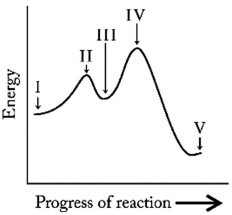
(Multiple Choice)
4.9/5 (68)
(68) In a(n) ________ step of a reaction mechanism, the partial orders (or molecularities) are determined by the stoichiometric coefficients of the reaction.
(Short Answer)
4.9/5 (85)
(85) Nitric oxide and nitrogen dioxide are found in photochemical smog. Nitrogen dioxide is formed from nitrogen monoxide in the exhaust of automobile engines. A possible mechanism for this reaction is given below. What is the rate law predicted by the mechanism? Reaction:  Step 1 (fast):
 Step 2 (slow):

Step 1 (fast): Step 2 (slow): (Multiple Choice)
4.9/5 (69)
(69) 
Filters
- Essay(0)
- Multiple Choice(0)
- Short Answer(0)
- True False(0)
- Matching(0)