



 Chat with AI
Exam 13: Chemical Kinetics: Reactions in the Atmosphere

Exam 1: Matter and Energy: The Origin of the Universe103 Questions
Exam 2: Atoms, Ions, and Molecules: Matter Starts Here144 Questions
Exam 3: Stoichiometry: Mass, Formulas, and Reactions141 Questions
Exam 4: Solution Chemistry: The Hydrosphere148 Questions
Exam 5: Thermochemistry: Energy Changes in Reactions139 Questions
Exam 6: Properties of Gases: The Air We Breathe164 Questions
Exam 7: A Quantum Model of Atoms: Waves and Particles166 Questions
Exam 8: Chemical Bonds: What Makes a Gas a Greenhouse Gas156 Questions
Exam 9: Molecular Geometry: Shape Determines Function188 Questions
Exam 10: Intermolecular Forces: The Uniqueness of Water165 Questions
Exam 11: Solutions: Properties and Behavior150 Questions
Exam 12: Solids: Crystals, Alloys, and Polymers130 Questions
Exam 13: Chemical Kinetics: Reactions in the Atmosphere155 Questions
Exam 14: Chemical Equilibrium: How Much Product Does a Reaction Really Make111 Questions
Exam 15: Acidbase Equilibria: Proton Transfer in Biological Systems122 Questions
Exam 16: Additional Aqueous Equilibria: Chemistry and the Oceans127 Questions
Exam 17: Thermodynamics: Spontaneous and Nonspontaneous Reactions and Processes186 Questions
Exam 18: Electrochemistry: The Quest for Clean Energy167 Questions
Exam 19: Nuclear Chemistry: Applications to Energy and Medicine165 Questions
Exam 20: Organic and Biological Molecules: the Compounds of Life168 Questions
Exam 21: The Main Group Elements: Life and the Periodic Table96 Questions
Exam 22: Transition Metals: Biological and Medical Applications142 Questions
Select questions type


For the rate law Rate k[A]1/2[B], the partial order with respect to A is ________, the partial order with respect to B is ________, and the total order is ________.
(Multiple Choice)
4.8/5  (91)
(91) The energy profiles for four different reactions are shown below. The scales are the same for each. Which reaction is the most endothermic? 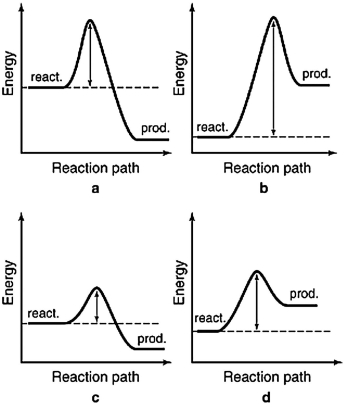
(Multiple Choice)
4.9/5 (85)
(85) If the rate of appearance of O2 in the reaction:  is 0.250 M/s over the first 5.50 s, how much oxygen will form during this time?
 (Multiple Choice)
5.0/5 (88)
(88) Given the following data for the reaction A  B, determine the activation energy, Ea, of the reaction. k (M/s)
T (K)
2)04 104
250
6)78 103
400
B, determine the activation energy, Ea, of the reaction. k (M/s)
T (K)
2)04 104
250
6)78 103
400 (Multiple Choice)
4.8/5 (76)
(76) The following figure shows Arrhenius plots for four different reactions. Which reaction has the greatest temperature dependence? 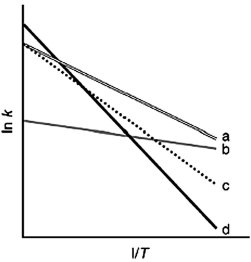
(Multiple Choice)
4.9/5 (67)
(67) The energy profiles for four different reactions are shown below. The scales are the same for each. Which reaction is the most exothermic? 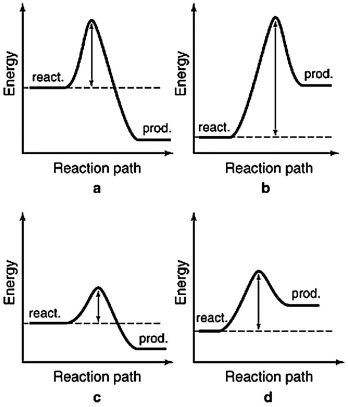
(Multiple Choice)
4.7/5 (74)
(74) The decomposition of ozone is thought to proceed through the following mechanism: Step 1:  Step 2:
 If the rate law k[O3][NO], what is the molecularity of steps 1 and 2, and which step is the slow, or rate-determining, step?
Step 2: If the rate law k[O3][NO], what is the molecularity of steps 1 and 2, and which step is the slow, or rate-determining, step? (Multiple Choice)
4.8/5 (77)
(77) One reaction that contributes to acid rain is the conversion of dinitrogen pentoxide to nitric acid upon reaction with water. How could the rate of this reaction be expressed correctly in terms of the rate at which the concentration of a reactant or product changes? N2O5(g) H2O(g)  2HNO3(g)
 (Multiple Choice)
4.9/5 (84)
(84) Given the following data for the reaction A  B, determine the frequency factor, A, of the reaction.
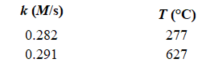
B, determine the frequency factor, A, of the reaction. (Multiple Choice)
4.9/5 (90)
(90) The rate of popcorn popping at different temperatures was found to be described by the Arrhenius equation. How many times faster does the popcorn pop at 210°C compared with that at 180°C when the activation energy is 167 kJ/mol?
(Multiple Choice)
4.9/5 (78)
(78) From the following concentration versus time plot for four different reactions, which has the greatest instantaneous rate of disappearance at the time indicated by the arrow? 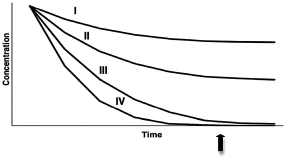
(Multiple Choice)
4.8/5 (79)
(79) What is the predicted rate law for the following mechanism for the decomposition of hydrogen peroxide? Step 1:  (slow)
Step 2:
 (fast)
What is the rate law?
(slow)
Step 2: (fast)
What is the rate law? (Multiple Choice)
4.9/5 (76)
(76) The reaction A(g) B(g)  C(g) has the following rate law: Rate k[A]1/2[B]2. If the concentration of A is quadrupled while the concentration of B is halved, the rate will change by a factor of ________.
 (Multiple Choice)
4.9/5 (84)
(84) NO2 concentrations during photochemical smog events often have two peaks, one in the early morning (8 A.M.) and another, smaller peak around 7 P.M. The second peak is due to ________
(Multiple Choice)
4.7/5 (79)
(79) A proposed mechanism for the decomposition of ozone in the stratosphere is: Step 1:  Step 2:
 What is the molecularity of step 2?
Step 2: What is the molecularity of step 2? (Multiple Choice)
4.8/5 (61)
(61) For the reaction 2A 3B  4C 5D, the rate of the reaction in terms of D would be written as ________.
 (Short Answer)
4.9/5 (88)
(88) Which of the following is not important as a contributing factor to photochemical smog?
(Multiple Choice)
4.9/5 (72)
(72) For the rate law Rate k[A]5/2[B], the partial order with respect to A is ________, the partial order with respect to B is ________, and the total order is ________.
(Multiple Choice)
5.0/5 (81)
(81) The half-life (t1/2) of a first-order reaction is 0.100 s. What is the rate constant?
(Multiple Choice)
4.7/5 (91)
(91) 
Filters
- Essay(0)
- Multiple Choice(0)
- Short Answer(0)
- True False(0)
- Matching(0)