



 Chat with AI
Exam 13: Chemical Kinetics: Reactions in the Atmosphere

Exam 1: Matter and Energy: The Origin of the Universe103 Questions
Exam 2: Atoms, Ions, and Molecules: Matter Starts Here144 Questions
Exam 3: Stoichiometry: Mass, Formulas, and Reactions141 Questions
Exam 4: Solution Chemistry: The Hydrosphere148 Questions
Exam 5: Thermochemistry: Energy Changes in Reactions139 Questions
Exam 6: Properties of Gases: The Air We Breathe164 Questions
Exam 7: A Quantum Model of Atoms: Waves and Particles166 Questions
Exam 8: Chemical Bonds: What Makes a Gas a Greenhouse Gas156 Questions
Exam 9: Molecular Geometry: Shape Determines Function188 Questions
Exam 10: Intermolecular Forces: The Uniqueness of Water165 Questions
Exam 11: Solutions: Properties and Behavior150 Questions
Exam 12: Solids: Crystals, Alloys, and Polymers130 Questions
Exam 13: Chemical Kinetics: Reactions in the Atmosphere155 Questions
Exam 14: Chemical Equilibrium: How Much Product Does a Reaction Really Make111 Questions
Exam 15: Acidbase Equilibria: Proton Transfer in Biological Systems122 Questions
Exam 16: Additional Aqueous Equilibria: Chemistry and the Oceans127 Questions
Exam 17: Thermodynamics: Spontaneous and Nonspontaneous Reactions and Processes186 Questions
Exam 18: Electrochemistry: The Quest for Clean Energy167 Questions
Exam 19: Nuclear Chemistry: Applications to Energy and Medicine165 Questions
Exam 20: Organic and Biological Molecules: the Compounds of Life168 Questions
Exam 21: The Main Group Elements: Life and the Periodic Table96 Questions
Exam 22: Transition Metals: Biological and Medical Applications142 Questions
Select questions type


The rate of popcorn popping at different temperatures was found to be described by the Arrhenius equation. How many times faster does the popcorn pop at 210°C compared with that at 180°C when the activation energy is 167 kJ/mol?
(Short Answer)
4.9/5  (89)
(89) N2O5 is used as a source of NO2 in chemical reactions. The compound decomposes in a first order reaction. If the initial concentration of N2O5 0.400 M, and the concentration is 0.025 M after 120 seconds, what is the rate constant k of the reaction?
(Multiple Choice)
4.8/5 (93)
(93) A scientist conducts an experiment to determine the rate of the following reaction:  If the initial concentration of H2 was 0.150 M and the concentration of H2 was 0.050 M after 2.10 s, what is the average rate of the reaction?
 (Multiple Choice)
4.8/5 (80)
(80) One reaction that occurs in an automobile catalytic converter is the conversion of carbon monoxide to carbon dioxide. How is the rate of this reaction related to the rate at which the concentration of a reactant or product changes? 2CO(g) O2(g) →2CO2(g)
I. Rate  II. Rate
 III. Rate
 IV. Rate

II. Rate III. Rate IV. Rate (Multiple Choice)
5.0/5 (85)
(85) For the reaction 2A 3B  4C 5D, the rate of the reaction in terms of A would be written as ________
 (Multiple Choice)
4.8/5 (66)
(66) The energy profiles for four different reactions are shown below. The scales are the same for each. Which reaction requires the least energetic collisions to reach the transition state? 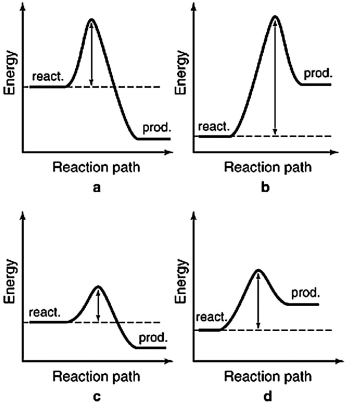
(Multiple Choice)
4.9/5 (64)
(64) The reaction A(g) B(g)  C(g) has the following rate law: Rate k[A]2[B]. If the concentration of A is tripled while the concentration of B is doubled, the rate will increase by a factor of ________.
 (Multiple Choice)
4.8/5 (91)
(91) The steps in a reaction mechanism are as follows. Which species is acting as a catalyst? Step 1:  Step 2:
 Step 3:

Step 2: Step 3: (Multiple Choice)
4.9/5 (80)
(80) Collision theory assumes that the rate of a reaction depends on ________
(Multiple Choice)
4.8/5 (76)
(76) The device in automobiles that has decreased NO and partially oxidized hydrocarbons from exhaust gases is termed a(n) ________ .
(Short Answer)
4.8/5 (86)
(86) A scientist conducts an experiment to determine the rate of the following reaction:  If the initial concentration of NO was 0.00 M and the concentration of NO was 0.050 M after 0.100 s, what is the average rate of the reaction?
 (Multiple Choice)
4.9/5 (76)
(76) Given the following data for the reaction A  B, determine the frequency factor, A, of the reaction. k (M/s)
T (K)
2)04 104
250
6)78 103
400
B, determine the frequency factor, A, of the reaction. k (M/s)
T (K)
2)04 104
250
6)78 103
400 (Multiple Choice)
4.9/5 (86)
(86) NO2 contributes to the "brown haze" associated with photochemical smog events. At what time of day is NO2 concentration highest?
(Multiple Choice)
4.8/5 (84)
(84) The energy needed to form an activated complex is called ________
(Multiple Choice)
4.8/5 (72)
(72) The mechanism for the reaction  in the presence of I(aq) is proposed to be: Step 1:
 (slow)
Step 2:
 (fast)
What is the molecularity of the rate-determining step?
in the presence of I(aq) is proposed to be: Step 1: (slow)
Step 2: (fast)
What is the molecularity of the rate-determining step? (Multiple Choice)
4.9/5 (68)
(68) Indicate which of the following compounds is a component of photochemical smog.
(Multiple Choice)
5.0/5 (89)
(89) Given the following data for the reaction A  B, determine the frequency factor, A, of the reaction.
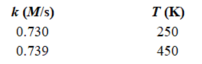
B, determine the frequency factor, A, of the reaction. (Multiple Choice)
4.8/5 (85)
(85) The mechanism for the first-order reaction  in the presence of I(aq) is proposed to be: Step 1:
 (slow)
Step 2:
 (fast)
Identify the catalyst in the reaction.
in the presence of I(aq) is proposed to be: Step 1: (slow)
Step 2: (fast)
Identify the catalyst in the reaction. (Multiple Choice)
4.9/5 (79)
(79) One reaction that occurs in an automobile catalytic converter is the conversion of nitrogen monoxide to nitrogen and oxygen. How could the rate of this reaction be expressed correctly in terms of the rate at which the concentration of a reactant or product changes? 2NO(g)  N2(g) O2(g)
 (Multiple Choice)
4.9/5 (81)
(81) The rate law of a particular reaction was determined to be Rate k[A][B]. What is the unit of the rate constant for the reaction?
(Multiple Choice)
4.9/5 (93)
(93) 
Filters
- Essay(0)
- Multiple Choice(0)
- Short Answer(0)
- True False(0)
- Matching(0)