



 Chat with AI
Exam 13: Chemical Kinetics: Reactions in the Atmosphere

Exam 1: Matter and Energy: The Origin of the Universe103 Questions
Exam 2: Atoms, Ions, and Molecules: Matter Starts Here144 Questions
Exam 3: Stoichiometry: Mass, Formulas, and Reactions141 Questions
Exam 4: Solution Chemistry: The Hydrosphere148 Questions
Exam 5: Thermochemistry: Energy Changes in Reactions139 Questions
Exam 6: Properties of Gases: The Air We Breathe164 Questions
Exam 7: A Quantum Model of Atoms: Waves and Particles166 Questions
Exam 8: Chemical Bonds: What Makes a Gas a Greenhouse Gas156 Questions
Exam 9: Molecular Geometry: Shape Determines Function188 Questions
Exam 10: Intermolecular Forces: The Uniqueness of Water165 Questions
Exam 11: Solutions: Properties and Behavior150 Questions
Exam 12: Solids: Crystals, Alloys, and Polymers130 Questions
Exam 13: Chemical Kinetics: Reactions in the Atmosphere155 Questions
Exam 14: Chemical Equilibrium: How Much Product Does a Reaction Really Make111 Questions
Exam 15: Acidbase Equilibria: Proton Transfer in Biological Systems122 Questions
Exam 16: Additional Aqueous Equilibria: Chemistry and the Oceans127 Questions
Exam 17: Thermodynamics: Spontaneous and Nonspontaneous Reactions and Processes186 Questions
Exam 18: Electrochemistry: The Quest for Clean Energy167 Questions
Exam 19: Nuclear Chemistry: Applications to Energy and Medicine165 Questions
Exam 20: Organic and Biological Molecules: the Compounds of Life168 Questions
Exam 21: The Main Group Elements: Life and the Periodic Table96 Questions
Exam 22: Transition Metals: Biological and Medical Applications142 Questions
Select questions type


A reaction is first order in A. If the rate constant of the reaction is 3.45 103 s1, what is the half-life (t1/2) of the reaction?
(Multiple Choice)
4.8/5  (83)
(83) If the rate of formation of dinitrogen is 0.540 M/s, what is the rate of disappearance of oxygen? 
(Multiple Choice)
4.9/5 (77)
(77) At what time of day are ozone concentrations highest during a photochemical smog event?
(Multiple Choice)
4.8/5 (84)
(84) The mechanism for the reaction  in the presence of I(aq) is proposed to be: Step 1:
 (slow)
Step 2:
 (fast)
What is the rate law for the overall reaction?
in the presence of I(aq) is proposed to be: Step 1: (slow)
Step 2: (fast)
What is the rate law for the overall reaction? (Multiple Choice)
4.7/5 (74)
(74) If the rate of formation of dinitrogen is 0.540 M/s, what is the rate of formation of water? 
(Multiple Choice)
5.0/5 (79)
(79) If the rate of formation of ammonia is 0.345 M/s, what is the rate of disappearance of H2? 
(Multiple Choice)
4.8/5 (81)
(81) Which point as labeled by an asterisk (*) on the following energy profile is the transition state?
(Multiple Choice)
4.8/5 (81)
(81) For the rate law Rate k[A][B]3/2, the partial order with respect to A is ________, the partial order with respect to B is ________, and the total order is ________.
(Short Answer)
4.7/5 (78)
(78) A second-order reaction (2A  B) with a rate constant of 0.350 M 1s 1 is found to have a half-life of 3.45 s. What was the initial concentration of the reactant, [A]0?
 (Multiple Choice)
4.8/5 (80)
(80) Octane can undergo combustion to produce carbon dioxide and water and release tremendous amounts of energy. The balanced chemical equation for this reaction is shown below. How could the rate of this reaction be expressed correctly in terms of the rate at which the concentration of a reactant or product changes? 
(Multiple Choice)
4.8/5 (85)
(85) The mechanism for the reaction  in the presence of I(aq) is proposed to be:
Step 1:
 (slow)
Step 2:
 (fast)
Identify a) any intermediates, b) any catalysts, and c) the rate law for the reaction.
in the presence of I(aq) is proposed to be:
Step 1: (slow)
Step 2: (fast)
Identify a) any intermediates, b) any catalysts, and c) the rate law for the reaction. (Essay)
4.8/5 (74)
(74) The reaction  is thought to occur by the following mechanism: Step 1:
 Step 2:
 Which of the following species is an intermediate?
is thought to occur by the following mechanism: Step 1: Step 2: Which of the following species is an intermediate? (Multiple Choice)
5.0/5 (85)
(85) The reaction of NO gas with H2 gas has the following rate law: Rate k[H2][NO]2. A proposed mechanism is: Step 1:  Step 2:
 What is the molecularity of steps 1 and 2, and which step is the slow, or rate-determining, step?
Step 2: What is the molecularity of steps 1 and 2, and which step is the slow, or rate-determining, step? (Multiple Choice)
4.8/5 (83)
(83) The disappearance of HI in the reaction  is shown in the following figure. What is the instantaneous rate of this reaction at t 5 s if the instantaneous rate of change of [HI] is 0.02 M/s?
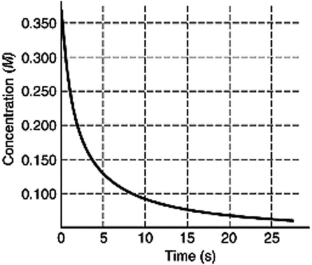
is shown in the following figure. What is the instantaneous rate of this reaction at t 5 s if the instantaneous rate of change of [HI] is 0.02 M/s? (Multiple Choice)
4.7/5 (63)
(63) Which of the following reaction pathways shows the effect of a catalyst (black) on an uncatalyzed reaction (gray)?
(Multiple Choice)
4.8/5 (84)
(84) The following figure shows Arrhenius plots for four different reactions. Which reaction has the lowest activation energy? 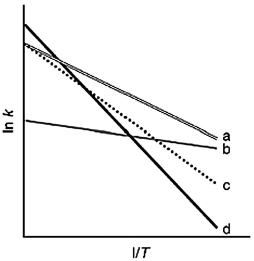
(Multiple Choice)
4.8/5 (79)
(79) The energy profiles for four different reactions are shown below. The scales are the same for each. Which of the reactions will have the largest rate constant? 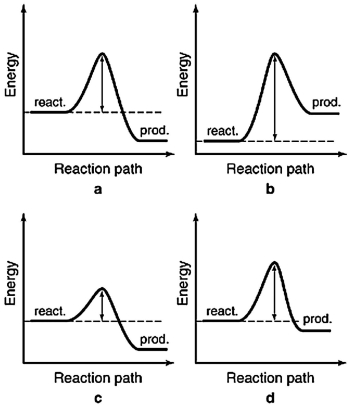
(Multiple Choice)
4.9/5 (73)
(73) The photochemical decomposition of chlorofluorocarbons  was shown to enhance the decomposition of ozone 2 O3(g)
 3 O2(g)
Leading to the formation of an ozone hole over the South Pole. In the following mechanism for the decomposition of ozone, characterize the products (ClO, O2, and Cl) in each of the two steps.
Step 1:
 Step 2:

was shown to enhance the decomposition of ozone 2 O3(g) 3 O2(g)
Leading to the formation of an ozone hole over the South Pole. In the following mechanism for the decomposition of ozone, characterize the products (ClO, O2, and Cl) in each of the two steps.
Step 1: Step 2: (Multiple Choice)
4.8/5 (101)
(101) The second-order reaction A  B is found to have a rate constant of 0.978 M 1s 1. What is the half-life of this reaction when [A]0 0.0300 M ?
 (Multiple Choice)
5.0/5 (76)
(76) Chlorine dioxide (ClO2) is used as a disinfectant in municipal water-treatment plants. It decomposes in a first-order reaction with a rate constant of 14 s1. How long would it take for an initial concentration of 0.06 M to decrease to 0.02 M?
(Short Answer)
4.9/5 (85)
(85) 
Filters
- Essay(0)
- Multiple Choice(0)
- Short Answer(0)
- True False(0)
- Matching(0)