



 Chat with AI
Exam 13: Chemical Kinetics: Reactions in the Atmosphere

Exam 1: Matter and Energy: The Origin of the Universe103 Questions
Exam 2: Atoms, Ions, and Molecules: Matter Starts Here144 Questions
Exam 3: Stoichiometry: Mass, Formulas, and Reactions141 Questions
Exam 4: Solution Chemistry: The Hydrosphere148 Questions
Exam 5: Thermochemistry: Energy Changes in Reactions139 Questions
Exam 6: Properties of Gases: The Air We Breathe164 Questions
Exam 7: A Quantum Model of Atoms: Waves and Particles166 Questions
Exam 8: Chemical Bonds: What Makes a Gas a Greenhouse Gas156 Questions
Exam 9: Molecular Geometry: Shape Determines Function188 Questions
Exam 10: Intermolecular Forces: The Uniqueness of Water165 Questions
Exam 11: Solutions: Properties and Behavior150 Questions
Exam 12: Solids: Crystals, Alloys, and Polymers130 Questions
Exam 13: Chemical Kinetics: Reactions in the Atmosphere155 Questions
Exam 14: Chemical Equilibrium: How Much Product Does a Reaction Really Make111 Questions
Exam 15: Acidbase Equilibria: Proton Transfer in Biological Systems122 Questions
Exam 16: Additional Aqueous Equilibria: Chemistry and the Oceans127 Questions
Exam 17: Thermodynamics: Spontaneous and Nonspontaneous Reactions and Processes186 Questions
Exam 18: Electrochemistry: The Quest for Clean Energy167 Questions
Exam 19: Nuclear Chemistry: Applications to Energy and Medicine165 Questions
Exam 20: Organic and Biological Molecules: the Compounds of Life168 Questions
Exam 21: The Main Group Elements: Life and the Periodic Table96 Questions
Exam 22: Transition Metals: Biological and Medical Applications142 Questions
Select questions type


What is the predicted rate law for the following mechanism for the reduction of nitrogen in NO by hydrogen? Step 1:  (slow)
Step 2:
 (fast)
What is the rate law?
(slow)
Step 2: (fast)
What is the rate law? (Multiple Choice)
4.9/5  (98)
(98) Using the reaction shown below, which statement is correct? 
(Multiple Choice)
4.9/5 (85)
(85) Which of the following plots indicates that the reaction is second order?
(Multiple Choice)
4.8/5 (72)
(72) A proposed mechanism for the reduction of nitrogen as NO by hydrogen is: Step 1:  Step 2:
 What is the molecularity of step 1?
Step 2: What is the molecularity of step 1? (Multiple Choice)
4.9/5 (84)
(84) The difference between an average rate and an instantaneous rate is ________
(Multiple Choice)
4.8/5 (89)
(89) The energy profiles for four different reactions are shown below. The scales are the same for each. Which reaction requires the most energetic collisions to reach the transition state? 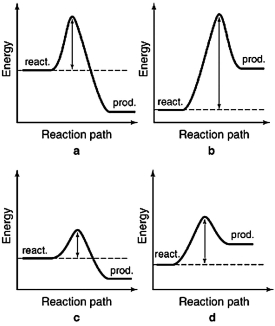
(Multiple Choice)
4.8/5 (90)
(90) Which statement A-D regarding the reaction described by the energy profile below is not correct? 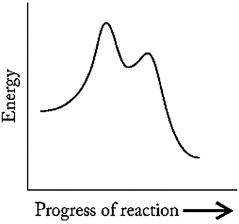
(Multiple Choice)
4.9/5 (88)
(88) For the rate law Rate k[A]1/2[B], the partial order with respect to A is ________, the partial order with respect to B is ________, and the total order is ________.
(Short Answer)
4.9/5 (77)
(77) Which point in the reaction profile below represents an intermediate? 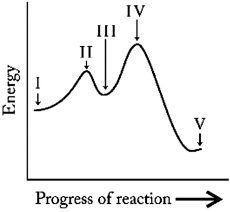
(Multiple Choice)
4.9/5 (79)
(79) Large cities often issue ozone advisories. At what time of year would an advisory be likely to occur most often?
(Multiple Choice)
4.8/5 (89)
(89) From the following concentration versus time plot for four different reactions, which has the greatest instantaneous rate of disappearance at the time indicated by the arrow? 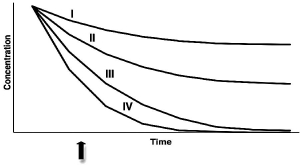
(Multiple Choice)
4.9/5 (85)
(85) In a first order reaction, the initial concentration of A is 0.40 M. What is the concentration of A after 15 seconds if the half-life of the reaction is 3 seconds?
(Multiple Choice)
4.8/5 (76)
(76) If the rate of formation of ammonia is 0.345 M/s, what is the rate of disappearance of N2? 
(Multiple Choice)
4.8/5 (70)
(70) The energy profiles for four different reactions are shown below. The scales are the same for each. Which of the reactions will have the smallest rate constant?
(Multiple Choice)
4.8/5 (74)
(74) The order in which ozone, nitrogen monoxide, and nitrogen dioxide build up in the atmosphere over the course of the day is first ________ then ________ then ________.
(Short Answer)
4.8/5 (81)
(81) For the rate law Rate k[A][B]1/2, the partial order with respect to A is ________, the partial order with respect to B is ________, and the total order is ________.
(Multiple Choice)
4.8/5 (75)
(75) The high temperatures in an automobile engine cause nitrogen and oxygen to form noxious nitrogen monoxide. Use the following data on the temperature dependence of the rate constant to determine the activation energy for this reaction. T (K)
K (M1 s1)
2,200
1,800
2,400
7,400
(Multiple Choice)
4.9/5 (69)
(69) If the rate of the reaction:  is 0.250 M/s over the first 5.50 s, how much ozone will be consumed during this time?
 (Short Answer)
4.8/5 (78)
(78) The second-order reaction A  B is found to have a rate constant of 0.978 M1s1. What is the half-life of this reaction when [A]0 0.0300 M?
 (Short Answer)
4.8/5 (73)
(73) For the reaction 2A 3B  4C 5D, the rate of the reaction in terms of A would be written as ________.
 (Short Answer)
4.7/5 (73)
(73) 
Filters
- Essay(0)
- Multiple Choice(0)
- Short Answer(0)
- True False(0)
- Matching(0)